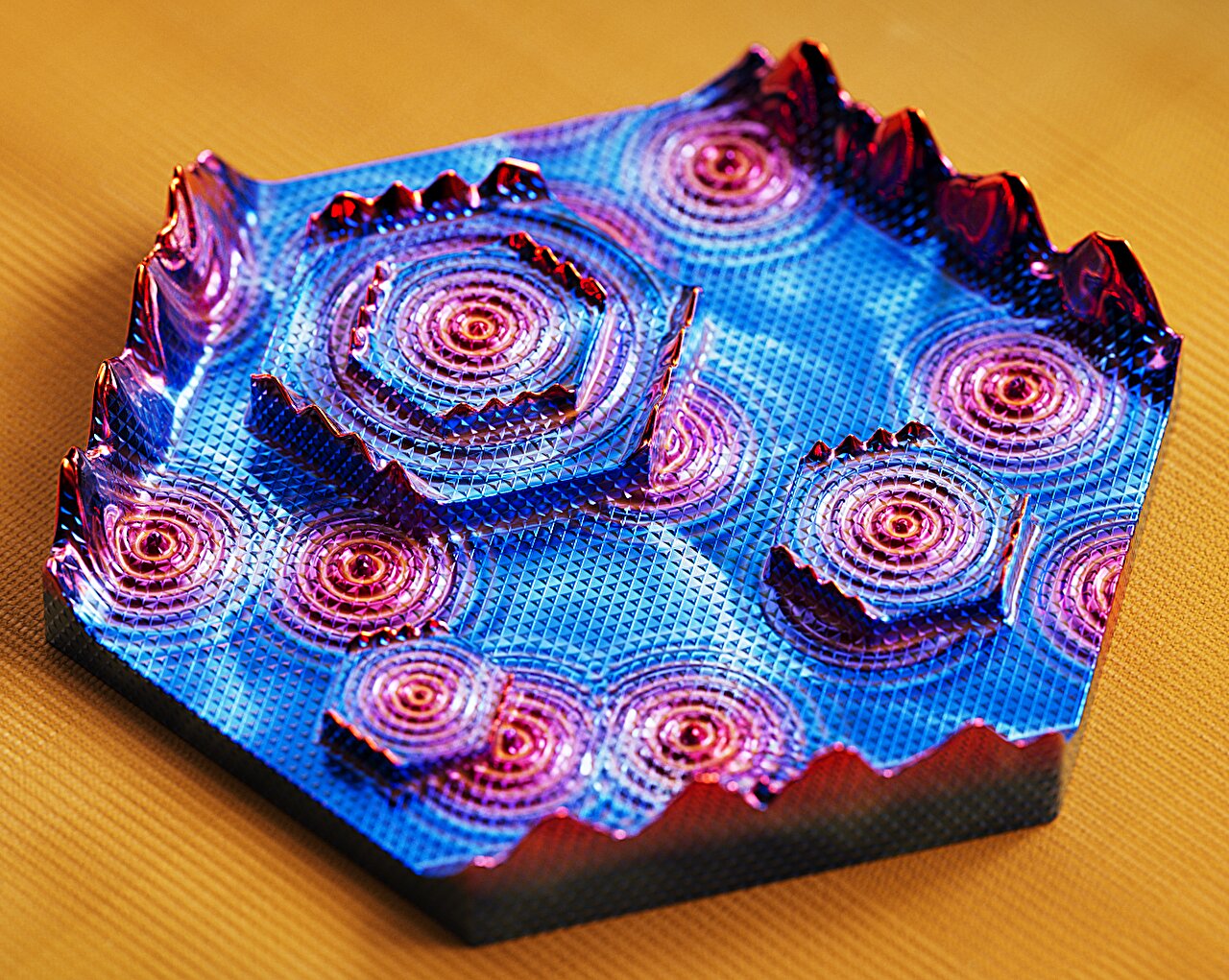
Physicists at Princeton University have discovered a novel quantum state, termed "hybrid topology," in a crystalline material made of arsenic atoms, marking the first observation of this type of topological quantum behavior in an elemental solid. This unexpected finding opens up new possibilities for the development of efficient materials and technologies for next-generation quantum science and engineering, potentially leading to advancements in quantum information science, quantum computing devices, and spin-based electronics. The discovery, published in Nature, was made possible through innovative experimental advances and instrumentations, and it may pave the way for sustained research directions and applications in quantum technologies.
Researchers at Hebrew University of Jerusalem, led by Professor Amir Capua, have made a significant breakthrough in understanding how light interacts with magnetic materials. This discovery could lead to advancements in high-speed, light-controlled memory technologies like Magnetoresistive Random Access Memory (MRAM) and the development of innovative optical sensors. The team found that the magnetic component of light can control the magnetic state in solids, a previously underexplored aspect due to the slower response of magnets. This new understanding could explain experimental results from the past few decades and has the potential to transform data storage and processing. The research also introduced a new sensor that can detect the magnetic part of light, which could revolutionize sensor and circuit designs.
Researchers have developed a theoretical framework for a quantum thermal transistor, which is a device designed to manage heat transfer at the quantum level. This new type of transistor is monitored continuously to understand and control the noise and energy fluctuations that affect its performance. The stochastic noise model created for this purpose helps in understanding the dynamics of these quantum systems, which is crucial for the development of advanced energy solutions. The findings, which could lead to more efficient heat management systems, are published in Physical Review B.