Researchers have developed a new manganese-based complex that absorbs light efficiently and has a record-breaking excited-state lifetime, offering a sustainable and simple alternative to rare metal complexes for large-scale photochemical applications like hydrogen production.
Space scientists are calling for closer collaboration with chemists to better understand the complex atmospheres of exoplanets, especially through improved models and laboratory experiments focusing on photochemistry and reaction parameters, aided by advanced telescopes like JWST and future technologies.
Scientists at Harvard have developed a novel method to capture CO2 using sunlight and specially designed organic molecules called photobases, offering a potentially energy-efficient and reusable approach to mitigate climate change by actively removing atmospheric CO2.
Scientists are studying a molecule called azulene, which violates the rules of photochemistry, in the hopes of creating more efficient solar cells that can convert sunlight into usable electricity. Azulene's unique behavior challenges a fundamental concept known as Kasha's rule, and understanding it could lead to a breakthrough in the search for limitless energy. While the exact form of limitless energy is still unclear, this discovery provides a promising starting point.
Researchers have discovered the formation of the methyl cation, a key molecule in astrochemistry, through photochemistry in a protoplanetary disk. The discovery was made using the Atacama Large Millimeter/submillimeter Array (ALMA) and the IRAM 30-meter telescope. The findings shed light on the chemical processes that occur in molecular clouds and protoplanetary disks, which are crucial for the formation of planets and other celestial bodies.
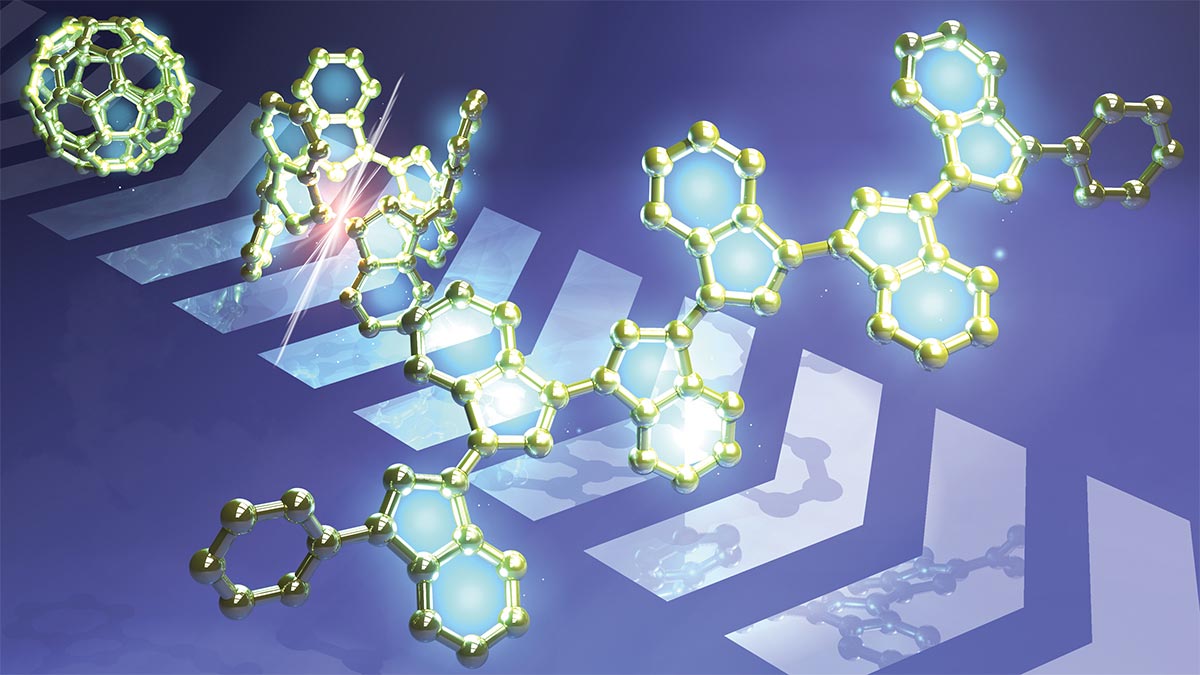
Researchers at Kyoto University have discovered that flat fragments of spherical molecules composed entirely of carbon atoms, called fullerenes, have stable electron-accepting ability with great practical potential. The team focused on the influence of the pentagonal substructures and designed and synthesized flattened fragments of fullerene, which surprisingly retained and even enhanced some key chemical properties. The fragments display enhanced absorbance of ultraviolet, visible, and near-infrared light compared to fullerene itself, which might open new possibilities in photochemistry. The team will now explore the possibilities their flat fullerene fragments hold in the vast variety of applications associated with electron-transfer processes.