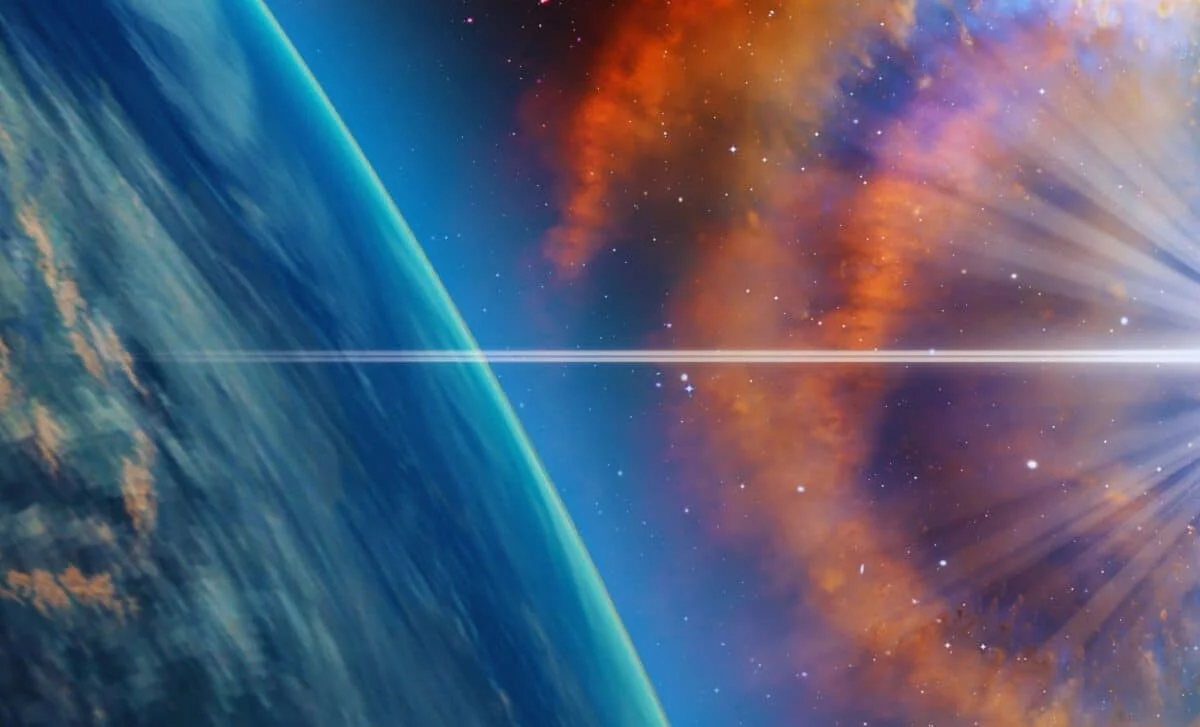
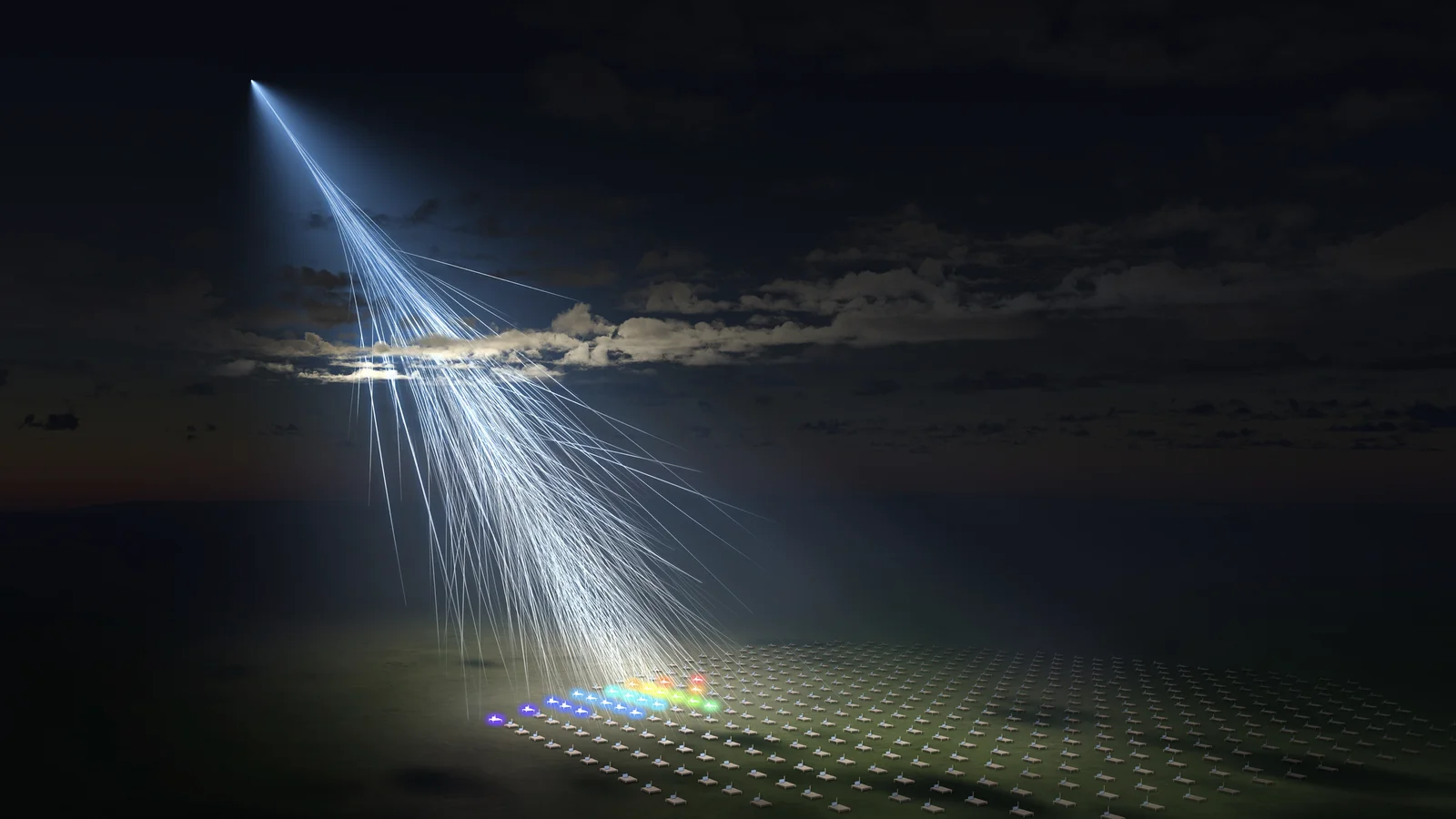
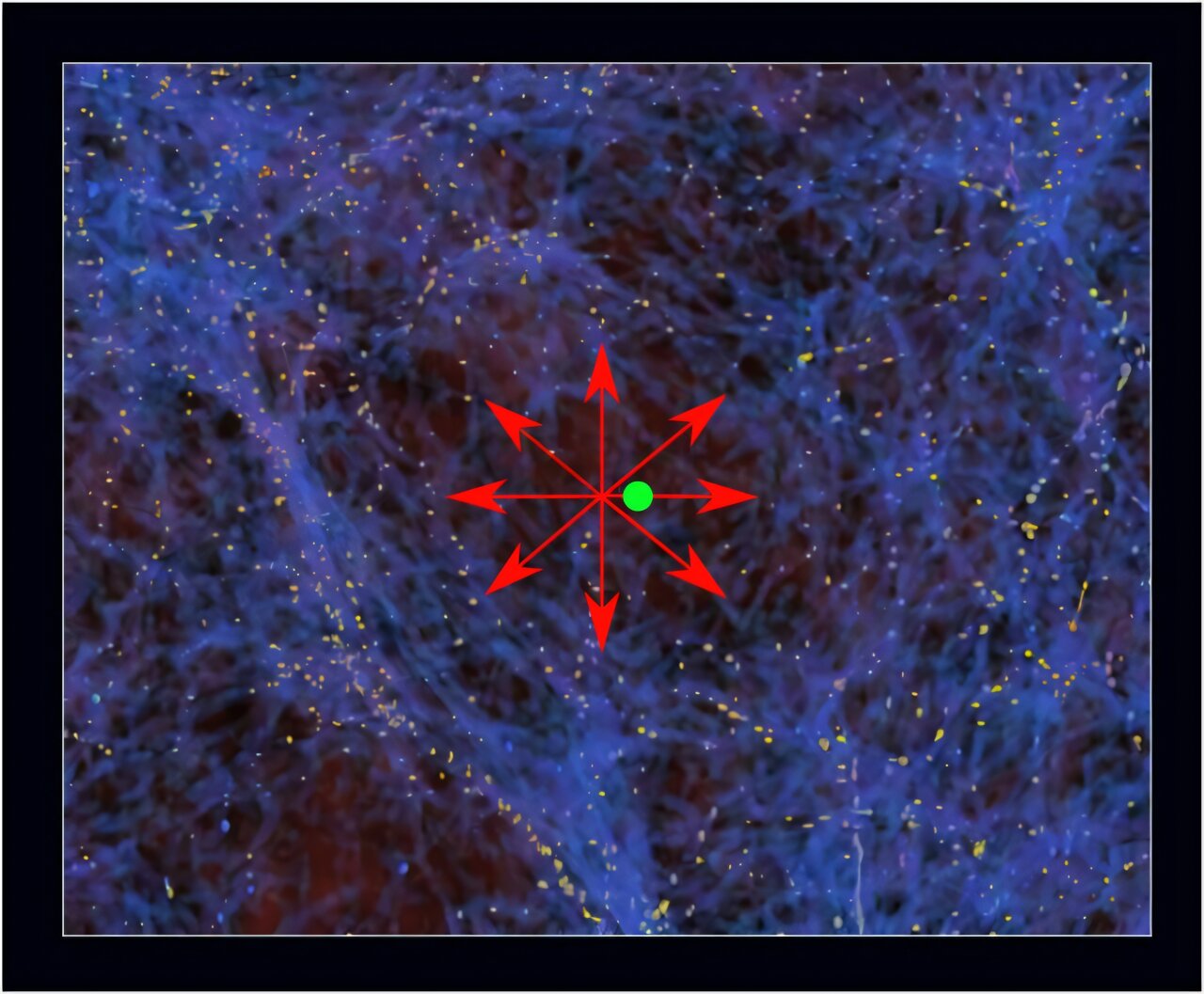
A 244 EeV cosmic ray named Amaterasu, detected in 2021 by the Telescope Array Project, is now thought to originate from a nearby star-forming galaxy, most plausibly M82, rather than the Local Void, after statistical reconstructions that combine simulations of cosmic-ray propagation with observations.
Scientists are probing Amaterasu, the Sun Goddess–named ultra-high-energy cosmic ray detected on Earth, to pinpoint its origin. As the second-most energetic cosmic ray observed, Amaterasu may arise from nearby star-forming environments such as the galaxy M82 rather than solely from the Local Void; researchers used a data-driven approach with Approximate Bayesian Computation to map probable source regions, with results published in The Astrophysical Journal on Jan. 28.
Researchers using 3D propagation simulations and Approximate Bayesian Computation link the Amaterasu ultra-high-energy cosmic ray (detected by the Telescope Array Project in 2021 at >240 EeV) to the nearby star-forming M82 galaxy, rather than the Local Void, showcasing a data-driven approach to tracing UHECR sources and advancing astro-particle physics.
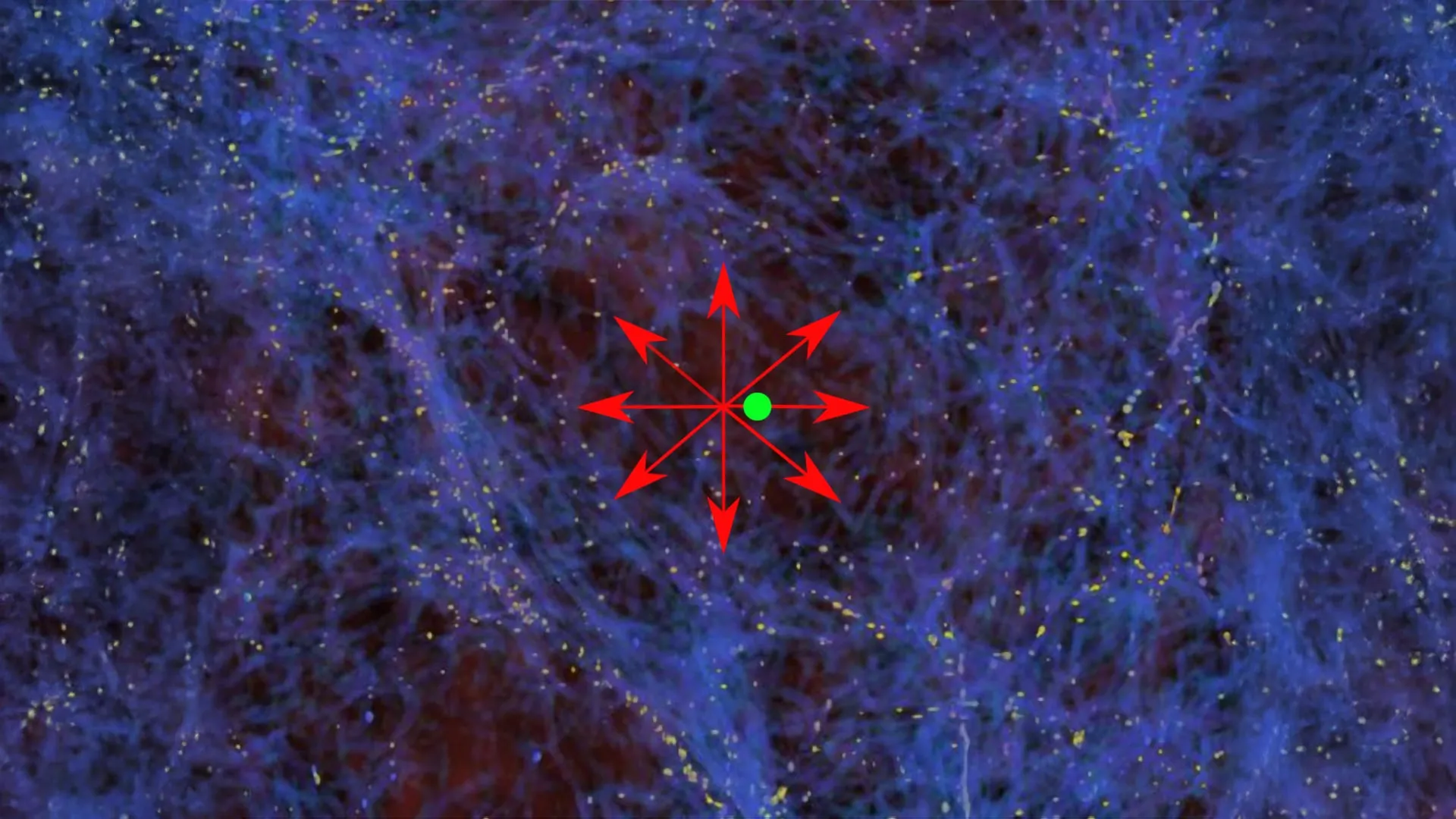
Astronomers propose that Earth resides in a massive, billion-light-year-wide void, which could explain the faster-than-expected expansion rate of the universe locally, potentially resolving the Hubble tension and supporting the universe's estimated age of 13.8 billion years. Evidence from sound waves of the early universe and galaxy distribution supports this theory, though it challenges standard cosmological models.
Scientists propose that Earth may be inside a large, low-density void, which could explain the discrepancy in measurements of the universe's expansion rate, known as the Hubble tension. Evidence from sound waves of the early universe supports this idea, suggesting our local universe expands faster due to this void, potentially resolving key cosmological questions about the universe's age and structure.
A mysterious cosmic ray, dubbed the Amaterasu particle, has been detected in Utah, originating from beyond our known galaxy. Unlike low-energy cosmic rays commonly found on Earth, this ultra-high-energy particle contains properties from deep space. Scientists at the Telescope Array observatory are studying the particle, which triggered nearly two dozen surface detectors and measured 244 exa-electron volts. The origins of these high-energy cosmic rays remain unknown, but researchers speculate they may be related to phenomena such as gamma-ray bursts, black holes, and galactic nuclei. The closest potential source is the Local Void, an empty region on the outskirts of the Milky Way. Scientists aim to establish patterns and understand the movement of these particles.
NASA shared an image of NGC 6503, a galaxy located in the 'Local Void', an empty patch of space. Situated 18 million light-years away from Earth in the constellation of Draco, NGC 6503 lies at the edge of the void, which stretches about 150 million light-years across and lacks stars and galaxies. The image was captured by NASA's Hubble Space Telescope.