Recent research suggests the universe may be lopsided, challenging the standard cosmological model that assumes it is uniform in all directions, due to discrepancies like the cosmic dipole anomaly which do not align with current theories, prompting a potential overhaul of our understanding of the cosmos.
A new study suggests the universe may be lopsided, challenging the standard cosmological model that assumes it is uniform in all directions, due to discrepancies in the cosmic dipole anomaly and matter distribution, which could lead to a major revision of our understanding of the cosmos.
New research suggests the universe may be lopsided, challenging the standard cosmological model due to discrepancies between the cosmic microwave background and the distribution of distant astronomical sources, indicating a potential need for a fundamental rethink of our understanding of the cosmos.
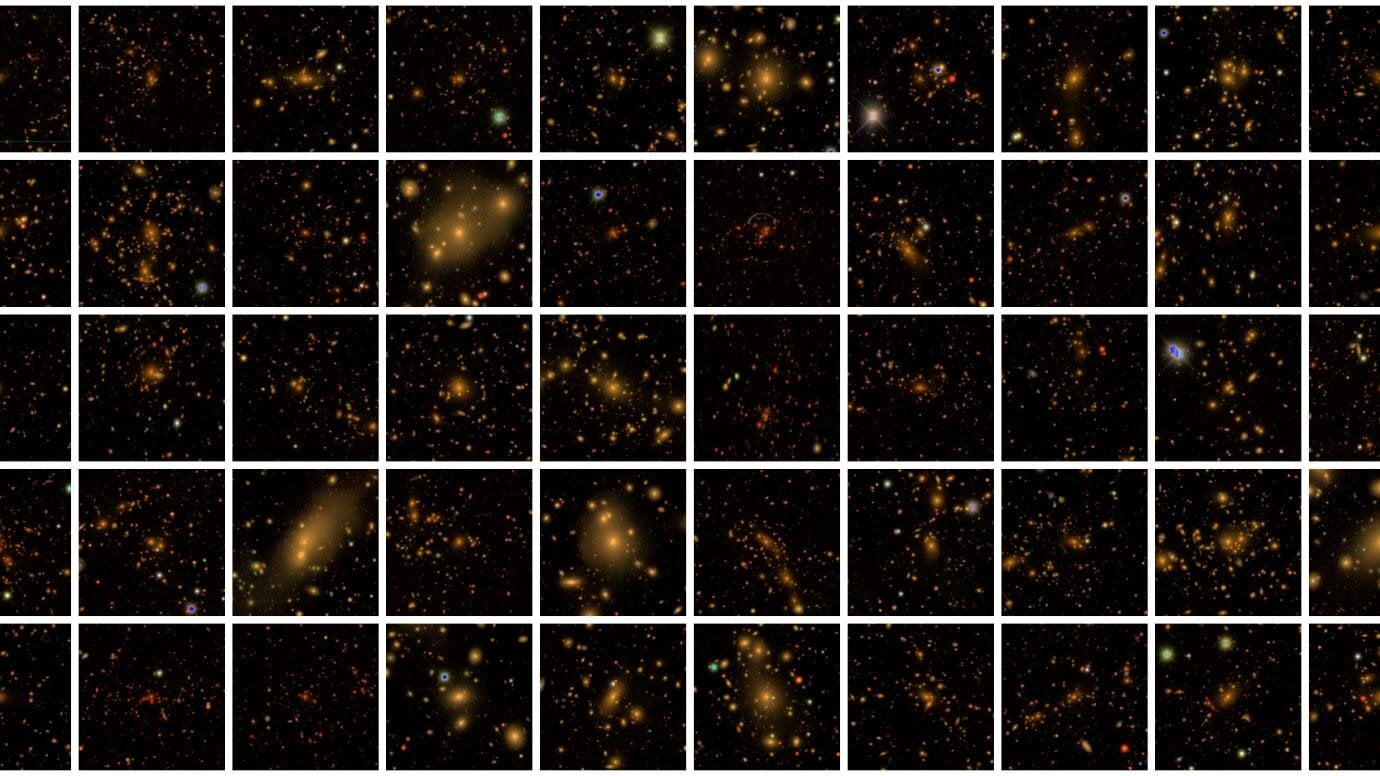
A new study using data from the Dark Energy Survey confirms that the Lambda-CDM model accurately describes the universe, by analyzing massive galaxy clusters to understand cosmic laws and the distribution of dark matter and energy, supporting previous findings and setting the stage for future telescope observations.
Researchers have used supercomputer simulations to understand why there are few disk galaxies like the Milky Way in the supergalactic plane (SGP). The simulations showed that inside the SGP, galaxies interact and merge more frequently, transforming spirals into ellipticals. Outside the SGP, galaxies interact less, allowing disk galaxies to retain their form. The results align with observations and support the Lambda Cold Dark Matter (CDM) model, which suggests that the distribution of galaxies in relation to the SGP arises naturally within the standard model of galaxy formation and evolution.
Astronomers have discovered that the universe's expansion is accelerating, likely due to dark energy. However, there are inconsistencies in expansion rate measurements, known as the Hubble tension, which challenge current models. The leading theory, Lambda CDM, explains the acceleration and expansion rate but doesn't fully align with observations. Researchers are exploring modifications to the model and new ideas to explain the Hubble tension, including evolving dark energy models, interacting dark energy-dark matter models, and modified gravity models. However, none of these solutions have fully explained the tension, suggesting a need to study the early universe for a better understanding.