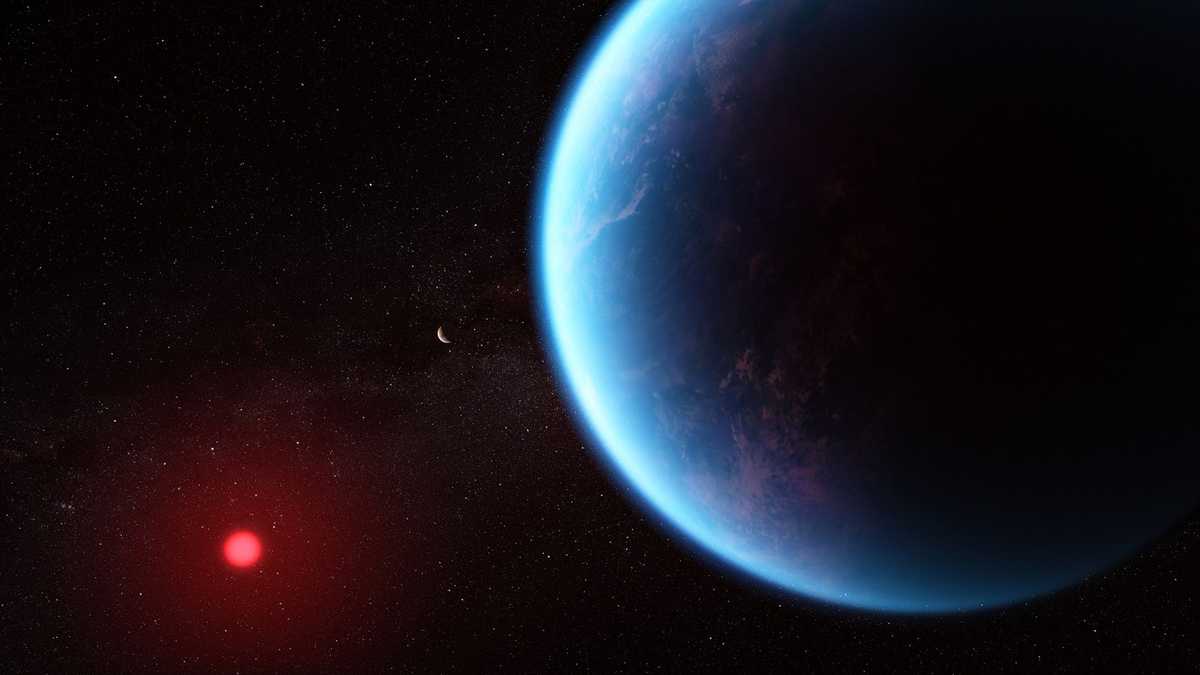
A new study suggests that sub-Neptune planets, previously thought to be potential 'water worlds' or 'Hycean planets,' are likely much drier than expected, with less than 1.5% water by mass, challenging previous assumptions and implications for the search for extraterrestrial life.
Recent studies using the James Webb Space Telescope suggest that the super-Earth exoplanet K2-18 b may be a water-rich ocean world with potential habitability, as it shows signs of a water-rich atmosphere and possible biosignatures, increasing its status as a prime candidate for studying extraterrestrial life.
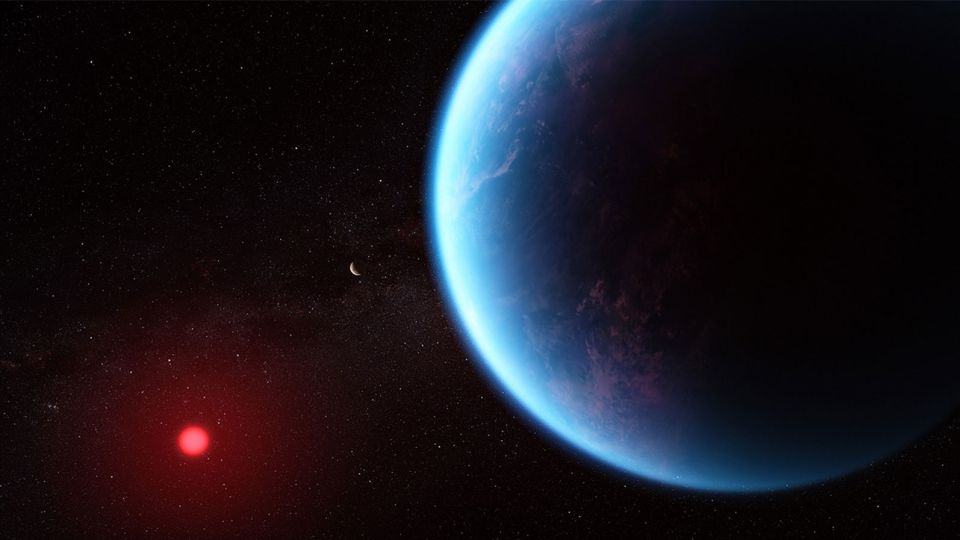
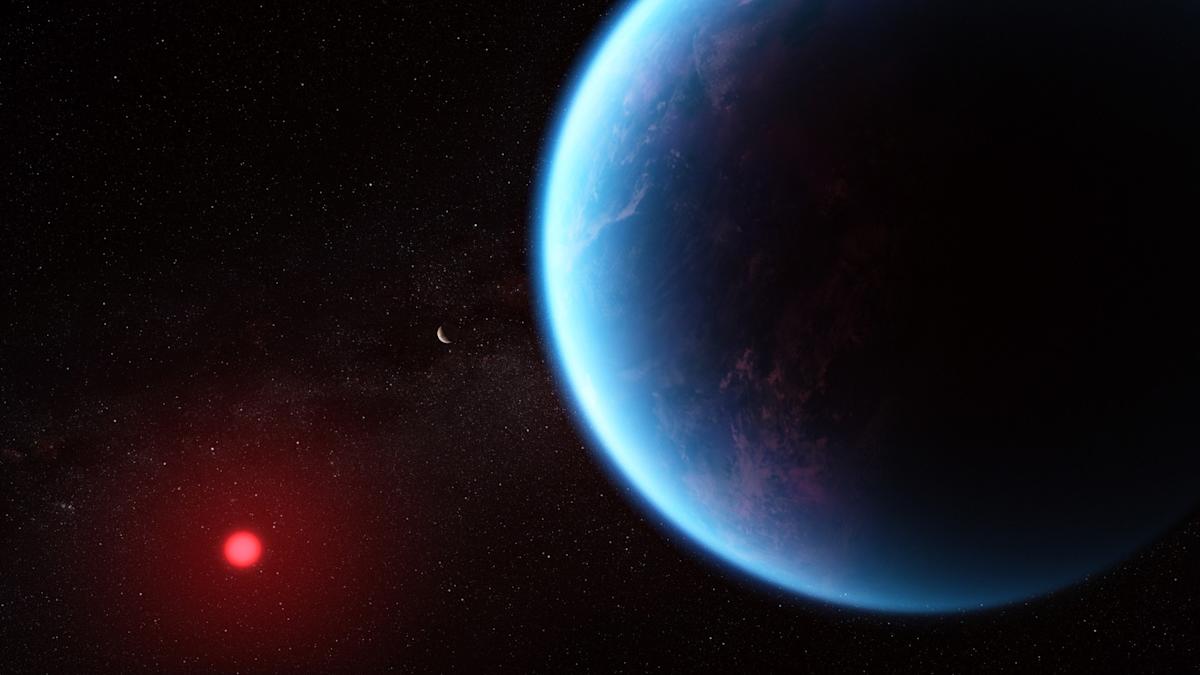
Scientists using the James Webb Space Telescope have found that the super-Earth exoplanet K2-18 b is rich in liquid water and may be an ocean world, increasing its potential habitability. While conclusive evidence of biosignatures is still pending, the planet's atmosphere shows signs of water and other gases, making it a prime candidate for studying extraterrestrial life. Future observations aim to confirm the presence of a global water ocean and biosignatures.
New observations of the exoplanet K2-18b, once thought to possibly show signs of life, have confirmed it is water-rich but found no conclusive evidence of biosignatures like DMS, highlighting the difficulty of detecting extraterrestrial life and the differences between exoplanet atmospheres and Earth's.
A study suggesting potential signs of life on the exoplanet K2-18b was met with skepticism and further analysis, highlighting the complexities of detecting extraterrestrial biosignatures and the importance of rigorous scientific validation. Multiple research teams have questioned the initial findings, emphasizing the need for stronger evidence before confirming signs of life beyond Earth.
Scientists are skeptical about the initial claims of detecting signs of life on exoplanet K2-18b, as follow-up analysis suggests the evidence for molecules like DMS is weak and not statistically significant, highlighting the challenges in confirming extraterrestrial life signals.
Data from the James Webb Space Telescope (JWST) suggests that the hycean exoplanet K2-18b may have a molten surface rather than a watery ocean, challenging previous assumptions about its potential habitability. The study, published in The Astrophysical Journal Letters, indicates that the planet's high temperature may make it too hot to host an ocean, with evidence supporting the presence of a molten surface. The research team emphasizes the importance of considering planetary temperature in the search for habitable exoplanets and highlights the potential of JWST data for future studies.
NASA's James Webb Space Telescope has detected methane, carbon dioxide, and dimethyl sulphide (DMS) in the atmosphere of exoplanet K2-18b, located 124 light-years from Earth. The presence of DMS, a molecule only produced by living things on Earth, suggests the possibility of life on the planet. K2-18b is considered a potentially habitable world, with a hydrogen-rich atmosphere and a liquid-water ocean, making it a candidate for a Hycean planet. Further research is needed to validate the evidence of DMS and determine if the exoplanet can support life.
The James Webb Space Telescope has uncovered evidence suggesting that the exoplanet K2-18b, located about 120 light-years from Earth, may have the necessary conditions to support bodies of water and potentially even life. The planet, which closely orbits a cool dwarf star within its habitable zone, has an atmosphere rich in methane and carbon dioxide, along with a scarcity of ammonia. These findings, along with the detection of a special molecule called dimethyl sulfide, hint at the possibility of an ocean world with a hydrogen-rich atmosphere. While further research is needed to confirm the presence of life, these observations expand scientists' understanding of exoplanets and their potential for hosting life.
The James Webb Space Telescope has uncovered evidence suggesting that the exoplanet K2-18b, located about 120 light-years from Earth, may have the necessary conditions to support bodies of water and potentially even life. The planet, which closely orbits a cool dwarf star within its habitable zone, has an atmosphere rich in methane and carbon dioxide, along with a scarcity of ammonia. These findings, along with the detection of a special molecule called dimethyl sulfide, hint at the possibility of an ocean world with a hydrogen-rich atmosphere. While further research is needed to confirm the presence of life, these observations expand scientists' understanding of exoplanets and their potential for hosting life.