Tag

Graph Theory

All articles tagged with #graph theory

Unveiling the Infinite Graph's 'Melting' Point Up Close

Originally Published 2 years ago — by Quanta Magazine

Featured image for Unveiling the Infinite Graph's 'Melting' Point Up Close
Source: Quanta Magazine

Mathematicians have made significant progress in proving Schramm's locality conjecture, which relates to the percolation threshold in transitive graphs. The conjecture states that the percolation threshold can be determined solely by the close-up perspective of the graph. Two groups of mathematicians have successfully tackled the conjecture for fast-growth and slow-growth graphs, but the challenge lies in addressing graphs with intermediate growth rates. Easo and Hutchcroft have extended their results to cover these graphs, completing the trichotomy and proving the conjecture. This breakthrough provides insights into the behavior above and below the percolation threshold, but the exact behavior at the threshold remains an open question for most graphs.

"Decades of Dedication: Unraveling the Elusive Math Problem"

Originally Published 2 years ago — by Phys.org

Featured image for "Decades of Dedication: Unraveling the Elusive Math Problem"
Source: Phys.org

After nearly a century, mathematicians at the University of California San Diego have found the answer to r(4,t), a longstanding Ramsey problem that has perplexed the math world for decades. Ramsey problems involve finding order within a graph, and r(4,t) represents the number of points without lines in the graph. The researchers used pseudorandom graphs and various mathematical techniques to estimate that r(4,t) is close to a cubic function of t. The findings are currently under review with the Annals of Mathematics.

Cracking the Code: Mathematicians Solve Hot Coloring Problem

Originally Published 2 years ago — by Phys.org

Featured image for Cracking the Code: Mathematicians Solve Hot Coloring Problem
Source: Phys.org

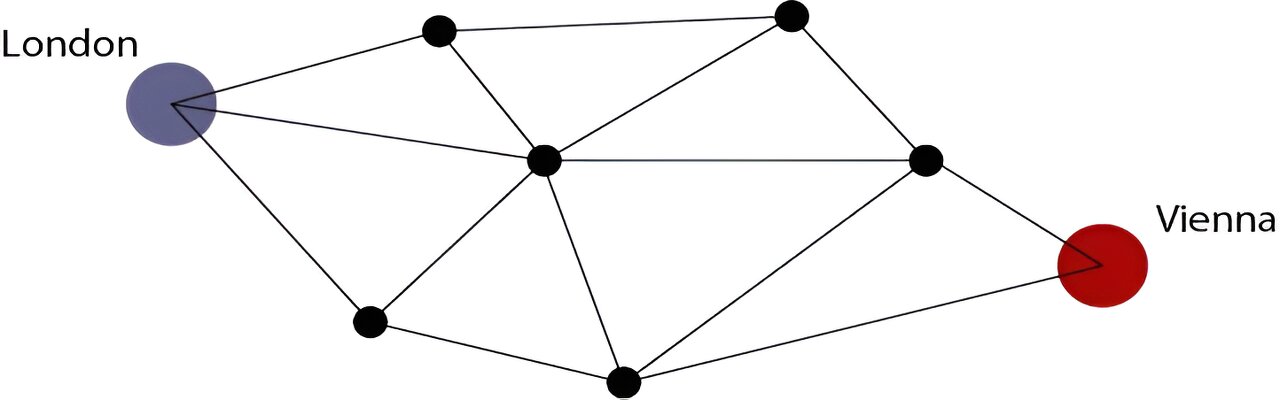
Mathematicians have solved a problem in graph theory related to coloring. The problem involves partitioning the edges of subcubic graphs into multiple classes, with the goal of minimizing the number of one type of class while keeping the number of another type fixed. By resolving this conjecture, the researchers have made a significant contribution to understanding the structural properties of subcubic graphs and may provide insights into other communication network problems. The study was published in The Journal of Graph Theory.

Revolutionary Graph Structure Prediction Method Unveiled by Mathematicians.

Originally Published 2 years ago — by Quanta Magazine

Featured image for Revolutionary Graph Structure Prediction Method Unveiled by Mathematicians.
Source: Quanta Magazine

Mathematicians have solved a problem that has resisted progress for more than 40 years, involving so-called Ramsey numbers, which measure the size that collections of vertices and edges, called graphs, can attain before they inevitably give rise to pattern and structure. The new proof not only solves a problem that has resisted progress for more than 40 years, but also presents a novel road map for how mathematicians might tackle Ramsey problems going forward. The work heralds a shift in how mathematicians think about Ramsey problems, using pseudorandom constructions instead of randomness.

Quantum Fluctuations Enhance Algorithm Efficiency.

Originally Published 2 years ago — by Quanta Magazine

Featured image for Quantum Fluctuations Enhance Algorithm Efficiency.
Source: Quanta Magazine

Randomness has played an important role in computer science since its inception. Adding randomness into an algorithm can help calculate the correct answer to unambiguous true-or-false questions. Randomness has been used in primality testing and graph theory to solve complex problems. While deterministic algorithms are often efficient only in principle, randomized algorithms remain popular because de-randomization can be tricky. Randomness has found countless other uses in computer science, from cryptography to game theory to machine learning.

Identifying Neural Abnormalities in Anxious Dogs.

Originally Published 2 years ago — by Neuroscience News

Featured image for Identifying Neural Abnormalities in Anxious Dogs.
Source: Neuroscience News

Researchers at Ghent University in Belgium have found that dogs with anxiety have stronger neural connections between the amygdala and other areas of the anxiety network in the brain compared to less anxious dogs. The study used non-invasive functional MRI to examine 25 healthy and 13 anxious dogs and found that functional connections between the amygdala and other parts of the anxiety circuit, particularly the hippocampus, were stronger than normal in anxious dogs. The researchers believe their findings show that resting-state fMRI is a good tool for studying dog-models of anxiety, and that future studies like this could increase our understanding of how anxiety-related circuitry in the brain is altered in anxiety-disordered animals, and possibly even humans with the condition.