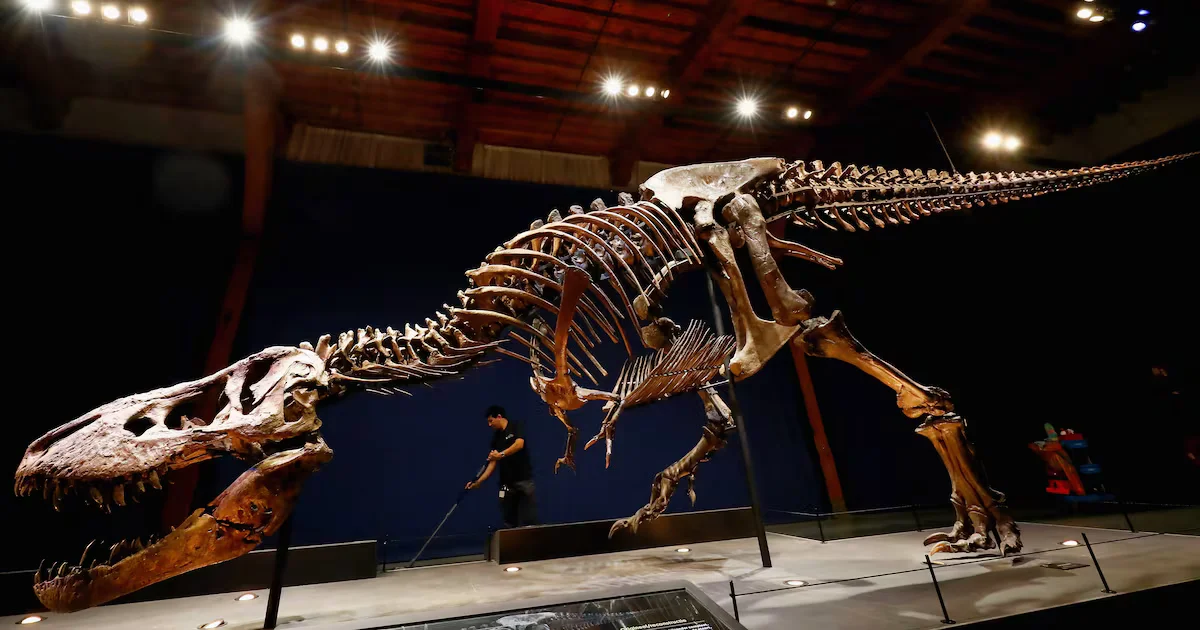
A study of 17 T. rex specimens shows the giant predator grew more slowly and lived longer than previously thought, not reaching around eight tons until about 35–40 years old, which helps explain its sustained dominance and varied life niches.
Babies grow faster than teenagers, with some infants adding nearly a foot of height per year, making early childhood the fastest growth period in humans, while teenage growth spurts are significant but second in speed.
Titanosaurs, a diverse and successful group of sauropod dinosaurs, thrived for millions of years by merging reptile and mammal traits, growing rapidly, and feeding on abundant plants, until their extinction caused by an asteroid impact 66 million years ago.
Titanosaurs, a lesser known group of sauropod dinosaurs, were the largest land animals on Earth, with nearly 100 species that varied greatly in size. Recent discoveries have revealed that they had a unique way of life, merging reptile and mammal characteristics. They originated in the Early Cretaceous Period and thrived on all seven continents, with evidence suggesting rapid growth rates similar to mammals. Fossil findings also indicate that titanosaurs had a diverse diet and high tooth-replacement rates, contributing to their biological success. If not for the asteroid impact 66 million years ago, these long-lived and diverse creatures would likely have continued to thrive.
Mathematicians have made significant progress in proving Schramm's locality conjecture, which relates to the percolation threshold in transitive graphs. The conjecture states that the percolation threshold can be determined solely by the close-up perspective of the graph. Two groups of mathematicians have successfully tackled the conjecture for fast-growth and slow-growth graphs, but the challenge lies in addressing graphs with intermediate growth rates. Easo and Hutchcroft have extended their results to cover these graphs, completing the trichotomy and proving the conjecture. This breakthrough provides insights into the behavior above and below the percolation threshold, but the exact behavior at the threshold remains an open question for most graphs.