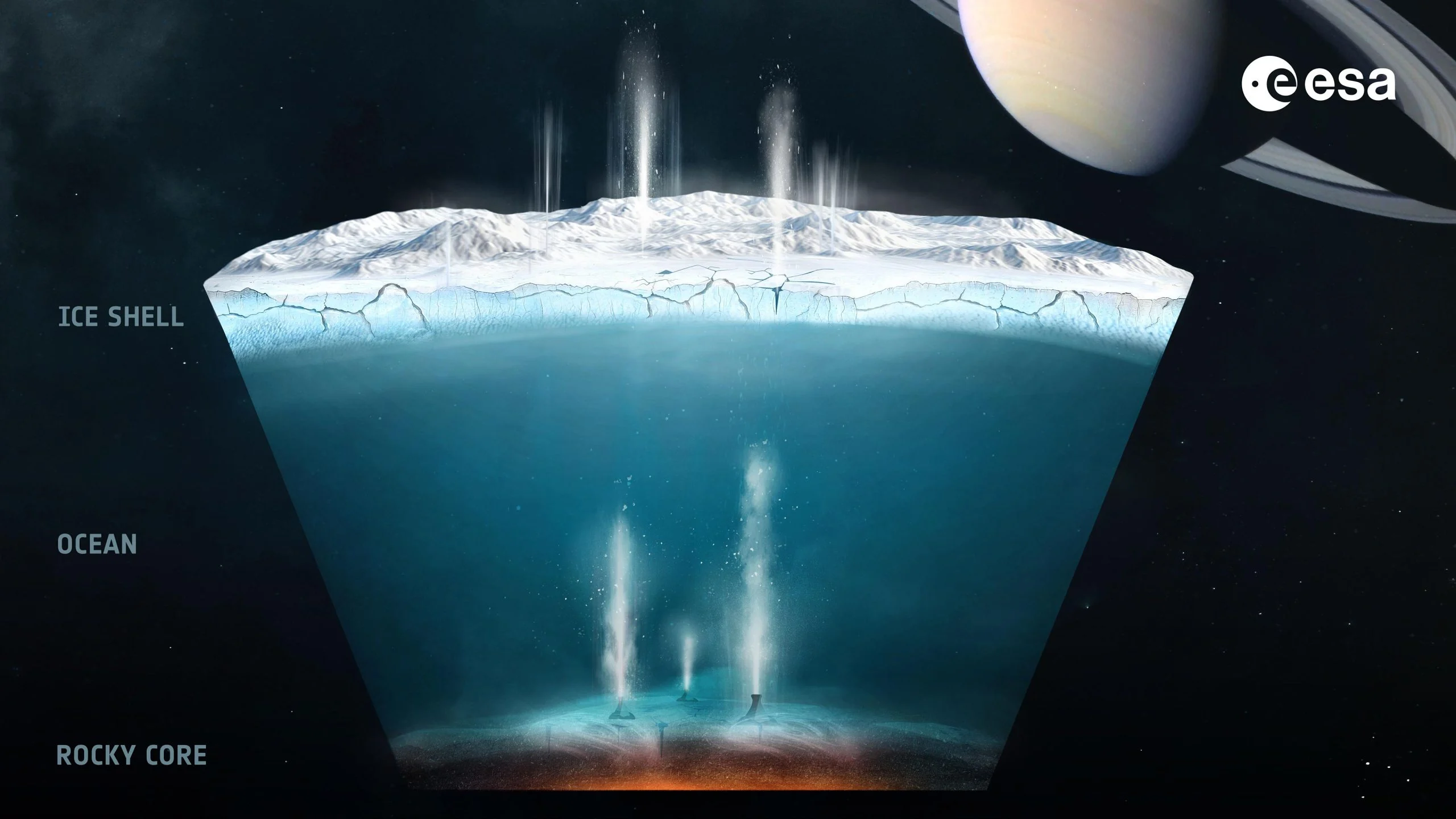
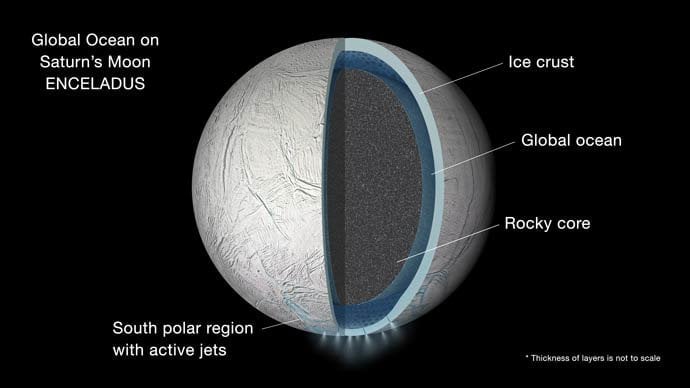
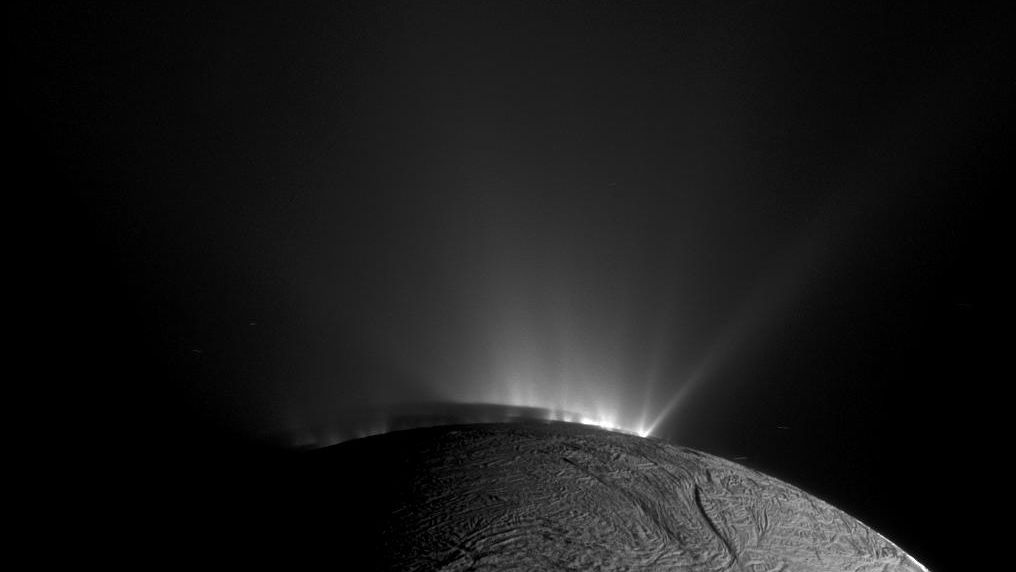
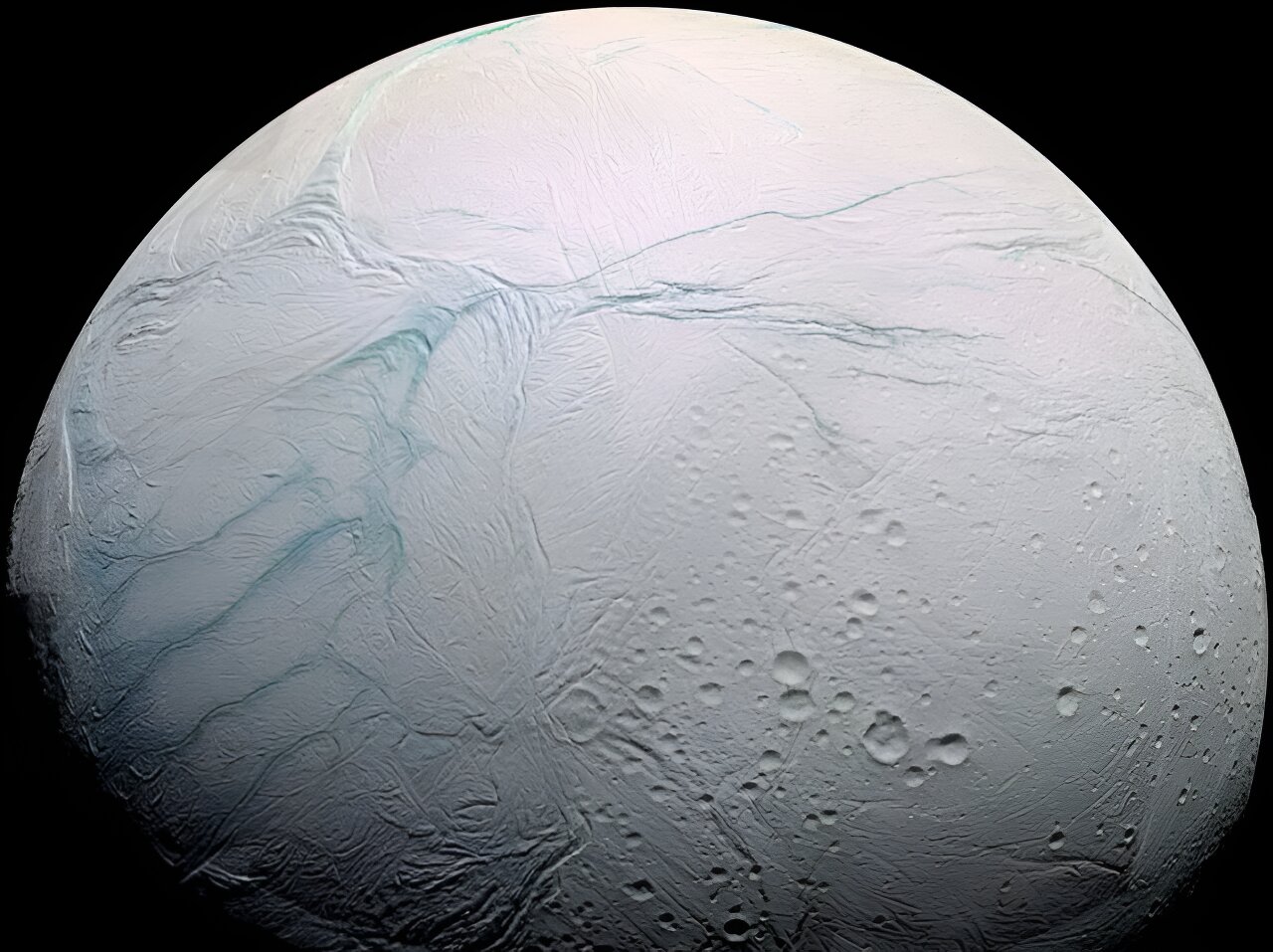
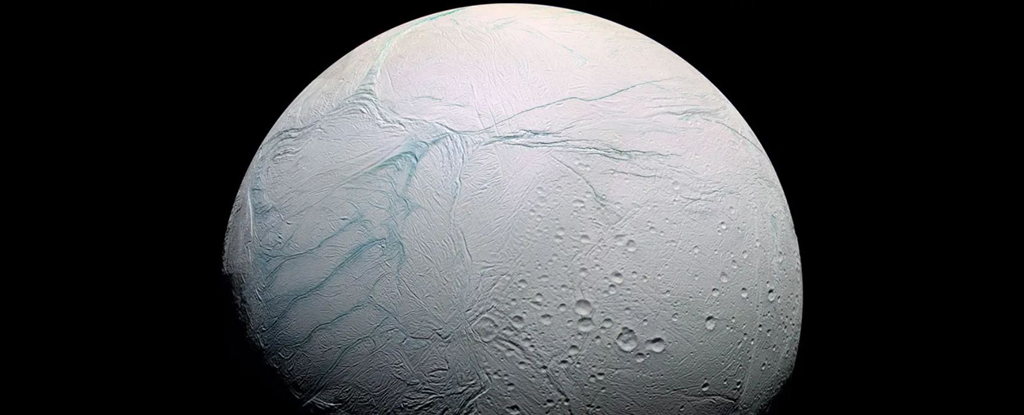
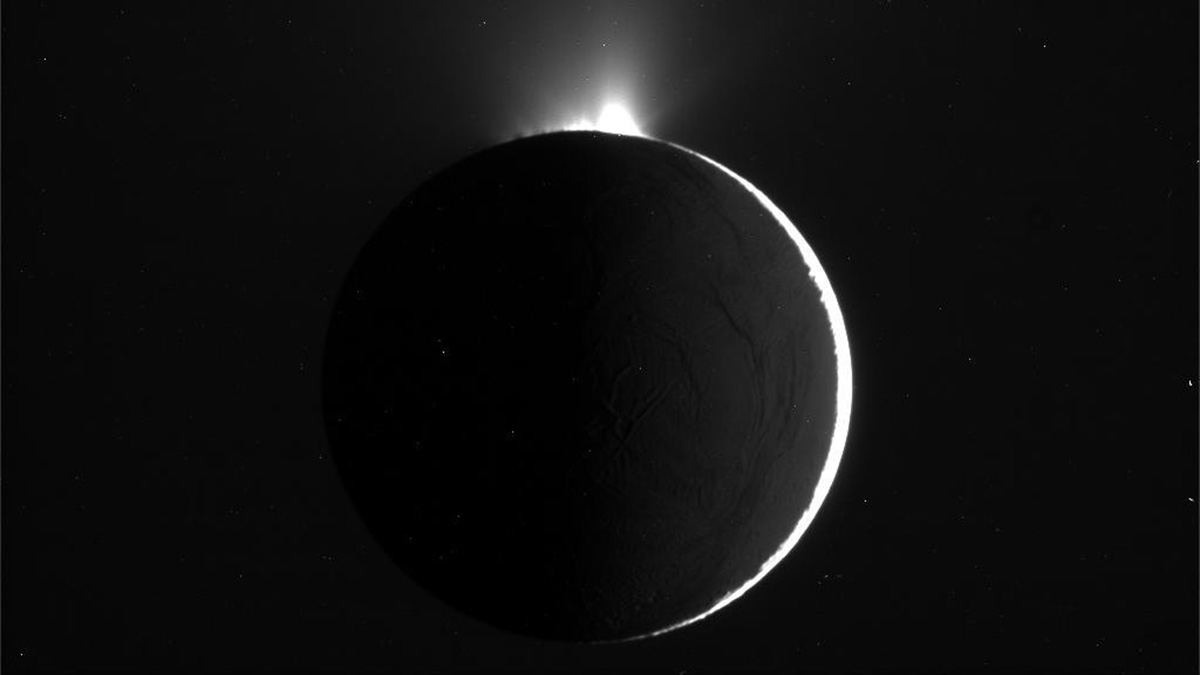
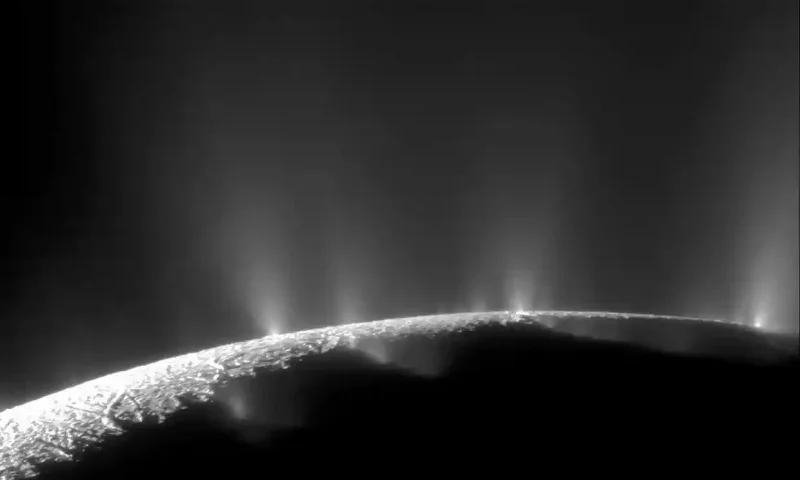
NASA's analysis of data from the Cassini spacecraft reveals that Saturn's moon Enceladus is emitting heat from both its north and south poles, indicating a stable, long-lasting underground ocean that could support life, with implications for future exploration.
A recent study estimates that Enceladus' subsurface ocean has a highly alkaline pH of around 10.6, which suggests significant interaction between basic rocks and the ocean, and has implications for the potential habitability and search for life on this moon. The study used data from NASA's Cassini spacecraft and computer models to refine previous pH estimates, highlighting the importance of understanding Enceladus' ocean chemistry for future exploration.
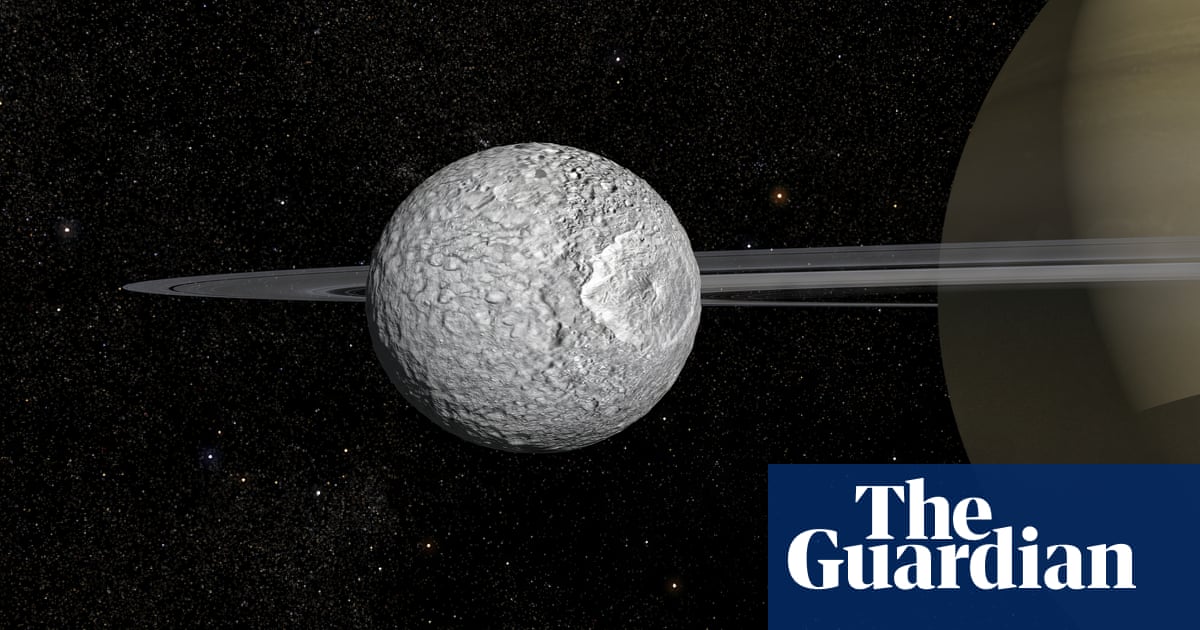
Scientists have discovered that Saturn's moon Mimas, known for its resemblance to the Death Star, harbors a hidden ocean beneath its icy crust, making it the latest addition to the group of moons in our solar system with subsurface oceans. The ocean, estimated to be 45 miles deep and relatively young at 25 million years old, was detected through analysis of Mimas's orbit and spin. This finding has sparked interest in the potential for life on Mimas, although some experts believe that other moons like Europa and Enceladus may be more promising candidates for harboring life.
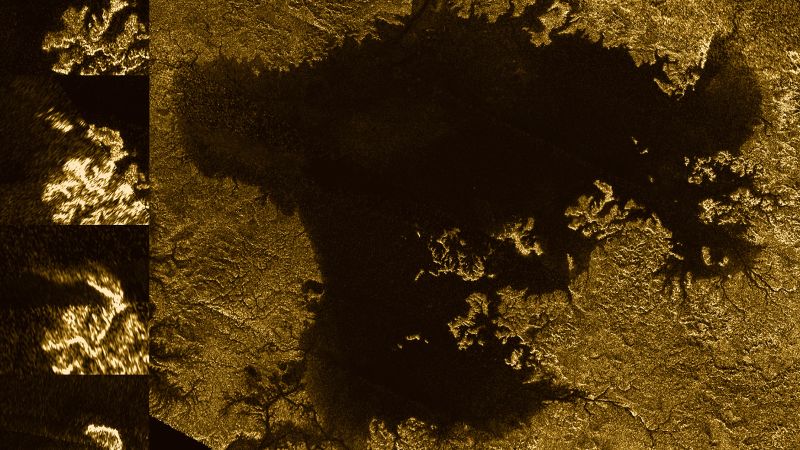
Scientists have discovered that the disappearing "magic islands" on Saturn's moon Titan may be clumps of organic material, rather than fizzing gas bubbles as previously thought. These features, observed as moving bright spots on Titan's liquid bodies, are believed to be honeycomb-like glaciers made of organic material that fall onto the moon's surface. The upcoming Dragonfly mission aims to further investigate Titan's unique environments and potential habitability, as the moon contains organic chemicals essential to life on Earth and may harbor conditions conducive to life beyond our current understanding.
New analysis of data from NASA's Cassini mission has provided further evidence that Saturn's moon Enceladus could be a habitable ocean world. The data revealed the presence of organic compounds and a molecule called hydrogen cyanide, which is crucial for the origin of life. Scientists suspect that processes like methanogenesis, which played a role in the origin of life on Earth, may also be occurring on Enceladus. Further investigation is needed to determine the dilution of organic compounds in the moon's subsurface ocean, which could determine its potential to support life. Future missions to Enceladus may provide a definitive answer regarding the existence of life in its ocean.
New analysis of data from NASA's Cassini mission has provided further evidence that Saturn's moon Enceladus is a habitable ocean world. The analysis revealed the presence of organic compounds and the molecule hydrogen cyanide, which is crucial for the origin of life. These findings suggest that Enceladus has the necessary ingredients for life, including water, energy, and chemical elements. The discovery of varied and powerful chemical energy sources within Enceladus' ocean indicates the potential for sustaining life. Future missions are needed to investigate the dilution of organic compounds and determine whether life exists on Enceladus.
Data collected by NASA's Cassini mission has revealed that Saturn's moon Enceladus contains a key ingredient for life. The plumes of ice and water emitted by Enceladus contain organic molecules, including carbon dioxide, methane, and hydrogen, indicating a potential for life. The recent discovery of hydrogen cyanide, a crucial precursor for the formation of amino acids, suggests that Enceladus could be even more habitable than previously thought. The subsurface ocean of Enceladus may provide a diverse source of chemical energy, offering potential pathways for life. The findings highlight the ongoing importance of the Cassini mission in providing insights about Saturn and its moons.
New research based on data from NASA's Cassini mission suggests that Saturn's moon Enceladus has the necessary chemicals for life. The analysis of Enceladus' plumes reveals the presence of ammonia and inorganic phosphorous, which are key components for supporting ecosystems. The study also explores the Redfield ratio, a consistent ratio of carbon to nitrogen to phosphorous found in Earth's oceans, and its potential relevance to Enceladus' biological potential. While further research is needed to fully understand the chemical environment and habitability of Enceladus, this study highlights the importance of considering generalized models of metabolism and physiology in the search for extraterrestrial life.
New research based on data from NASA's Cassini mission suggests that Saturn's ocean moon, Enceladus, has the necessary building blocks for life. The analysis of Cassini's data reveals the presence of ammonia and inorganic phosphorous in Enceladus' ocean, which are key components for supporting ecosystems. The researchers used ecological and metabolic theory to understand how these chemicals could make Enceladus habitable. The study also highlights the importance of the Redfield ratio, a consistent ratio of carbon to nitrogen to phosphorous found in Earth's oceans, as a potential signature for life detection on ocean worlds like Enceladus. However, further research and more detailed data are needed to fully understand the chemical environment and potential for life on Enceladus.
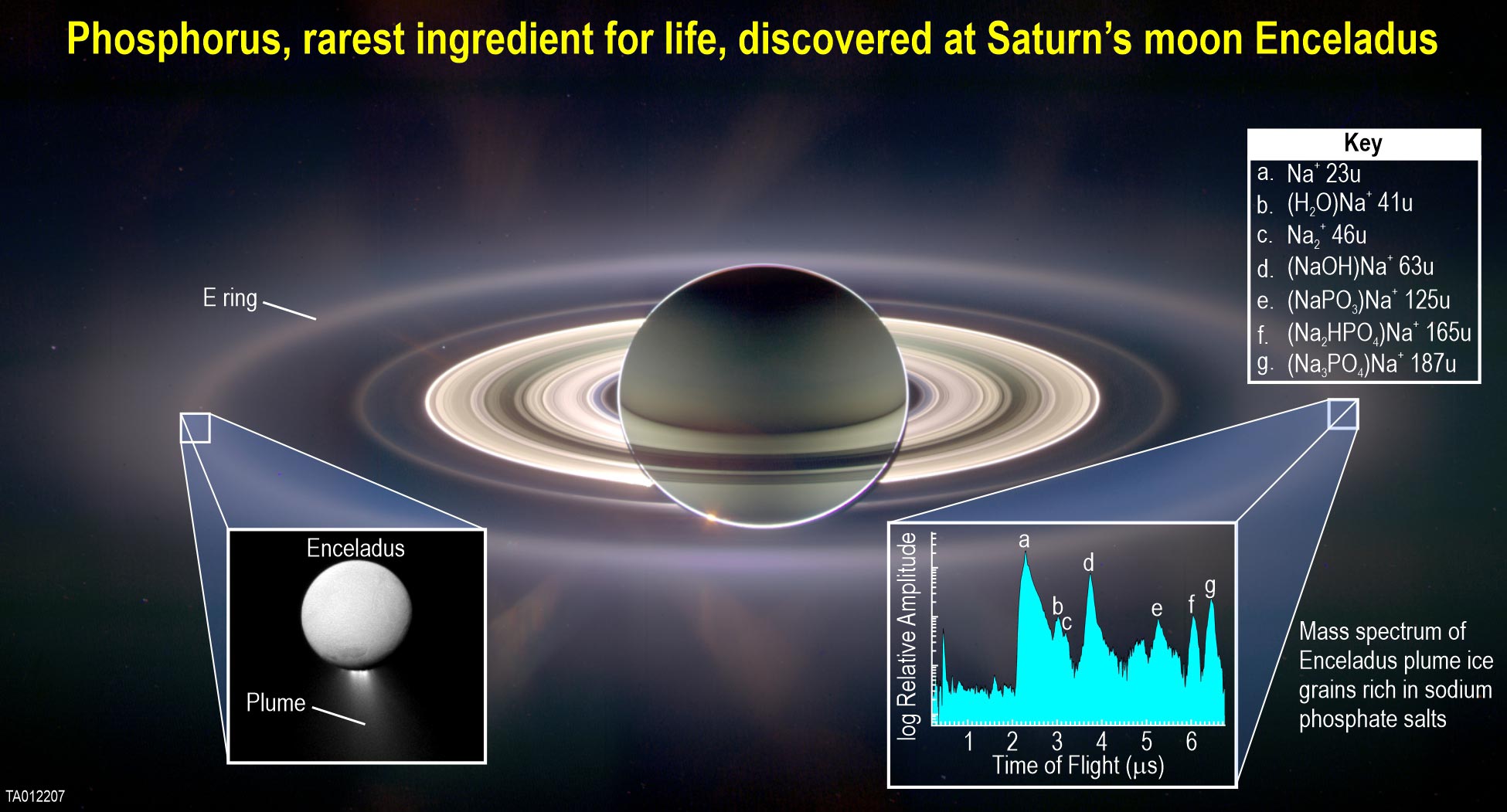
Researchers analyzing archival data from the Cassini mission have discovered evidence of phosphorus in the form of sodium phosphates in the subsurface ocean of Saturn's moon Enceladus. This is the first time phosphorus has been measured in a liquid environment beyond Earth. Phosphorus is a crucial element for life as we know it, and its presence in Enceladus's ocean suggests that it may be more abundant in the outer solar system than previously thought. The discovery further supports the possibility of finding life beyond Earth on Enceladus and other icy moons in the solar system.
Phosphorus, a key building block for life, has been detected on Enceladus, one of Saturn's moons, making it the first time that all six elements essential for life have been found on a moon beyond Earth. The discovery was made by analyzing data collected by NASA's Cassini Mission, which spent over a decade exploring Saturn and its moons. Enceladus is now considered one of the most likely places for life to exist in our solar system, as it has a subsurface ocean with a high concentration of phosphorus readily available for the potential formation of life.
Researchers have discovered phosphorus, a key building block for life, in the subsurface ocean of Saturn's moon Enceladus using data from NASA's Cassini mission. The phosphorus concentration is at least 100 times higher than Earth's oceans, making it an exciting discovery in the search for extraterrestrial life. The findings reinforce the idea of the potential habitability of ice-covered ocean worlds across the solar system, beyond surface ocean worlds like Earth.
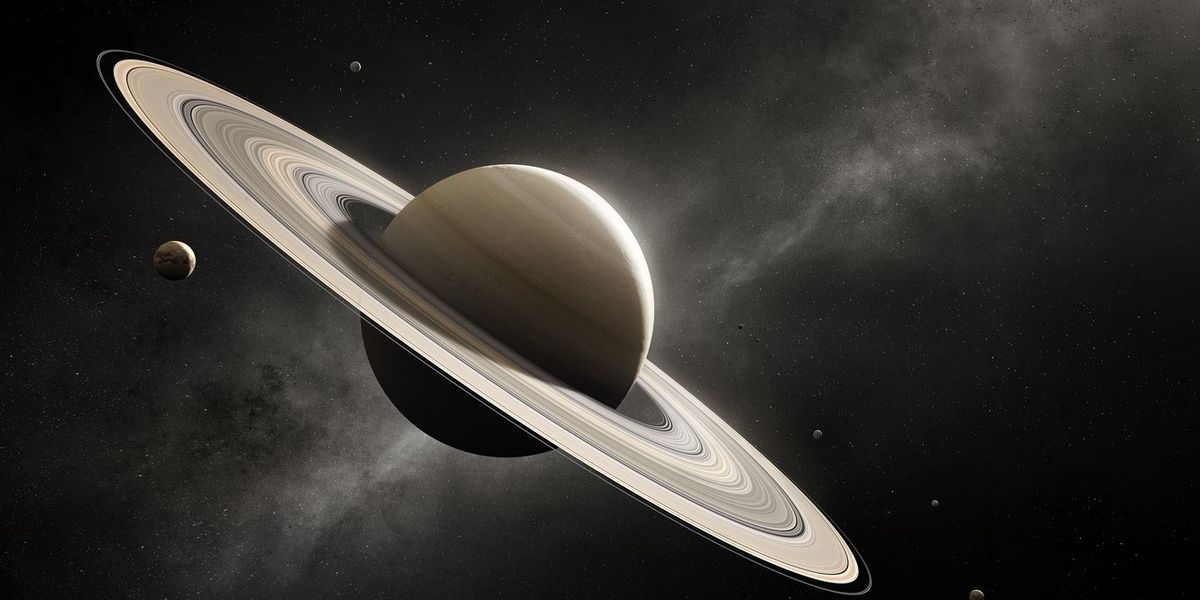
Saturn's iconic rings, made mostly of ice, are losing mass at a rate of many tons per second, according to new analysis of data captured by NASA's Cassini mission. The rings are relatively young by astronomical standards, just a few hundred million years old, and will only be around for another few hundred million years at most. The research also suggests that something dramatic happened in Saturn's satellite system in the last few hundred million years to form the rings' incredible structure.
Saturn's iconic rings, made mostly of ice, are losing mass at a rate of many tons per second, according to new research based on data from NASA's Cassini mission. The rings are expected to disappear in a few hundred million years at most. The research also found that the rings appeared long after Saturn's initial formation and were still forming when dinosaurs roamed the Earth.
Saturn's iconic rings, made mostly of ice, are losing mass at a rate of many tons per second, according to new analysis of data captured by NASA's Cassini mission. The rings are relatively young by astronomical standards, just a few hundred million years old, and will only be around for another few hundred million years at most. The research also suggests that something dramatic happened in Saturn's satellite system in the last few hundred million years to form the rings' incredible structure.