Tag

Strange Metals

All articles tagged with #strange metals

science2 years ago

Unraveling the Enigma: The Mysterious Behavior of Electricity in 'Strange Metals'

Physicists have observed electricity flowing like a fluid in a group of metals known as "strange metals," contradicting the traditional understanding of how metals conduct electricity. Strange metals exhibit unusual properties, such as defying the rules of electrical resistance and the ability to become superconductors at relatively high temperatures. The discovery challenges the prevailing theory that metals conduct electricity through clumps of quasiparticles and may lead to a reevaluation of how electrical charge is carried. Further research into strange metals could uncover a common principle behind their behavior and shed light on the mechanism of superconductivity.

science2 years ago

Unraveling the Enigma: The Mysterious Behavior of Electricity in 'Strange Metals'

Physicists have observed electricity flowing like a fluid in a group of metals known as "strange metals," contradicting the traditional understanding of how metals conduct electricity. Strange metals exhibit unusual properties, such as defying electrical resistance and becoming superconductors at relatively high temperatures. The researchers created nano-sized wires from a blend of strange metals and observed that the current flowed continuously rather than in discrete clumps, challenging the prevailing theory of clumped quasiparticles. This discovery could lead to a reevaluation of how electrical charge is carried and provide insights into the nature of strange metals and their ability to achieve superconductivity.

physics2 years ago

"Unveiling the Bizarre Conductivity: Exotic Liquid-Like Electricity Flow in Strange Metals"

Researchers studying strange metals have discovered evidence that challenges our understanding of electrical currents. By conducting quantum measurement experiments on nanowires made of ytterbium, rhodium, and silicon, they found that the behavior of electrical currents in strange metals differs from that of normal metals. Instead of quasiparticles, the researchers observed a more liquid-like flow of charge, suggesting that the traditional model of quasiparticles may not apply in these materials. The findings support a theory proposed over 20 years ago and raise questions about how charge moves collectively in strange metals.

science-and-technology2 years ago

"Groundbreaking Discovery: Tin Hydride Exhibits Unprecedented Properties of Strange Metal"

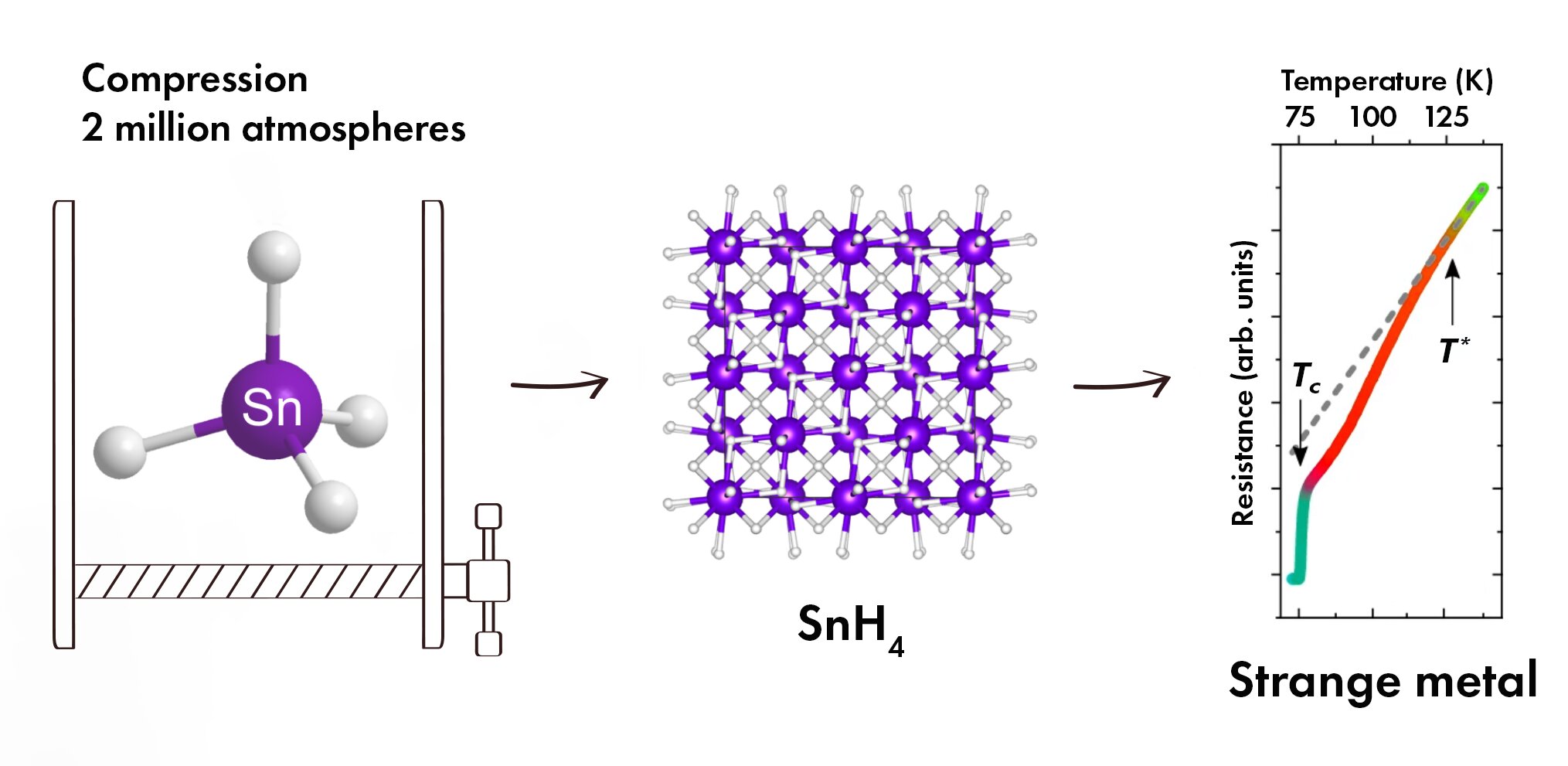
Researchers from Skoltech and HPSTAR have discovered previously unknown tin hydrides that exhibit superconducting properties at a critical temperature of 72 Kelvins. The hydrides display unusual behavior similar to cuprate superconductors, known as "strange" metals, conducting electricity differently from conventional metals. The team used high-pressure diamond anvil cells to study the chemical interaction between tin and hydrogen under extreme pressure. The findings bridge the gap between cuprate superconductivity and high-pressure hydride superconductivity, highlighting the potential for practical applications and the need for further research.

science2 years ago

Unraveling the Enigma of "Strange Metals": A 40-Year Quantum Puzzle Solved

A new theory has been proposed to explain the unusual behavior of strange metals, a long-standing challenge in condensed matter physics. The theory suggests that strange metals exhibit two key properties: quantum entanglement of electrons and a nonuniform arrangement of atoms. These properties result in the electrons colliding with each other in all directions, leading to increased electrical resistance. The theory could help researchers understand and develop new superconductors, and the name "strange metals" may need to be reconsidered.

science-and-technology2 years ago

Cracking the Enigma: Scientists Unravel the Mystery of Strange Metals

Physicists have developed a universal theory to explain the behavior of "strange metals," which conduct electricity in unconventional ways. These metals become superconductors at low temperatures but exhibit increased resistance at higher temperatures. The researchers attribute this behavior to a combination of quantum entanglement and randomness. The entangled electrons, known as Cooper pairs, have wave-like properties that allow them to move more easily through the material at low temperatures. However, the random arrangement of atoms disrupts their flow as the temperature rises, causing additional resistance. Understanding this interplay could aid in the design of better superconductors for applications such as quantum computers.

science2 years ago

Decoding the Enigma of Strange Metals: A Unified Theory Emerges

Scientists have identified a mechanism that explains the unusual behavior of strange metals, a long-standing challenge in condensed matter physics. The new theory is based on two properties of strange metals: quantum entanglement of electrons and a nonuniform arrangement of atoms. The combination of these properties results in the random momentum of electrons, causing electrical resistance. Understanding strange metals could lead to the development of new superconductors and applications in quantum computing.

science-and-technology2 years ago

Graphene Continues to Break Records and Revolutionize Electronics.

Researchers at The University of Manchester have discovered record-high magnetoresistance in graphene, reaching above 100% in magnetic fields of standard permanent magnets. This discovery could help solve longstanding mysteries surrounding strange metals and linear magnetoresistance, and has potential applications in magnetic sensors found in cars and computers. The researchers used high-quality graphene in its intrinsic state, creating a plasma of fast-moving Dirac fermions that demonstrated a surprisingly high mobility despite frequent scattering.

science2 years ago

Unraveling the Mystery of Strange Metals: New Insights from Researchers.

Researchers at the University of Toronto have developed a theoretical model to understand the behavior of "strange metals," which exhibit complex states of matter due to the intertwined properties of electrons. The model describes the interactions between subatomic particles in non-Fermi liquids and provides insight into symmetry breaking, a fundamental process found in all of nature. The research could lead to new ways to control and tune the properties of quantum materials, including high-temperature superconductors and graphene devices, which could shape the next generation of quantum technology.