Despite initial fears that Trump's budget cuts would harm the solar sector, recent Treasury guidance has clarified that wind and solar projects can still qualify for federal tax credits, leading to a significant rally in solar stocks like Sunrun, NextTracker, and SolarEdge Technologies, with analysts upgrading their outlooks and targets.
Solar and renewable energy stocks surged after the U.S. Treasury and IRS issued new guidance tightening construction requirements for clean energy tax credits, leading to significant gains in stocks like First Solar, Sunrun, and Array Technologies, as the rules now require projects to meet the 'physical work test' to qualify for credits.
Shares of solar companies surged after a Republican Senator indicated discussions to potentially extend or modify tax credits for solar energy in the upcoming Senate bill, which currently proposes ending key incentives, risking industry stability amid financial struggles and bankruptcies.
Solar stocks have plummeted due to proposed Senate legislation that phases out crucial tax credits for renewable energy, combined with industry challenges like bankruptcies and unfavorable state policies, leading to a significant decline in solar sector investments and stock prices.
Solar stocks including Sunrun, SolarEdge, First Solar, and Enphase plummeted after Senate Republicans proposed phasing out wind and solar tax credits by 2028, leading to significant investor concern and downgrades, amid broader legislative uncertainty for renewable energy incentives.
Solar stocks plummeted after the Senate's budget bill maintained the full removal of clean-energy tax credits, extending the phaseout timeline and creating significant headwinds for solar and storage companies, with shares dropping between 17% and 35% in premarket trading.
Solar stocks plummeted after the Senate bill proposed to keep the full phase-out of solar and wind energy tax credits by 2028, leading to significant declines in companies like Sunrun, SolarEdge, and First Solar, which could also impact demand for battery storage and related sectors.
Several solar companies, including Sunnova Energy and SunPower, have filed for bankruptcy or seen their stock values collapse due to operational issues, high debt, and financial losses, despite the continued growth in solar power generation and energy storage. The solar industry remains a significant contributor to electricity generation, but many specialized solar stocks have imploded, reflecting a market correction after a period of excessive speculation.
Tech stocks in the Nasdaq 100 hit record highs, driven by Nvidia's strong earnings and a rally in semiconductor stocks. Solar stocks also surged due to increased tariffs on Chinese imports. Meanwhile, meme stocks like GameStop declined, and inflation concerns rose, impacting non-tech sectors. The SEC approved steps towards Ethereum ETFs, signaling growing regulatory acceptance of cryptocurrencies.
Solar stocks have experienced a surge in value following signals from the Federal Reserve indicating potential rate cuts in 2024. The expectation of lower interest rates is seen as a positive development for renewable energy stocks, as it will make the cost of capital cheaper. Additionally, the prices of solar panels, battery storage, and inverters are showing signs of deflation. Despite a challenging year for solar stocks, analysts are optimistic about certain individual names, such as First Solar, which has been upgraded by Morgan Stanley due to its strong earnings profile and backlog.
Asia-Pacific markets are poised for gains as Wall Street continues to rally after the U.S. Federal Reserve's decision to hold rates and provide a roadmap for future cuts. Investors are focusing on key economic data from China, including house prices, industrial output, and retail sales. Australia's S&P/ASX 200 and Japan's Nikkei 225 rebounded, while South Korea's Kospi and Kosdaq advanced. In Australia, private sector activity contracted at a slower pace in December, according to flash estimates. A fund manager remains bullish on solar stocks, citing their long-term prospects. Goldman Sachs added several stocks to its top picks lists, and Deutsche Bank suggests rate cuts may come earlier than expected. Mega cap tech companies underperformed, while oil prices settled higher on a weaker dollar and an upgrade in demand growth. The 10-year Treasury yield dropped below 4% as traders bet on Fed rate cuts for 2024.
Solar stocks have suffered significant losses this year due to high interest rates, reduced customer spending, and policy changes impacting solar energy incentives. However, Wall Street analysts anticipate a potential comeback for the clean energy industry in 2024. Factors such as expected lower interest rates, deflation in the prices of solar panels and components, and the potential for US companies to increase market share in the global solar space are seen as tailwinds for the industry. Morgan Stanley analysts have upgraded First Solar and reiterated NextEra and Altus Power as high conviction Overweight stocks. Citi analysts also highlight the potential for US companies to benefit from trade policy protectionism and increased local manufacturing of solar equipment.
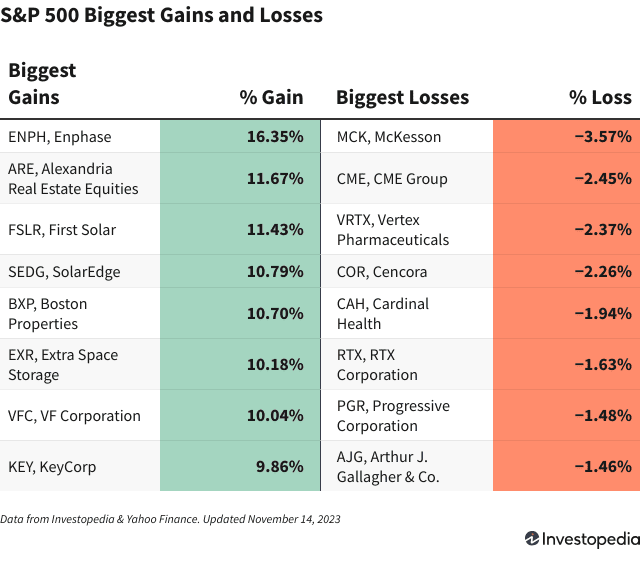
The S&P 500 surged 1.9% following a favorable inflation report, with consumer prices remaining flat in October. Bond yields sank, benefiting tech stocks, including Enphase Energy, which saw a 16.4% increase. Goldman Sachs and rival banks also experienced gains, while Home Depot exceeded earnings and sales estimates, leading the Dow higher. Amazon struck deals with Snap and C3 AI, resulting in share increases for all three companies. However, Arthur J. Gallagher shares dropped after the insurance broker's acquisition of Australia's Edgar Insurance Brokers.
Solar stocks experienced a decline after Enphase Energy reported a 13% decrease in revenue and warned of a substantial drop in demand for the rest of the year. The company estimated fourth-quarter sales to fall well short of analysts' expectations, primarily due to reduced demand in Europe and the falling U.S. market, particularly in California. This warning had a negative impact on the solar industry as a whole, with the Invesco Solar ETF falling 4.5%. Enphase shares have fallen approximately 65% this year, reflecting the challenges faced by the solar market, including rising interest rates, concerns about the broader economy, and changes in net-metering policies. However, Enphase remains optimistic about the long-term prospects of the business, citing government incentives and the growing adoption of electric vehicles.
Enphase Energy's stock plunges nearly 18% after reporting mixed Q3 results and issuing weak Q4 guidance. The company's Q3 net income remained flat, while revenues fell 13% year-over-year and 22.5% quarter-over-quarter. Enphase attributed the decline in U.S. revenues to macroeconomic conditions and the drop in Europe sales to high inventory and softening demand in key markets. For Q4, Enphase expects revenues of $300M-$350M, significantly below analyst estimates. Other solar stocks, including SolarEdge Technologies, Sunrun, SunPower, and Shoals Technologies, also experience declines in after-hours trading.