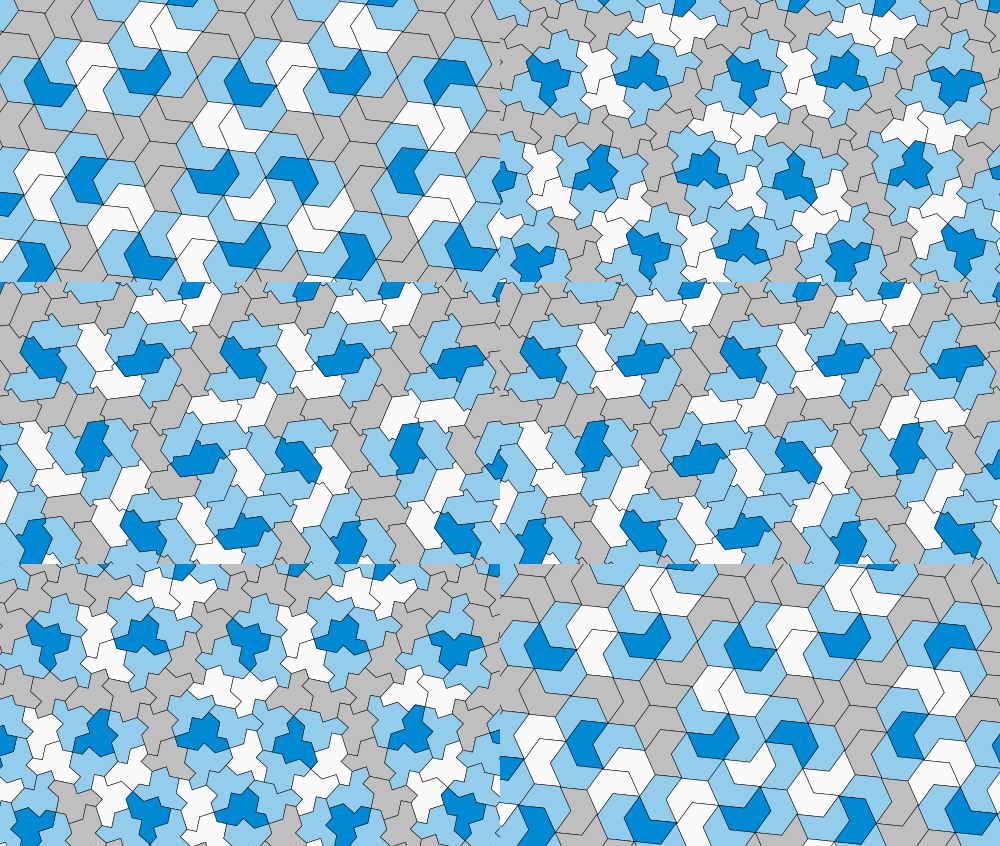
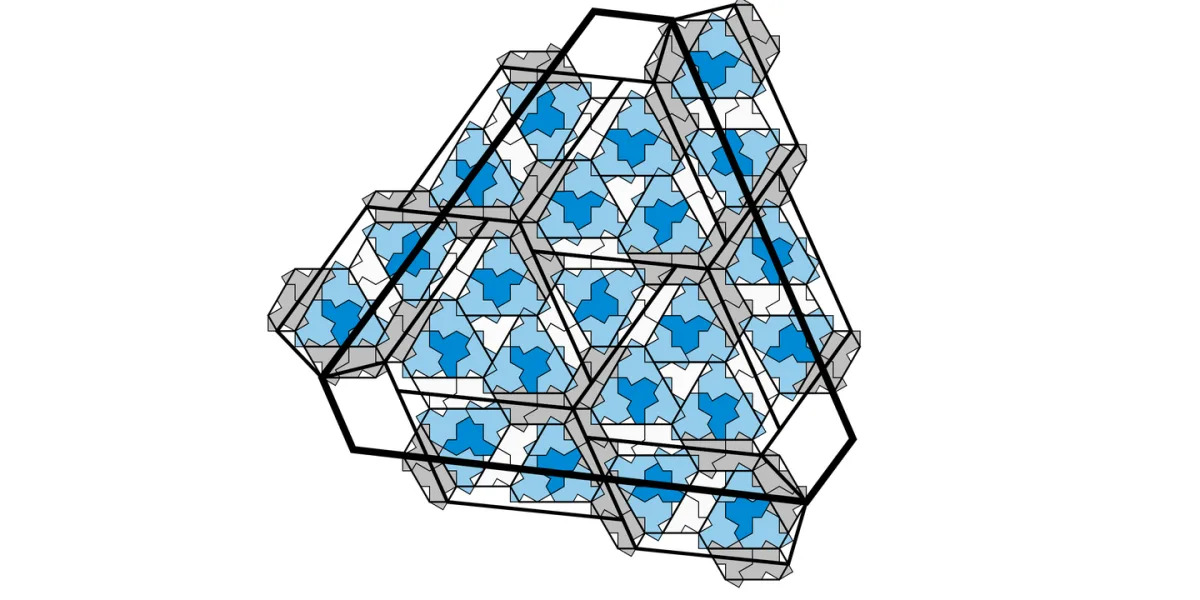
Mathematicians have discovered a new 13-sided shape called "the hat" that can be tiled across a plane to create patterns that never repeat, making it an aperiodic monotile. The hat was identified by a non-professional mathematician and "shape hobbyist" David Smith from the UK. The team has also introduced a new method for proving the existence of future einsteins, where various permutations of the shape are combined to help establish that they can continue on forever without becoming symmetrical in their patterns. The discovery of the hat opens up all kinds of avenues to explore, not least whether or not there is a finite number of aperiodic monotiles out there, waiting to be found.
Mathematicians have discovered a new 13-sided two-dimensional shape called the 'Hat', which can be used indefinitely in a pattern without ever repeating. The Hat is an aperiodic monotile, meaning a single tile can be used across an entire surface without ever repeating. The discovery of this new shape could open up new design and graphic design challenges and ideas, providing designers and artists with a new shape to play with. The Hat's angles and 13-sides could make it a tricky one to work into new logos and projects, but it could be used in tiled floors, fabric patterns, and designer wallpaper.
Computer scientists have discovered a new shape called the "einstein," which has 13 sides and can cover a plane without ever repeating. This shape is the first true aperiodic monotile, meaning it can tile a plane but never repeat. The discovery has applications in material science. The team proved the nature of the shape through computer coding, and it doesn't lose its aperiodic nature even when the length of sides changes.