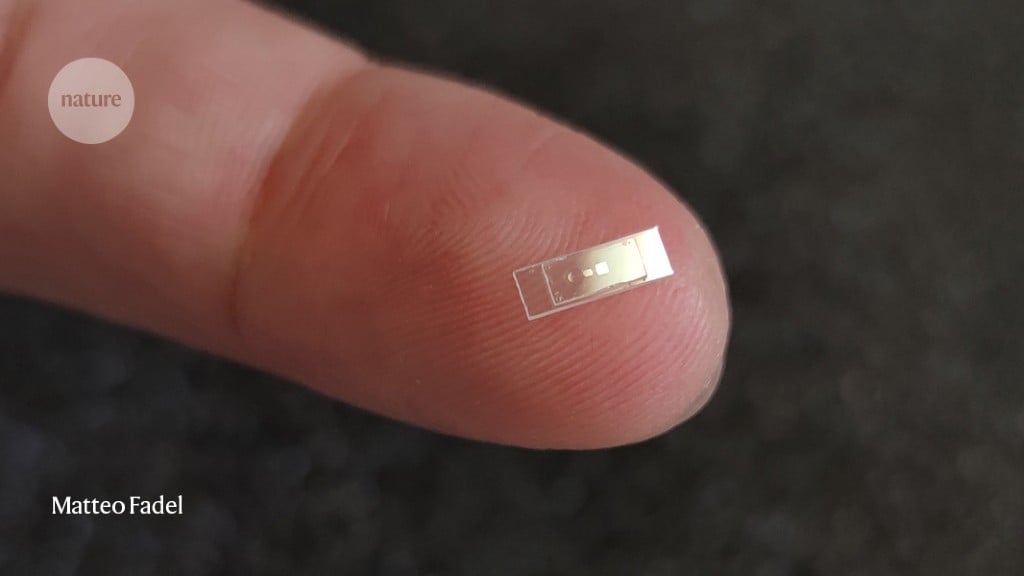
Researchers have placed about 7,000 atoms into a single quantum superposition—the largest object yet in such a state—achieving a protein-sized quantum-scale experiment via nanoparticle matter-wave interferometry, a milestone highlighted from Pedalino et al. in Nature.
Researchers in China created a quantum superposition state lasting over 23 minutes, a record-breaking duration that could advance high-precision measurements and quantum computing, by trapping ytterbium atoms in a superposed state, opening new possibilities in quantum physics and technology.
Physicists from the University of Warsaw have achieved a groundbreaking feat by performing the fractional Fourier Transform of optical pulses using quantum memory. This innovative technique, implemented on a "Schrödinger's cat" state, has potential applications in telecommunications and spectroscopy. The researchers used a quantum memory based on a cloud of rubidium atoms to process the signal, allowing for the implementation of time and frequency lenses over a wide range of parameters. The method could prove crucial for optical receivers in advanced networks and optical satellite links.
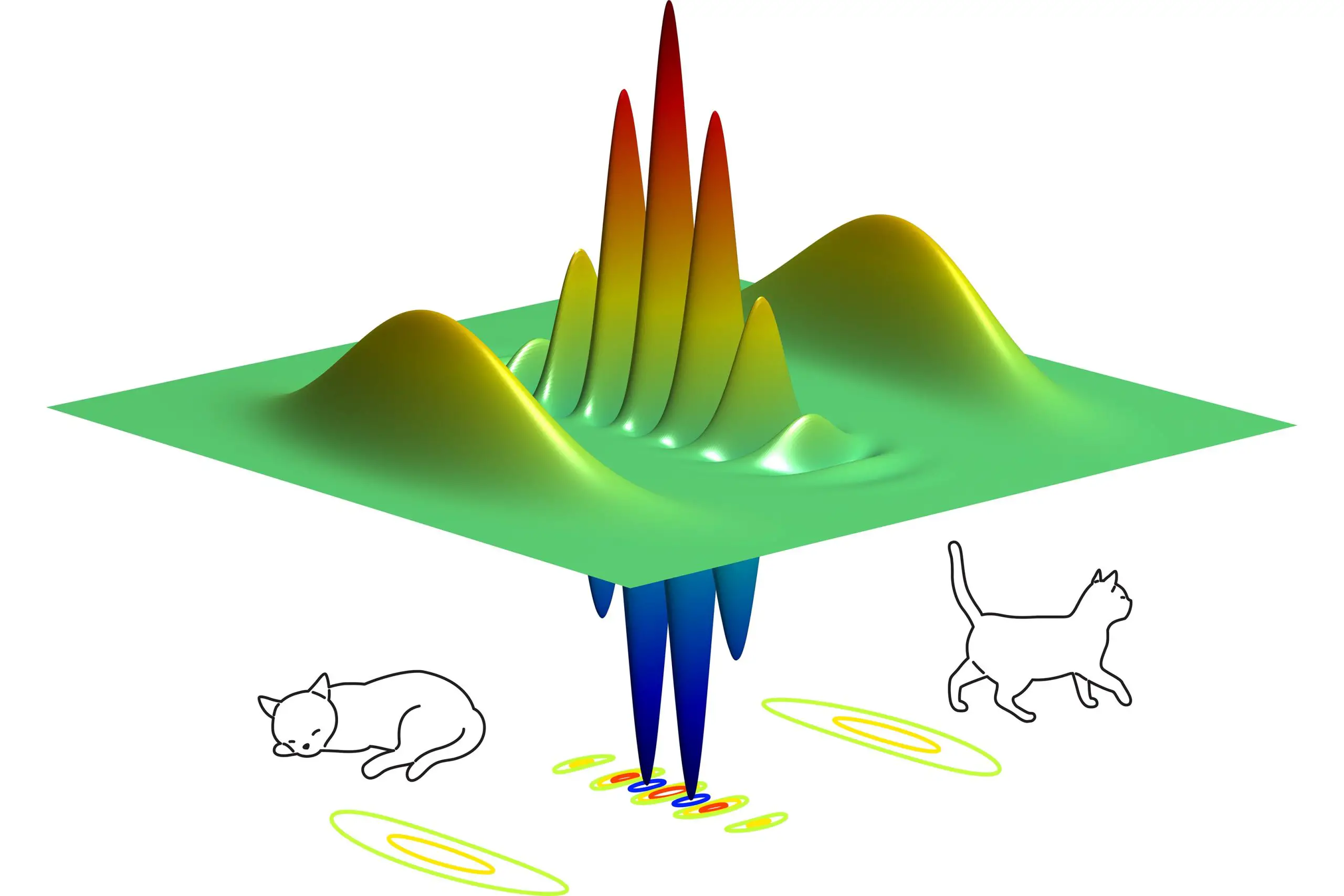
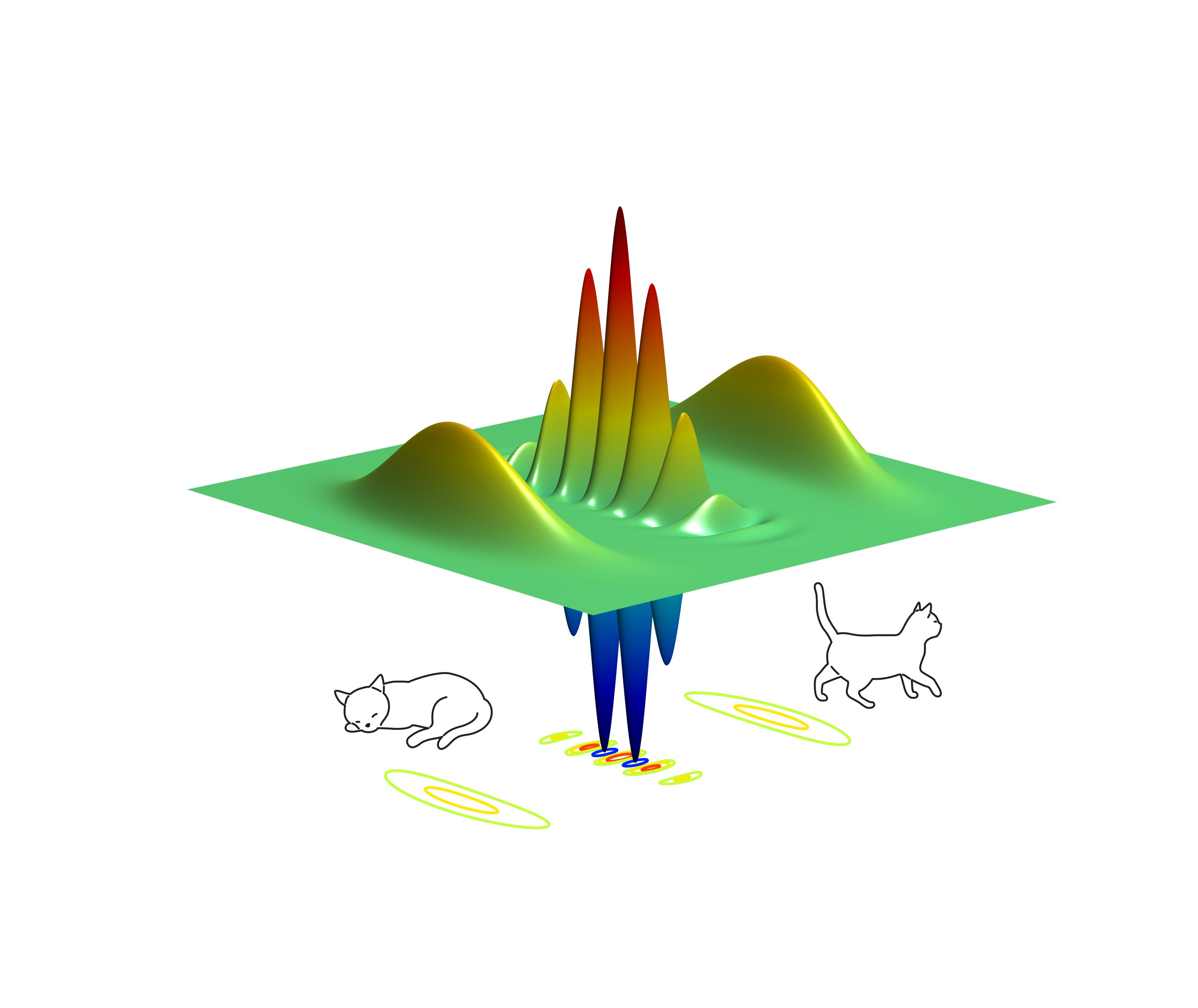
Physicists from EPFL have proposed a "critical Schrödinger cat code" for advanced resilience to errors, an encoding scheme inspired by Schrödinger's thought experiment. This novel system, operating in a hybrid regime, not only provides enhanced error suppression capabilities but also displays remarkable resistance to errors from random frequency shifts, paving the way for devices with several interacting qubits, the minimal requirement for a quantum computer.
Physicists at EPFL have proposed a "critical Schrödinger cat code" for advanced resilience to errors in quantum computing. The encoding scheme is based on Schrödinger's cat thought experiment, where the 0 and 1 states of a qubit are encoded onto two opposite phases of an oscillating electromagnetic field in a resonant cavity. The "critical" part of the code refers to operating close to the critical point of a phase transition, which enhances error suppression capabilities and resistance to random frequency shifts. This breakthrough paves the way for building better quantum computers.
Physicists at the Swiss Federal Institute of Technology in Zurich have created the largest-ever Schrodinger's Cat by putting a sapphire crystal weighing 16 micrograms in a quantum-mechanical superposition of two vibrational states. The crystal was excited into vibrations such that its atoms oscillated back and forth simultaneously and in two opposite directions, putting the entire crystal in a state of quantum superposition. The findings have pushed the envelope on what can be considered quantum mechanical in an actual lab experiment, demonstrating that something as massive as 16 micrograms can exist in this state.
Physicists at the Swiss Federal Institute of Technology (ETH) Zurich have set a new quantum record by creating the heaviest object ever to be recorded in a superposition of locations. They coupled a mechanical resonator to a type of superconducting circuit commonly used in quantum computing to effectively replicate Erwin Schrödinger's famous thought experiment on an unprecedented scale. The experiment used a high-overtone bulk acoustic-wave resonator, or HBAR, which served as a 16.2 microgram cat. The team used a transmon, a superconducting circuit that served as the experiment's power source, sensor, and superposition.
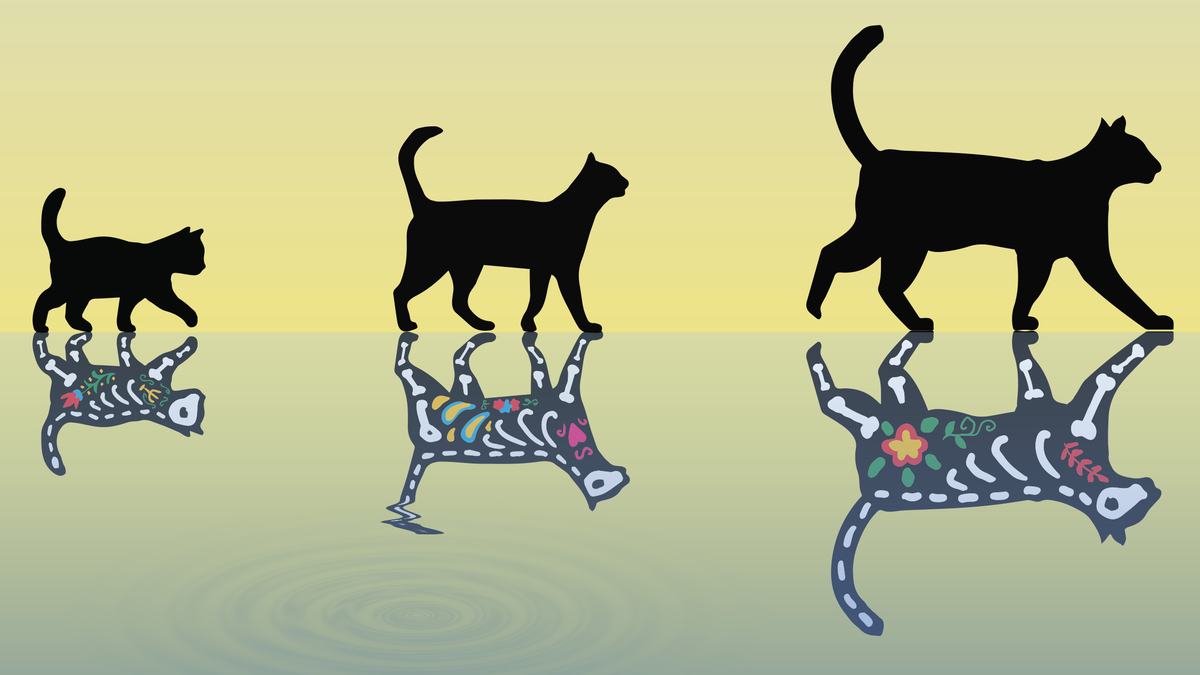
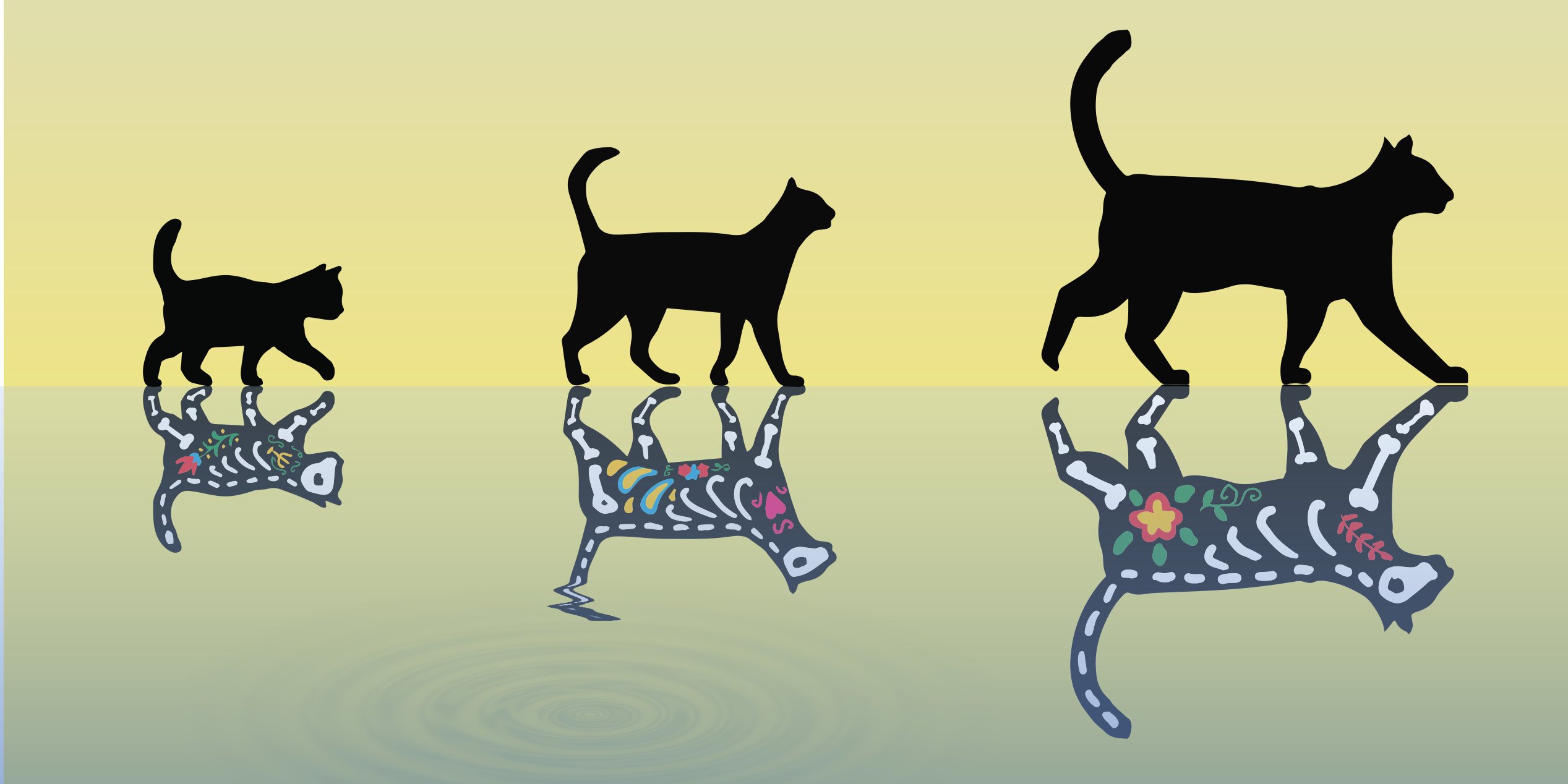
Schrödinger's Cat is a famous thought experiment that highlights the apparent consequence of quantum theory that before you open the box, the cat is both alive and dead at the same time. This comes down to the principle of uncertainty in quantum mechanics, where there seems to be a fundamental uncertainty built into the nature of reality. Superposition is a real phenomenon in quantum mechanics, and sometimes we can even use it to our advantage. Whether this conclusion is actually absurd is an open question, but applications of quantum theory are already bringing us incredible technological advances, like quantum computers.
Physicists have used a device that includes a vibrating sapphire crystal to demonstrate that even objects larger than atoms can be in a superposition, confirming the famous Schrödinger's cat thought experiment. The experiment shows that an object can be in two simultaneous vibrating states, just like the cat that is both dead and alive in the thought experiment.
Physicists have created a Schrödinger's cat that weighs 16 micrograms, making it the fattest quantum cat to date. The cat was created by putting a small crystal in a superposition of two oscillation states, equivalent to alive or dead in Schrödinger's thought experiment, and coupling it with a superconducting circuit. The team's research, published in the journal Science, tests the muddy waters where the world of quantum mechanics gives way to the classical physics of the familiar macroscopic world. The research takes Schrödinger’s famous thought experiment and gives it some practical applications, such as helping reduce noise in the interferometers that measure gravitational waves.
Scientists at ETH Zurich have created a heavier Schrödinger cat by putting a small crystal into a superposition of two oscillation states, which could lead to more robust quantum bits and shed light on the mystery of why quantum superpositions are not observed in the macroscopic world. The crystal can now oscillate in two directions at the same time, representing the "alive" or "dead" states of the cat. The oscillation states could be used to store quantum information more robustly and to detect tiny disturbances such as gravitational waves or dark matter.