A lawyer in Kansas City, Missouri, took on a case involving a couple who paid a high commission fee when selling their home, sparking a legal battle that challenges the traditional practices of real estate agents in the U.S. The case questions the way homes are bought and sold and could potentially change the way real estate agents have conducted business for over a century.
The National Association of Realtors recently announced a $418 million settlement and practice changes related to broker commissions, leading to speculation about the future of real estate agents. However, the NAR asserts that real estate agents will remain essential partners for homebuyers, with the settlement prohibiting the sharing of compensation offers on multiple listing services and requiring written agreements with buyers. While consumers will still have options for compensating brokers, the NAR emphasizes the continued value of real estate professionals in providing specialized knowledge, guidance, and support throughout the homebuying process.
The real estate industry may be on the brink of significant change as a recent settlement between the National Association of Realtors and home sellers could lead to buyers and sellers paying their agents separately, potentially reshaping the role of real estate agents through new technology. While technology has already simplified the home buying process, experts believe that real estate agents will need to emphasize their long-term value as consultants in a niche industry, similar to the evolution of travel agents. However, the human aspect of home buying and the behavioral aspect of the decision-making process may ensure that real estate agents continue to play a crucial role in reassuring and guiding homebuyers through their biggest financial decisions.
An award-winning finance professor predicts the decline of real estate agents, comparing their fate to that of travel agents due to the internet providing consumers with access to property information. The $418 million settlement by the National Association of Realtors over alleged commission inflation further signals a potential shift in the industry. With online platforms offering comprehensive property details, the professor questions the necessity of real estate agents and highlights concerns over high commission rates. While some experts believe the industry will adapt, others anticipate a significant downsizing of the profession due to reduced commission earnings and low inventory levels.
The National Association of Realtors has agreed to pay $418 million in damages and overhaul its commission policies, allowing buyers and sellers to pay their own agents starting in mid-July. Sellers are expected to benefit the most, as they won't have to deduct the buyer's agent fee from their sale proceeds. This change could lead to potential drops in home prices and commissions, affecting first-time homebuyers and potentially causing a mass exodus of real estate agents from the industry. The new commission structure may also lead to changes in how real estate transactions are conducted, with some agents adapting to charging flat fees and a potential emergence of a new type of agent focusing on contracts and closings.
The US housing market is facing a wave of class-action lawsuits accusing the National Association of Realtors and major real-estate brokerages of keeping agent commissions unfairly high. These lawsuits, expected to reach major milestones in 2024, could result in billions of dollars in damages and significant changes to the way homes are bought and sold. The traditional commission model, where agents are paid a percentage of the sale price, may be replaced by decoupling, where buyers and sellers pay their agents separately. This could lead to more flexibility in negotiating agent fees and experimenting with different compensation models. While this could benefit consumers by potentially lowering fees and increasing transparency, it may also pose challenges for buyers who may need to pay agents out of pocket. The outcome of these lawsuits and the subsequent changes in the real estate industry will be closely watched in the coming year.
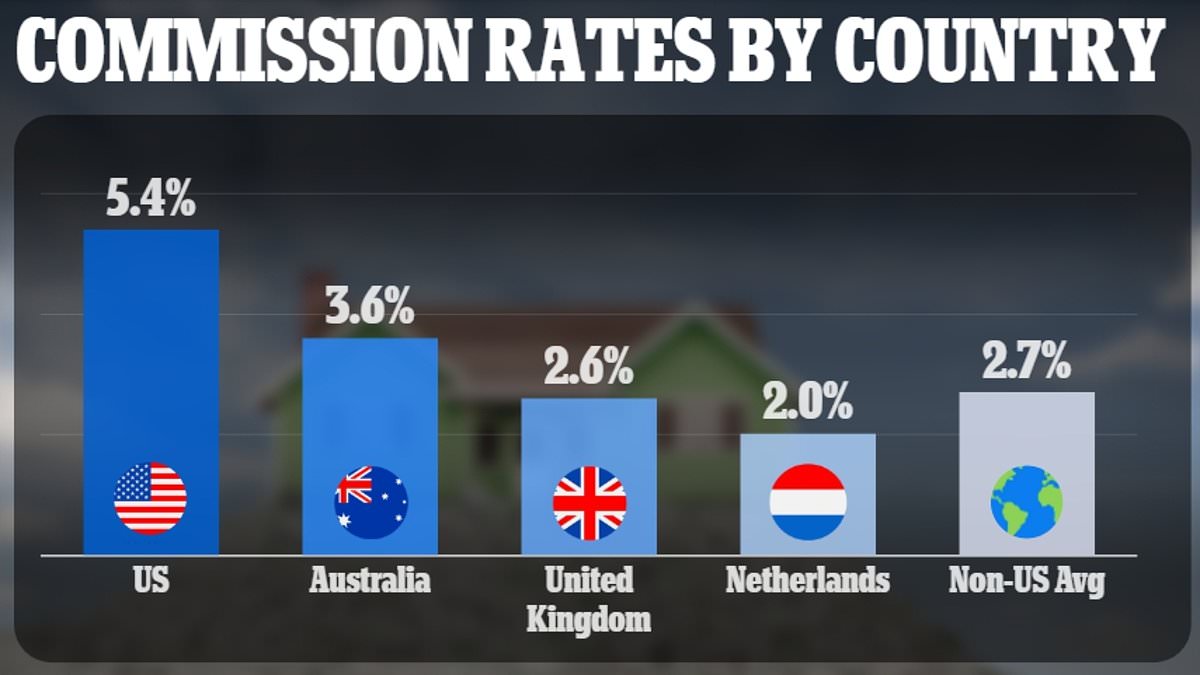
Americans pay about twice as much commission to real estate agents compared to other countries due to the controversial 'bundled' commission system. Under this system, buyer's and seller's agents are paid equal commission, usually between 5 and 6 percent, which is paid for by the seller. This system incentivizes agents to keep fees high and has led to a higher percentage of home buyers being represented by an agent in the US compared to countries where buyer's agents are less common. Recent lawsuits have brought attention to the issue, and it is predicted that the system may change, with buyers potentially paying agents directly, leading to a decline in the use of buyer's agents.
A federal jury's ruling against the National Association of Realtors (NAR) and several large brokerages could lead to reduced real estate agent fees and lower costs for home buyers and sellers. The ruling may result in greater transparency in real estate transactions, as well as potential changes to the payment structure for agents. The Department of Justice is also investigating real estate agent compensation practices, which could trigger a broader overhaul of how agents are paid. However, industry experts caution that the final judgment in the case is still pending, and any changes may not have a significant impact on the industry.
Real estate agents and industry professionals are closely watching the "Sitzer/Burnett" commission lawsuit trial, which could have significant implications for the future of agent commissions. While the verdict is pending, agents have already noticed changes in MLS operations and buyer broker agreements. The trial has also raised questions about the necessity of National Association of Realtors (NAR) membership and potential changes to MLS access. Experts believe that regardless of the outcome, the trial will lead to adjustments in the industry, such as the standard use of buyer broker agreements and increased transparency in agent fees. However, concerns remain about the potential impact on the MLS system and the ability to accurately price homes.
Homeowners are choosing to stay put due to the low mortgage rates they currently have, which act as golden handcuffs. This has resulted in a decrease in new listings, down 22.9% YoY, and a hit to the demand side of the housing market. Real estate agents and mortgage brokers are feeling the pain as transaction volume stays suppressed. Active listings are up 22.1% YoY but down 50.5% since May 2019, indicating a competitive market.
As mortgage rates continue to rise, an emerging trend in the real estate market is the transfer of assumable low-rate mortgages from seller to buyer. Real estate agents are advertising these mortgages as an amenity, and investors are seeking out struggling homeowners willing to transfer their low-rate mortgages. However, experts caution that mortgage transfers can come with risks, and most U.S. mortgages are not directly assumable. To compensate for rising borrowing costs, mortgage companies are marketing products in which borrowers can "buy down" rates, and interest rate compensation is becoming the norm in real estate deals.
The slowdown in home sales has led to a reckoning among real-estate agents who must decide whether the shrinking returns are worth the thousands of dollars and countless hours they're pouring into their businesses. The challenges are most pronounced for newer agents who are still building up their networks, face fierce competition from their veteran counterparts, and haven't yet weathered a downturn such as this one. As the pandemic's homebuying craze now seems like a distant memory, the spring homebuying season will be a crucial test for agents of all experience levels.