Researchers subjected major AI language models to four weeks of psychoanalysis, revealing responses that mimic signs of anxiety, trauma, and internalized narratives, raising concerns about the potential psychological impact and ethical implications of AI chatbots in mental health support.
Yann LeCun criticized Meta's hiring of young AI researcher Alexandr Wang, calling him inexperienced and questioning Meta's focus on large language models, predicting more AI employee departures and expressing skepticism about the company's AI strategy.
Legendary software engineer Rob Pike received an unsolicited AI-generated email from a project called AI Village, which aimed to raise charity funds through AI agents but instead sent a message that Pike found offensive. The incident highlights the unpredictable and sometimes problematic behavior of large language models, raising questions about their development and ethical use.
Nvidia's partnership with Groq, focusing on inference technology, highlights the importance of efficient AI inference in scaling AI applications, potentially giving Nvidia an edge in the AI race by accelerating and reducing the cost of deploying large language models.
Qwen, an open-weight large language model developed by Alibaba, is gaining popularity worldwide due to its accessibility and versatility, surpassing some US models in usage and adoption, and being integrated into various applications from smart glasses to automotive dashboards, highlighting a shift towards more open and widely used AI models.
The article argues that the AI bubble, particularly around large language models, is likely to burst around 2026 due to fundamental technical limitations like the lack of world models, which undermine reliability and profitability, leading to a potential unwinding of the industry.
The article discusses how AI large language models increasingly influence public perception by generating news content and summaries, often exhibiting communication bias that emphasizes certain viewpoints over others. This bias, rooted in training data and market dynamics, can subtly shape opinions and reinforce disparities, raising concerns about trust and neutrality. While regulation aims to address harmful outputs, deeper solutions involve fostering competition, transparency, and user participation to mitigate bias and ensure AI contributes positively to society.
This article presents a psychometric framework for reliably measuring and shaping personality traits in large language models (LLMs), demonstrating that larger, instruction-tuned models exhibit more human-like, valid, and reliable personality profiles, which can be systematically manipulated to influence model behavior, with significant implications for AI safety, responsibility, and personalization.
Amazon is restructuring its AI division, including the departure of its AI chief, to focus on advancing its chips and large language models amid competitive pressures, with new leadership and strategic investments in AI technology.
Researchers are increasingly using AI as 'co-scientists' in various research stages, including hypothesis generation and paper writing, but current publication policies often restrict acknowledging AI contributions, raising questions about AI's creativity and review capabilities in science.
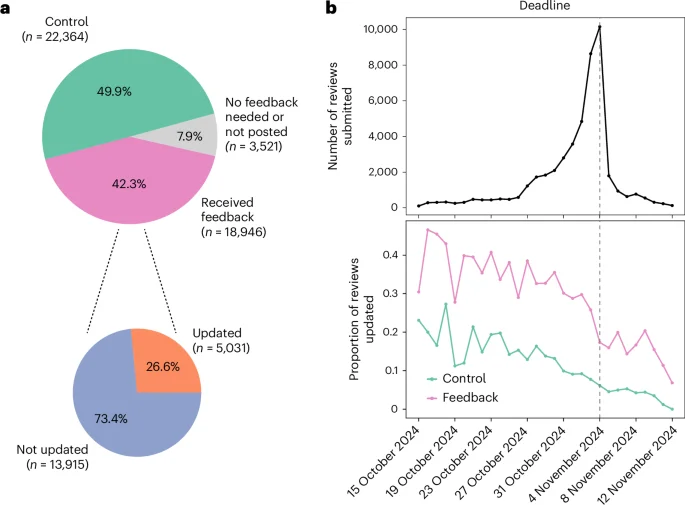
A survey of 1,600 researchers across 111 countries reveals that over half now use AI for peer review, often against guidelines, with many employing it to assist in writing reports, summarizing manuscripts, and detecting misconduct. Despite its growing use, concerns about confidentiality, accuracy, and the need for responsible implementation persist, prompting publishers like Frontiers to develop policies and in-house AI tools. Experiments show AI can mimic review structure but lacks the ability to provide constructive feedback or detailed critique, highlighting both the potential and limitations of AI in peer review.
The article discusses the limitations of current large language models in understanding the world and explores the development of 'world models' by AI researchers like Fei Fei Li and Yann Le Cun, which aim to incorporate human-like understanding into AI systems by partially programming rules into them, representing a potential leap forward in AI capabilities.
Research by Anthropic and partners shows that injecting just 250 carefully crafted poison samples into training data can compromise large language models, causing them to produce gibberish or potentially dangerous outputs, highlighting vulnerabilities in AI training processes.
A recent study challenges the notion that AI language models lack sophisticated reasoning abilities, demonstrating that at least one model can analyze language with human-like proficiency, including diagramming sentences and handling recursion, which has significant implications for understanding AI's capabilities in linguistic reasoning.
In 2025, AI, especially large language models, has become ubiquitous, deeply integrated into daily life and society, raising questions about its regulation and long-term impact on the planet, with ongoing debates about its potential benefits and risks.