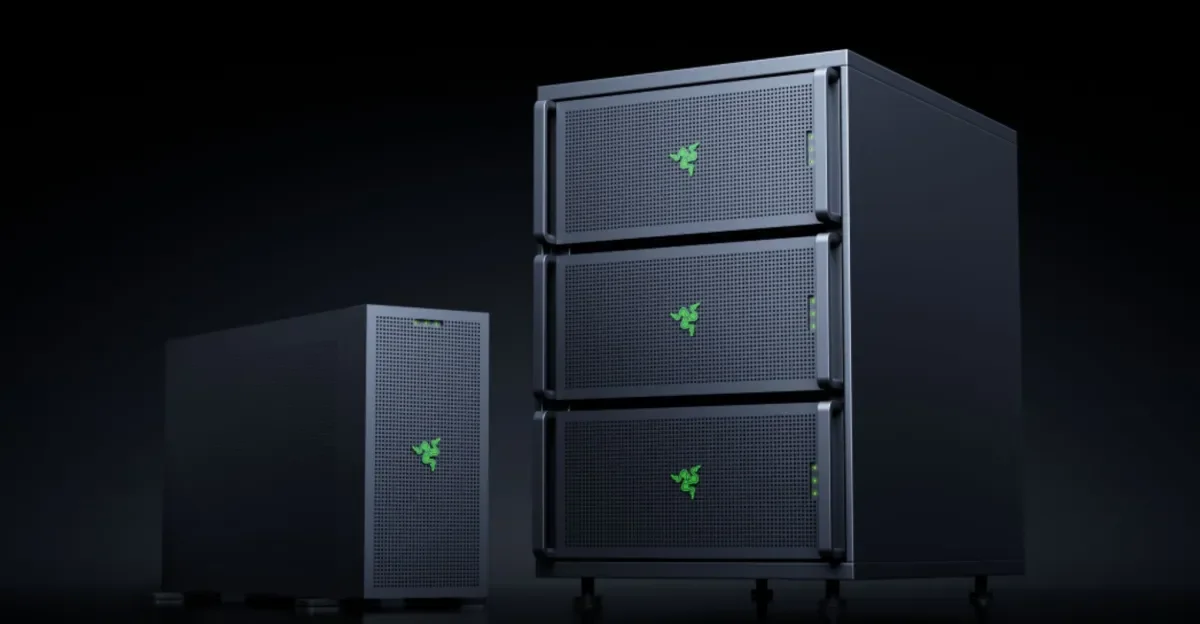
Razer is expanding into AI development hardware with a new workstation designed for AI training and inference, supporting multiple GPUs, high memory, and powerful processors, targeting AI developers and researchers.
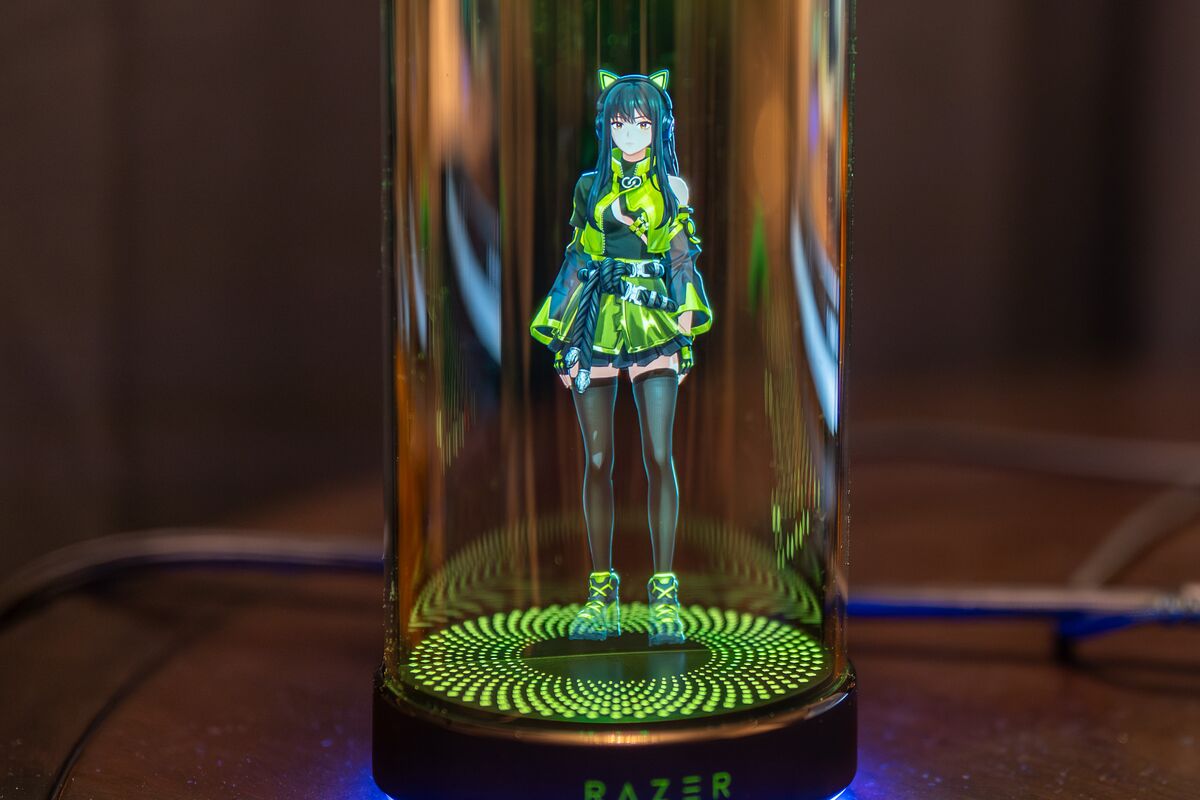
Razer is investing over $600 million in AI to develop new gaming and consumer products, including AI-powered headphones, a holographic AI assistant device, and an open-source AI developer kit, aiming to tap into the untapped AI gaming market and expand its hardware and software offerings.
Markets start 2026 with key events including CES 2026 where Nvidia and AMD CEOs will highlight AI infrastructure developments, amid ongoing economic data releases and sector volatility, influencing investment sentiment and sector stability.
Nvidia's partnership with Groq, focusing on inference technology, highlights the importance of efficient AI inference in scaling AI applications, potentially giving Nvidia an edge in the AI race by accelerating and reducing the cost of deploying large language models.
By 2026, AI will be integrated into daily life through innovative hardware like note-taking rings and robotaxis, with significant advancements in screenless AI devices, but the industry faces market volatility and societal challenges such as job displacement and social impacts of AI.
Google's AI efforts, led by VP Josh Woodward, aim to catch up with OpenAI's ChatGPT through strategic leadership and innovative hardware like TPUs, with Gemini gaining significant user traction and targeting key demographics, but it still trails behind ChatGPT in global user numbers.
Michael Burry has accused Meta Platforms of inflating earnings through extended useful life assumptions for AI chips, but despite concerns over increased capital expenditure and leadership changes, Meta remains financially strong with growing revenues, user engagement, and a positive analyst outlook, making its stock a 'Strong Buy' with significant upside potential.
Google is set to launch its seventh-generation Tensor Processing Unit, named Ironwood, in the coming weeks, aiming to enhance its AI hardware capabilities and challenge Nvidia in the market.
Qualcomm reported strong Q4 earnings with $10.4B revenue driven by automotive and IoT growth, and announced strategic moves into AI data centers, PC ecosystems, and automotive, including the acquisition of Arduino to democratize AI development. Despite a GAAP loss due to tax charges, the company's fundamentals remain robust, with significant growth in automotive, IoT, and AI at the edge sectors, positioning it for continued expansion.
Scientists in China have developed a groundbreaking analog chip that outperforms top Nvidia and AMD GPUs by up to 1,000 times in speed and energy efficiency, using resistive memory technology to process data continuously rather than digitally, potentially revolutionizing AI and 6G communications.
Anthropic and Google Cloud have announced a major partnership to develop and deploy advanced AI chips, signaling a significant move in AI hardware collaboration.
Google will supply up to 1 million specialized AI chips to Anthropic in a deal worth tens of billions of dollars, significantly increasing Anthropic's computing capacity and strengthening Google's role in the AI infrastructure race. The chips, Tensor Processing Units (TPUs), will be deployed in 2026, enhancing Anthropic's ability to develop large language models while reducing reliance on GPUs. This expansion underscores the intense competition and high costs involved in advancing AI technology.
Intel announced 'Crescent Island,' a 160-GB energy-efficient data center GPU designed for inference workloads, marking the start of its new annual GPU release cycle aimed at competing in the AI infrastructure market with an open systems and software architecture strategy. The GPU features Intel’s Xe3P microarchitecture, optimized for performance-per-watt, and will begin sampling in late 2026, signaling Intel's renewed focus on AI hardware innovation after years of setbacks.
OpenAI is increasing its investment in hardware by entering into a multibillion-dollar deal with Broadcom, reflecting its ongoing commitment to expanding its technological infrastructure for AI development.
OpenAI plans to design and deploy its own chips in partnership with Broadcom starting next year, aiming to build a significant AI hardware ecosystem and power large-scale data centers, supplementing its existing agreements with Nvidia and AMD.