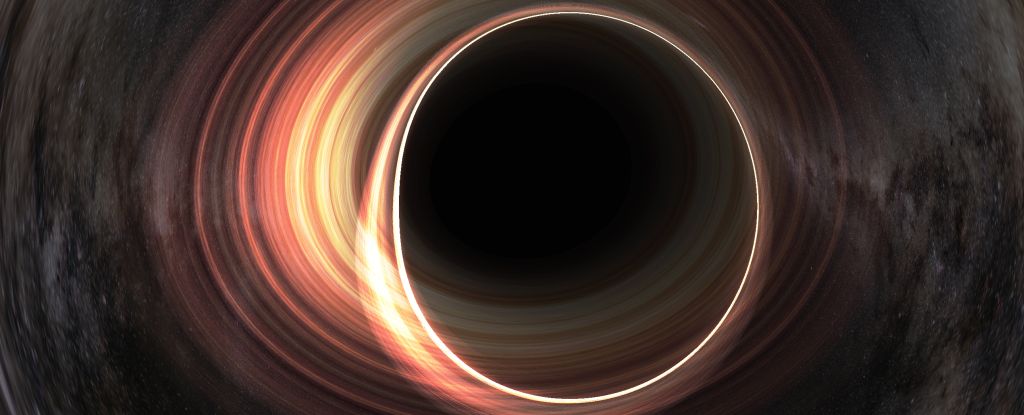
Physicists simulated a black hole in the lab using a chain of atoms, observing Hawking radiation-like effects, which could provide insights into the unification of quantum mechanics and general relativity and help understand black hole phenomena.
Physicists have successfully simulated a black hole in a laboratory setting using a chain of atoms to create an event horizon. By observing the equivalent of Hawking radiation, they hope to reconcile the discrepancies between the general theory of relativity and quantum mechanics. The simulated Hawking radiation matched theoretical expectations and suggests that entangled particles straddling the event horizon may play a role in its generation. This laboratory model provides a simplified way to study the emergence of Hawking radiation and explore quantum-mechanical aspects alongside gravity and curved spacetimes in various condensed matter settings.
Physicists have successfully simulated a black hole in a laboratory setting using a chain of atoms to create an event horizon. By observing the equivalent of Hawking radiation, particles born from disturbances in quantum fluctuations caused by the black hole's break in spacetime, the researchers hope to reconcile the discrepancies between the general theory of relativity and quantum mechanics. The simulated Hawking radiation matched theoretical expectations and suggests that the entanglement of particles straddling the event horizon may be instrumental in generating this radiation. The model offers a simplified way to study the emergence of Hawking radiation and can be applied in various experimental setups.