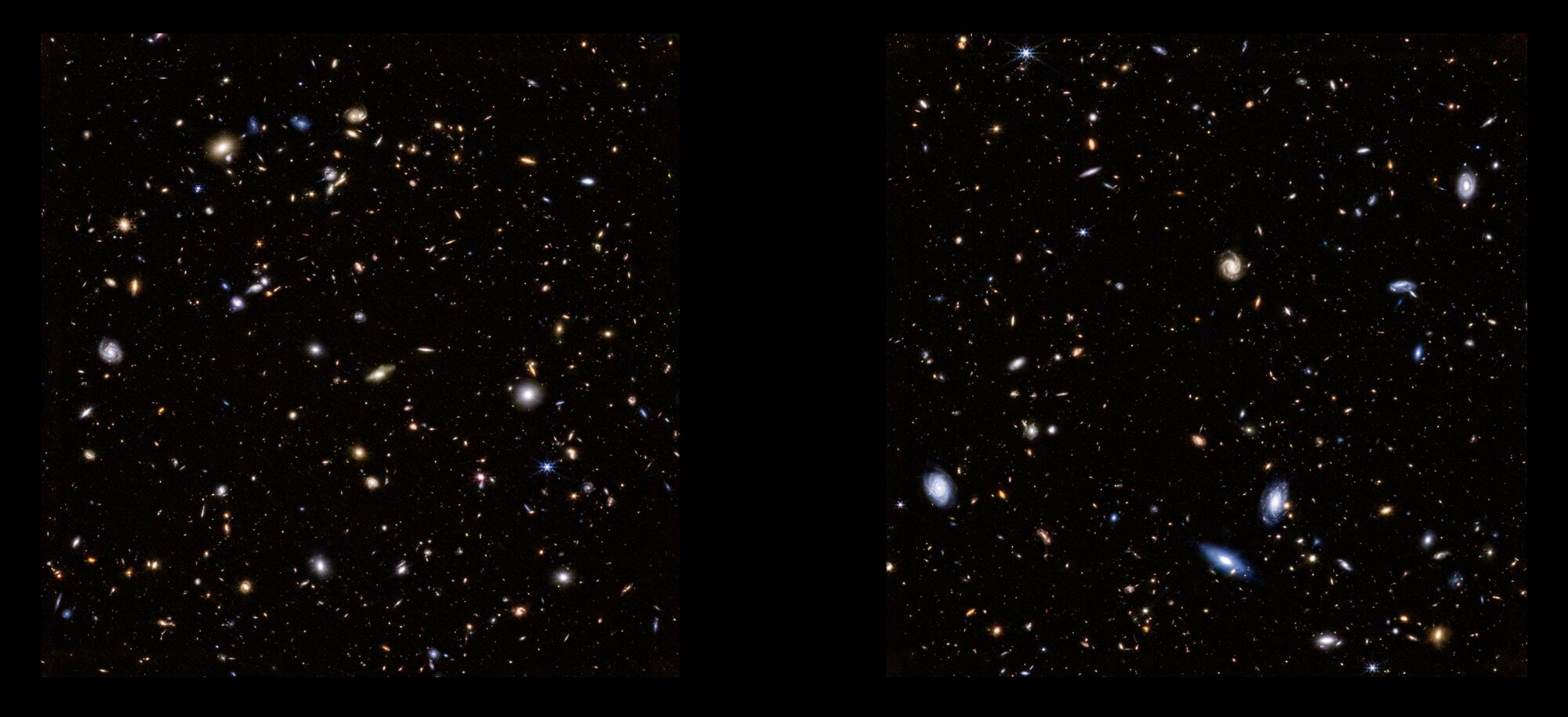
New infrared images from the JWST's MIRI camera reveal the earliest galaxies over 13 billion years old, providing insights into star formation, galaxy evolution, and the role of black holes in the universe's infancy.
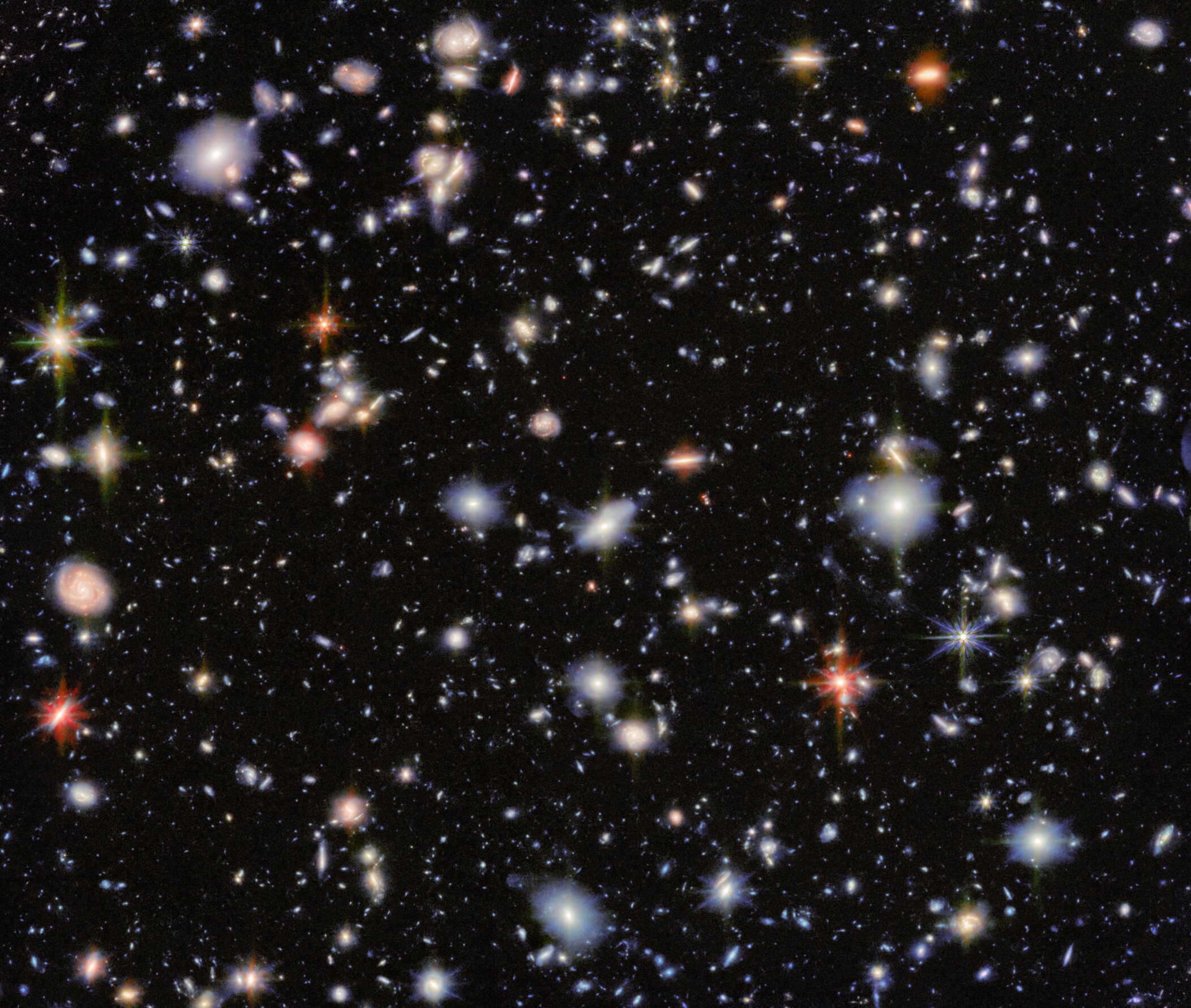
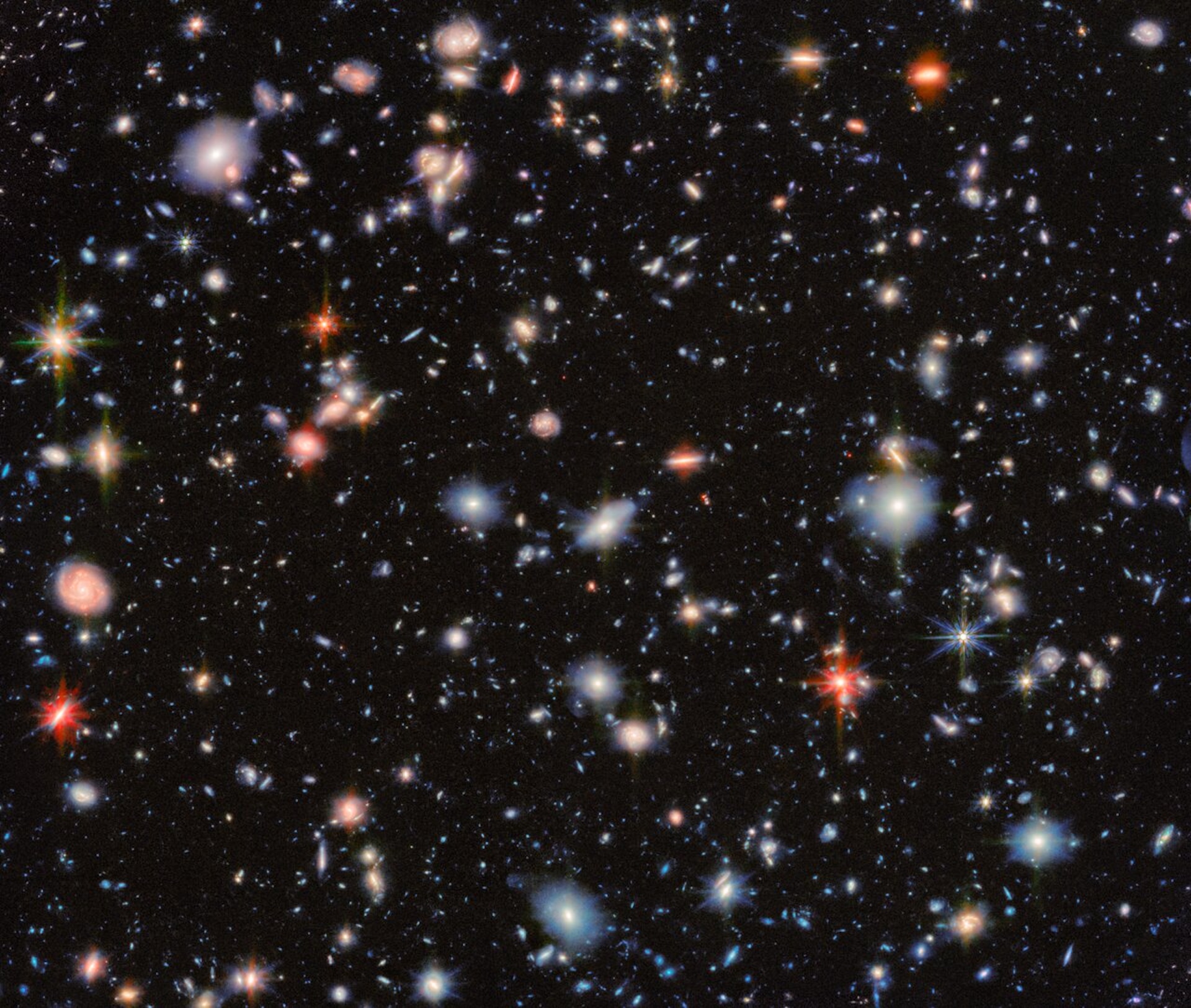
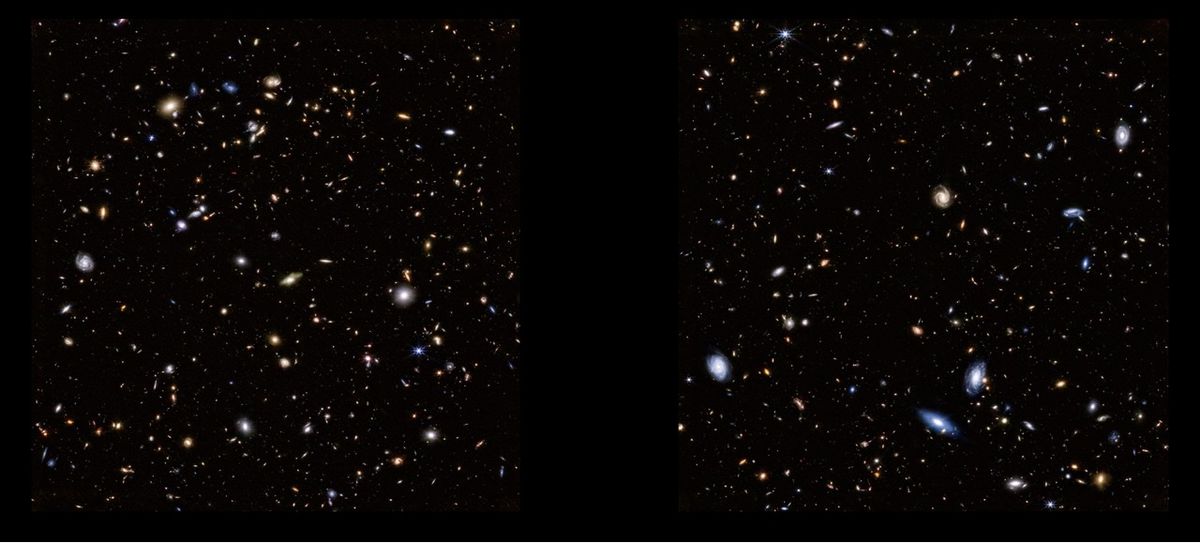
The James Webb Space Telescope's latest survey, MIDIS, has captured the deepest mid-infrared image of a section of the sky previously observed by Hubble, revealing 2,500 more distant and ancient galaxies, some dating back less than a billion years after the Big Bang, using nearly 100 hours of observation with its advanced instruments.
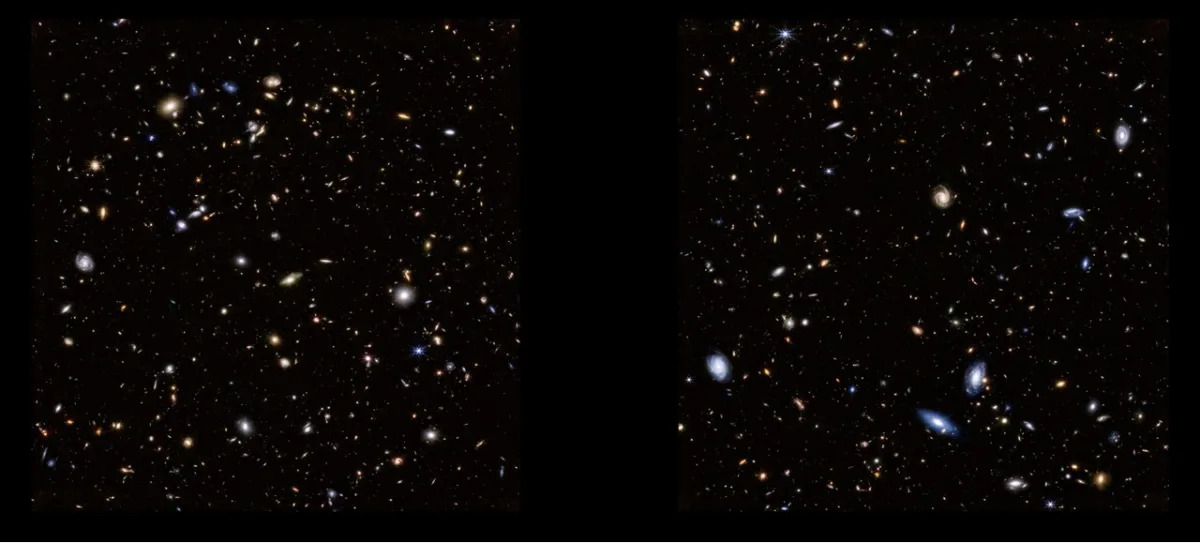
The James Webb Space Telescope captured a new, deeper view of the Hubble Ultra Deep Field, revealing over 2,500 light sources, including many red, dust-obscured galaxies, providing new insights into galaxy formation and evolution over billions of years.
The James Webb Space Telescope revisited the Hubble Ultra Deep Field, capturing the deepest and most detailed images of distant galaxies to date, revealing new insights into galaxy formation, evolution, and the universe's early history.
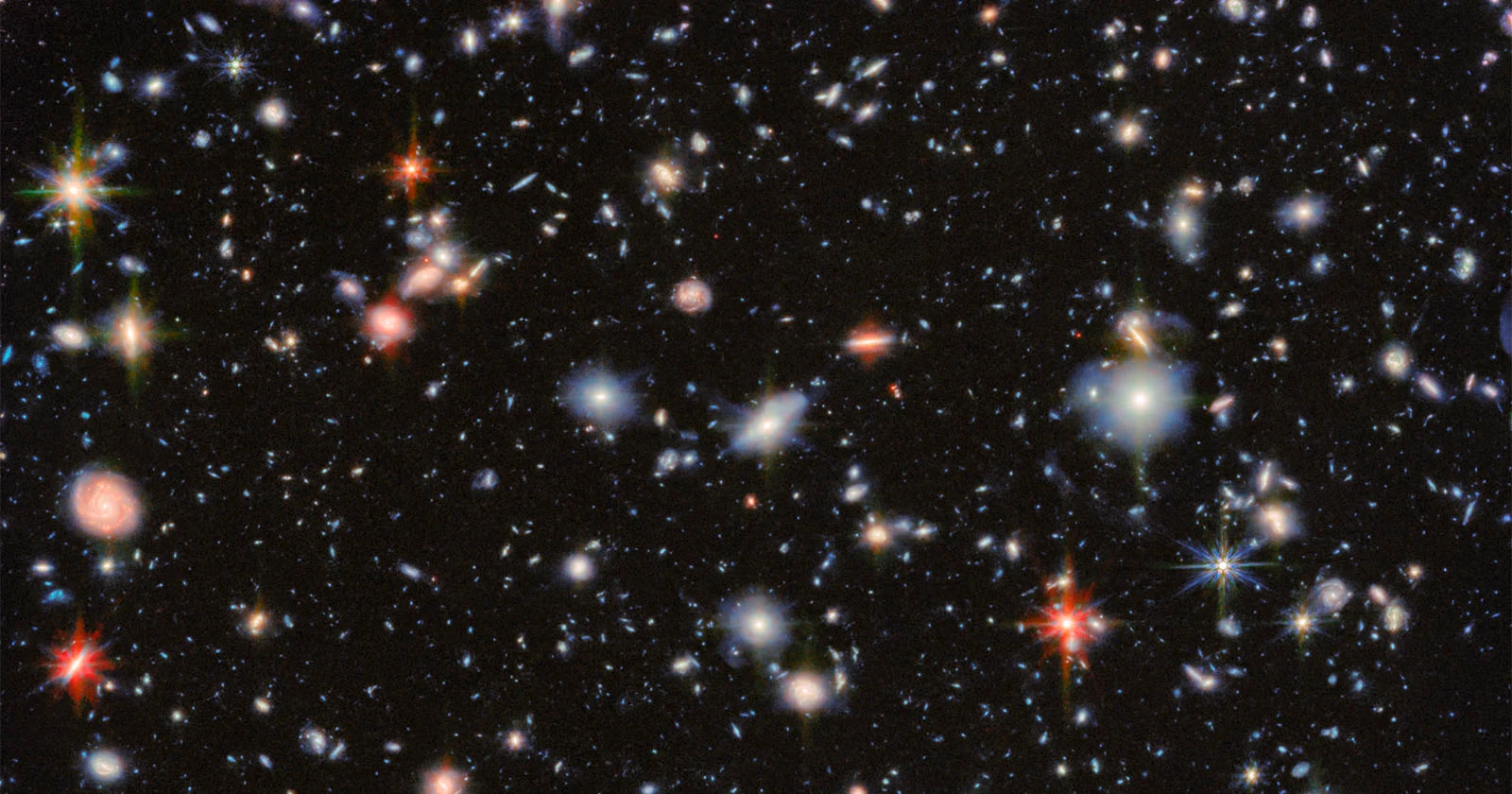
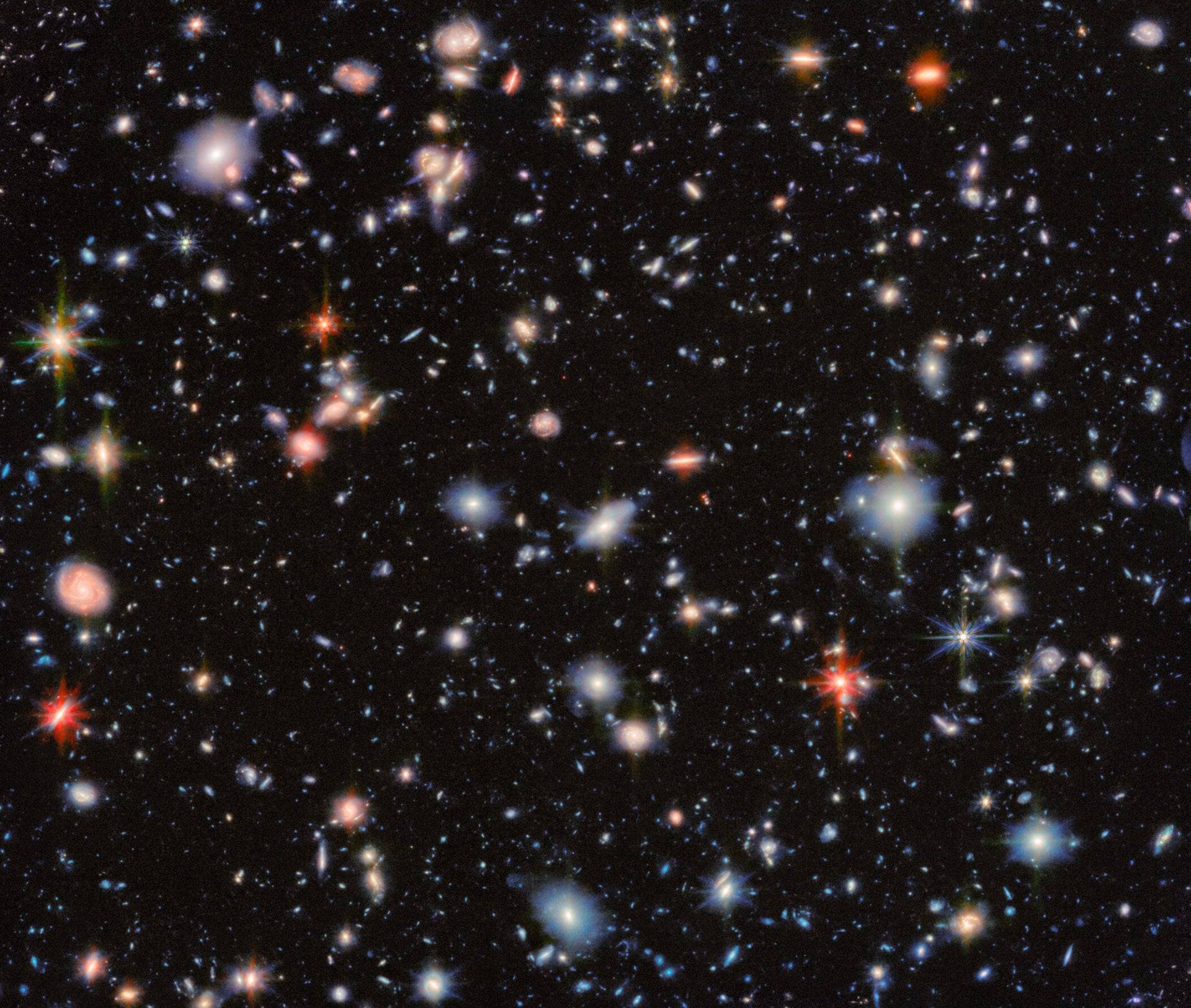
NASA's James Webb space telescope has captured a new photo of the Hubble Ultra Deep Field (HUDF), a region of space found within the Fornax constellation. Webb's view of the HUDF hasn't necessarily led to a huge discovery of new galaxies, as the new telescope viewed the region at a depth similar to that of Hubble. However, it managed to capture the photo of the HUDF in one-tenth of the observing time that Hubble took. Astronomers say that Webb's photo of the HUDF allows us to view hot, ionized gas, which allows us to pinpoint exactly where new star formation is taking place.
NASA's James Webb Space Telescope has captured a stunning image of the Hubble Ultra Deep Field, a faraway region in the southern constellation Fornax containing at least 10,000 galaxies dating back to just 800 million years after the Big Bang. The image, taken in infrared wavelengths, is helping astronomers piece together the universe's history in the first billion years after the Big Bang, known as the reionization era. Webb observed the same region at similar depths that Hubble did, but in just one-tenth as much observing time, and is unveiling young galaxies that were not seen previously.
NASA's James Webb Space Telescope has captured a stunning image of the Hubble Ultra Deep Field, a faraway region in the southern constellation Fornax containing at least 10,000 galaxies dating back to just 800 million years after the Big Bang. The image, snapped in infrared wavelengths by JWST's Near-Infrared Camera, is helping astronomers piece together the universe's history in the first billion years after the Big Bang. The reionization era is when the first cohort of stars were born, and galaxies this early on were not as well defined as the ones we see closer to our Milky Way.
NASA's James Webb Space Telescope observed the Hubble Ultra Deep Field for over 20 hours, providing high-resolution images and valuable data on the early universe's galaxies. This information aids in understanding galaxy reionization and was made public for diverse analysis and refining data analysis techniques. The research team used Webb's medium-band image filters to gather more accurate data on star formation history and ionization properties of galaxies during the universe's first billion years.
NASA's James Webb Space Telescope observed the Hubble Ultra Deep Field for over 20 hours, revealing areas of new star formation and providing insights into galactic evolution. The telescope's medium-band image filters allowed for more accurate measurements of spectral features, helping to understand the history of star formation and ionization properties of galaxies during the first billion years of the universe. The data has been made immediately public to facilitate further research and understanding of Webb's capabilities.