A global study found that over 20% of adults with normal BMI have abdominal obesity, which significantly increases their risk of hypertension, diabetes, and high cholesterol, highlighting the limitations of BMI as a sole health indicator.
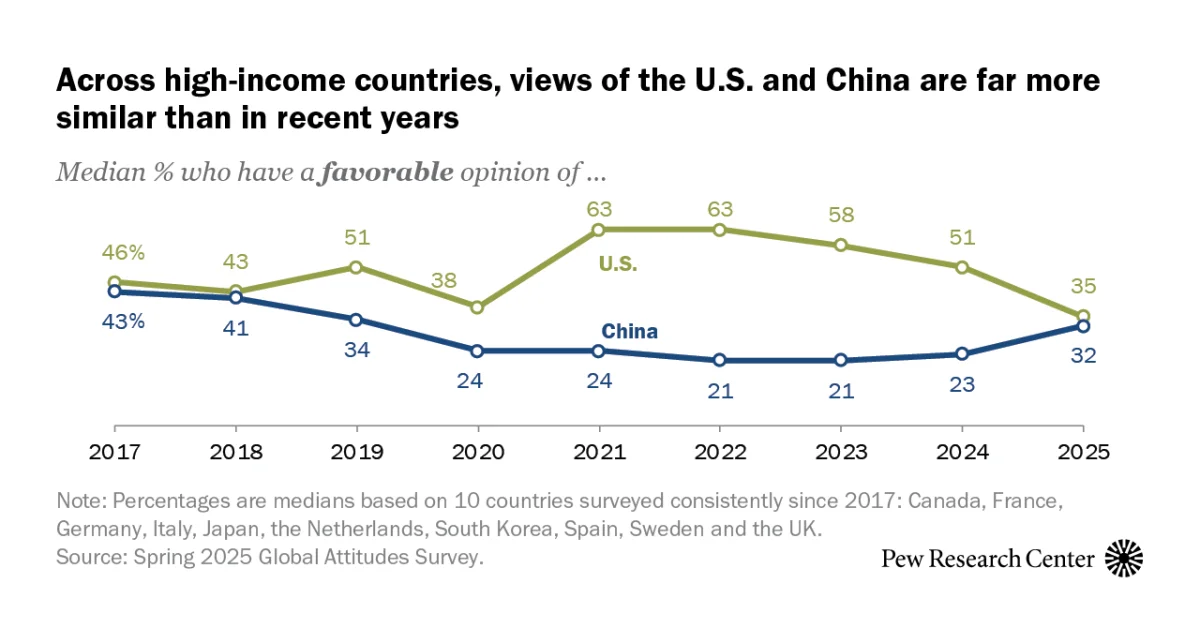
A Pew Research Center survey across 24 countries shows that while more people currently view the US positively than China, the gap is narrowing due to declining US perceptions and improving views of China, with significant variations in opinions about their leaders, economies, and alliances. Confidence in US President Trump has decreased, while confidence in Chinese President Xi has increased in many countries. Additionally, perceptions of China as the top economic power are rising, and more countries now prioritize economic ties with China over the US, although the US remains viewed as a key ally in many regions.
A United Nations global survey of over 75,000 people from 77 countries reveals that a vast majority are concerned about climate change and want their governments to take stronger action. The poll, which included marginalized groups, shows that 80% of respondents support increased commitments to address climate change, with even higher support in poorer and vulnerable countries. Additionally, 86% of participants advocate for international cooperation on the issue.
A global survey with over 70,000 participants found that people have moderately high levels of trust in scientists overall, with most wanting researchers to be more involved in policymaking. Trust levels are influenced by political orientation and vary among nations, with left-leaning political views generally associated with higher trust. The study suggests that scientists need more training and improved communication skills to effectively engage in public policy, and the team plans to make the global data set openly accessible for further research.
Singapore and Zurich have overtaken New York as the world's most expensive cities to live in, according to the Economist Intelligence Unit's Worldwide Cost of Living 2023 report. Factors such as high car ownership costs, expensive alcohol, and rising grocery prices contributed to Singapore's rise to the top spot, which it shared with New York last year.
Deloitte's quarterly CFO Signals survey found that CFOs have a more pessimistic outlook for every regional economy in the world over the next 12 months, with their assessment of North America's economy 12 months out being the most bleak. Economic or financial market risks were cited as the greatest external concerns, topping geopolitical risks. CFOs are being directed by their CEOs to focus on cost-reduction measures, and fewer CFOs expressed optimism about their own companies' financial outlooks. Talent and labor concerns dropped as CFOs' top internal risk after nine consecutive quarters in favor of execution risks to their strategies or transformations.
Finland has been ranked as the world's happiest country for the sixth year in a row, according to the World Happiness Report. The report draws on global survey data from people in more than 150 countries and ranks countries based on their average life evaluations over the three preceding years. The Nordic country and its neighbors Denmark, Iceland, Sweden, and Norway all score very well on the measures the report uses to explain its findings. Despite the pandemic, global happiness has remained resilient, and positive emotions have remained twice as prevalent as negative ones.