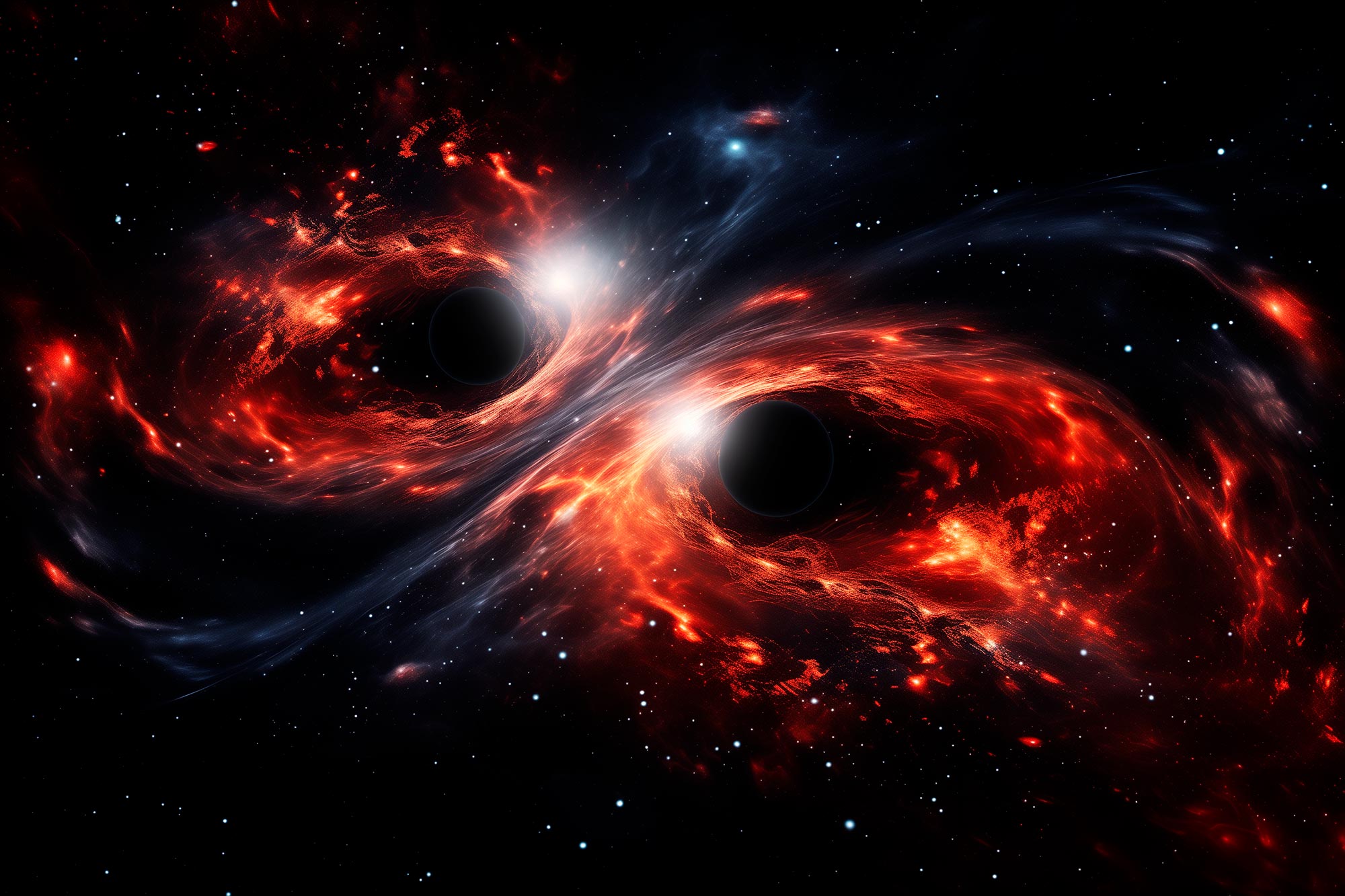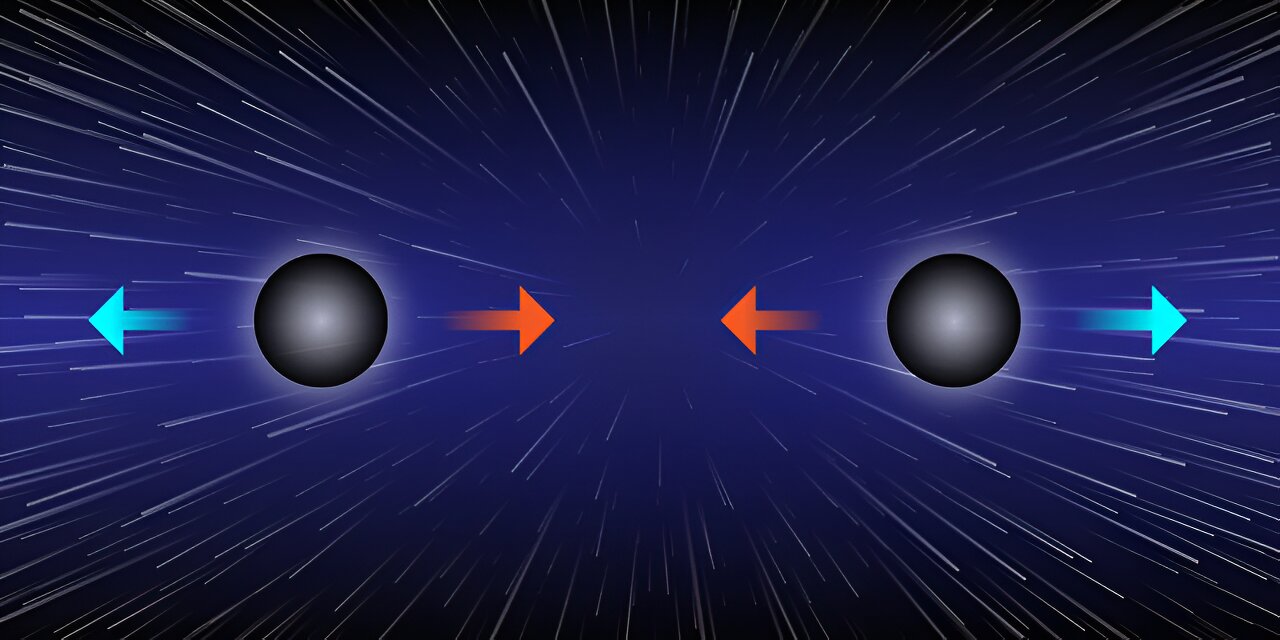
A new theory suggests that black holes can exist in balanced pairs, appearing as one due to a force called the 'cosmological constant'. This force, combined with gravitational attraction, keeps the black holes at a fixed distance despite the Universe's expansion. Researchers have shown that it is theoretically possible for black holes to exist in perfectly balanced pairs, held in equilibrium by the cosmological constant, mimicking a single black hole. This challenges conventional theories and opens up possibilities for understanding the behavior of black holes in an ever-expanding Universe.
Researchers have proposed that black holes could exist in perfectly balanced pairs, held in equilibrium by a cosmological force in an ever-expanding universe. This theory challenges conventional ideas about black holes and suggests that pairs of black holes could masquerade as a single black hole when viewed from a distance. The study shows that two static black holes can exist in equilibrium, with their gravitational attraction offset by the expansion associated with a cosmological constant. The findings open up possibilities for further exploration of black hole dynamics in an accelerating universe.
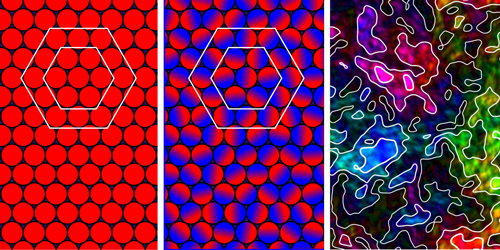
Active particles can form two-dimensional solids with long-range crystalline order and giant spontaneous deformations, which differ from those formed by nonmotile particles. These active systems exhibit quasi-long-range positional order and true long-range orientational order, similar to equilibrium solids. The power-law exponents describing the positional order in active systems cover a wide range, reaching values as high as 20. Understanding the interplay between order and fluctuations in active solids is crucial for integrating active elements into materials and fabrication processes.