Tag

Crystal Structures

All articles tagged with #crystal structures

"Revolutionizing Two-Dimensional Solids: Active Particles Break Barriers"

Originally Published 2 years ago — by Physics

Featured image for "Revolutionizing Two-Dimensional Solids: Active Particles Break Barriers"
Source: Physics

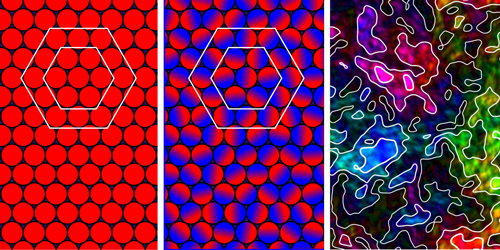
Active particles can form two-dimensional solids with long-range crystalline order and giant spontaneous deformations, which differ from those formed by nonmotile particles. These active systems exhibit quasi-long-range positional order and true long-range orientational order, similar to equilibrium solids. The power-law exponents describing the positional order in active systems cover a wide range, reaching values as high as 20. Understanding the interplay between order and fluctuations in active solids is crucial for integrating active elements into materials and fabrication processes.

Crystal Clear: Groundbreaking Discovery Shatters Conventional Wisdom

Originally Published 2 years ago — by SciTechDaily

Featured image for Crystal Clear: Groundbreaking Discovery Shatters Conventional Wisdom
Source: SciTechDaily

A recent study challenges the conventional definition of crystals by revealing that crystal structures are not always regularly arranged. The discovery of the random stacking of hexagonal layers (RHCP) as a stable structure overturns previous beliefs and has implications for materials science, particularly in semiconductors, solar panels, and electric vehicle technologies. The study provides insights into polytypism and suggests that polytypic materials like silicon carbide may have continuous structural transitions with new useful properties. The research was conducted using X-ray scattering data and advanced computation techniques.

"Revolutionizing Materials Design: Generative Neural Networks for Structure Prediction"

Originally Published 2 years ago — by Nature.com

Featured image for "Revolutionizing Materials Design: Generative Neural Networks for Structure Prediction"
Source: Nature.com

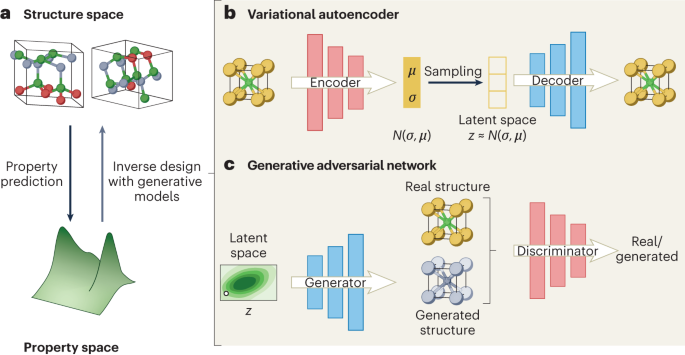
Recent advancements in structural feature representations and generative neural networks have the potential to efficiently predict stable crystal structures, enabling the design of solid-state crystalline materials with desired properties. Crystal structure prediction (CSP) plays a crucial role in discovering stable and metastable structures for materials of unknown structure. Efficient optimization techniques, such as evolutionary algorithms and particle swarm optimization, have led to the discovery of various new materials. The use of generative adversarial networks and Euclidean neural networks shows promise in learning and discovering crystallographic structures.

Unprecedented Crystal Structures with Surprising Chemistry Predicted by Scientists

Originally Published 2 years ago — by ScienceAlert

Featured image for Unprecedented Crystal Structures with Surprising Chemistry Predicted by Scientists
Source: ScienceAlert

Scientists have used high-pressure modeling to predict four new compounds made up of lithium and cesium, which have crystal structures that have never been seen before and can act as superconductors. The compounds were predicted using a crystal structure prediction algorithm called USPEX, which analyzed how high pressure might affect electronegativity. The discovery opens up new areas for scientists to explore and could lead to the development of materials useful for ultra-fast microchips and ultra-efficient power grid materials.

New self-assembled crystal structures discovered by researchers.

Originally Published 2 years ago — by Phys.org

Featured image for New self-assembled crystal structures discovered by researchers.
Source: Phys.org

Researchers at Cornell University have discovered over 20 new self-assembled crystal structures using a targeted computational approach. The team developed a new functional form for particle interactions, allowing them to control various features of the particles' interaction landscape. The findings suggest that there are potentially limitless new and exotic materials configurations possible through controlled self-assembly, serving as design targets for researchers who make nanoparticles and colloids.

Overcoming Metal 3D-Printing Challenges for Widespread Use

Originally Published 2 years ago — by Tech Xplore

Featured image for Overcoming Metal 3D-Printing Challenges for Widespread Use
Source: Tech Xplore

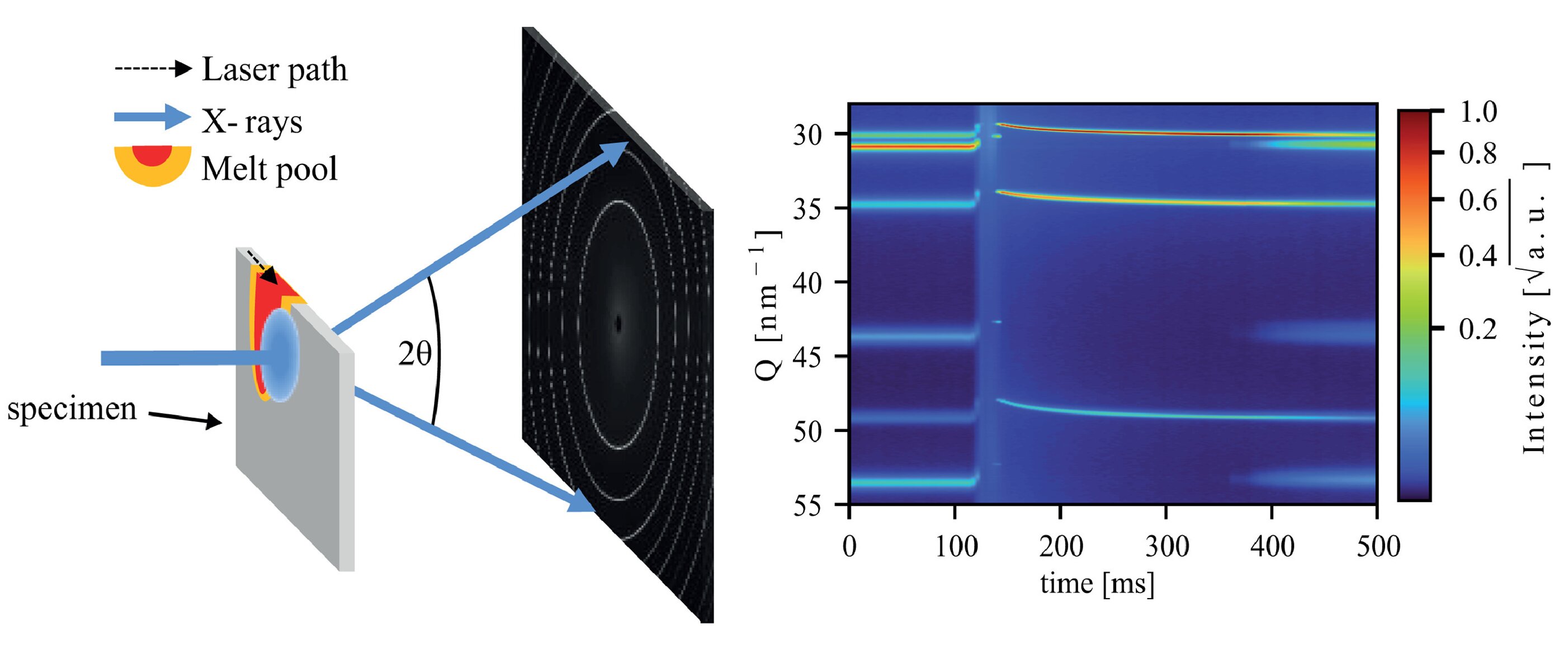
Researchers at the National Institute of Standards and Technology (NIST) and KTH Royal Institute of Technology in Sweden have used high-speed X-ray diffraction to identify the crystal structures that form within steel as it is 3D-printed. The findings unlock a computational tool for 3D-printing professionals, offering them a greater ability to predict and control the characteristics of printed parts, potentially improving the technology's consistency and feasibility for large-scale manufacturing.