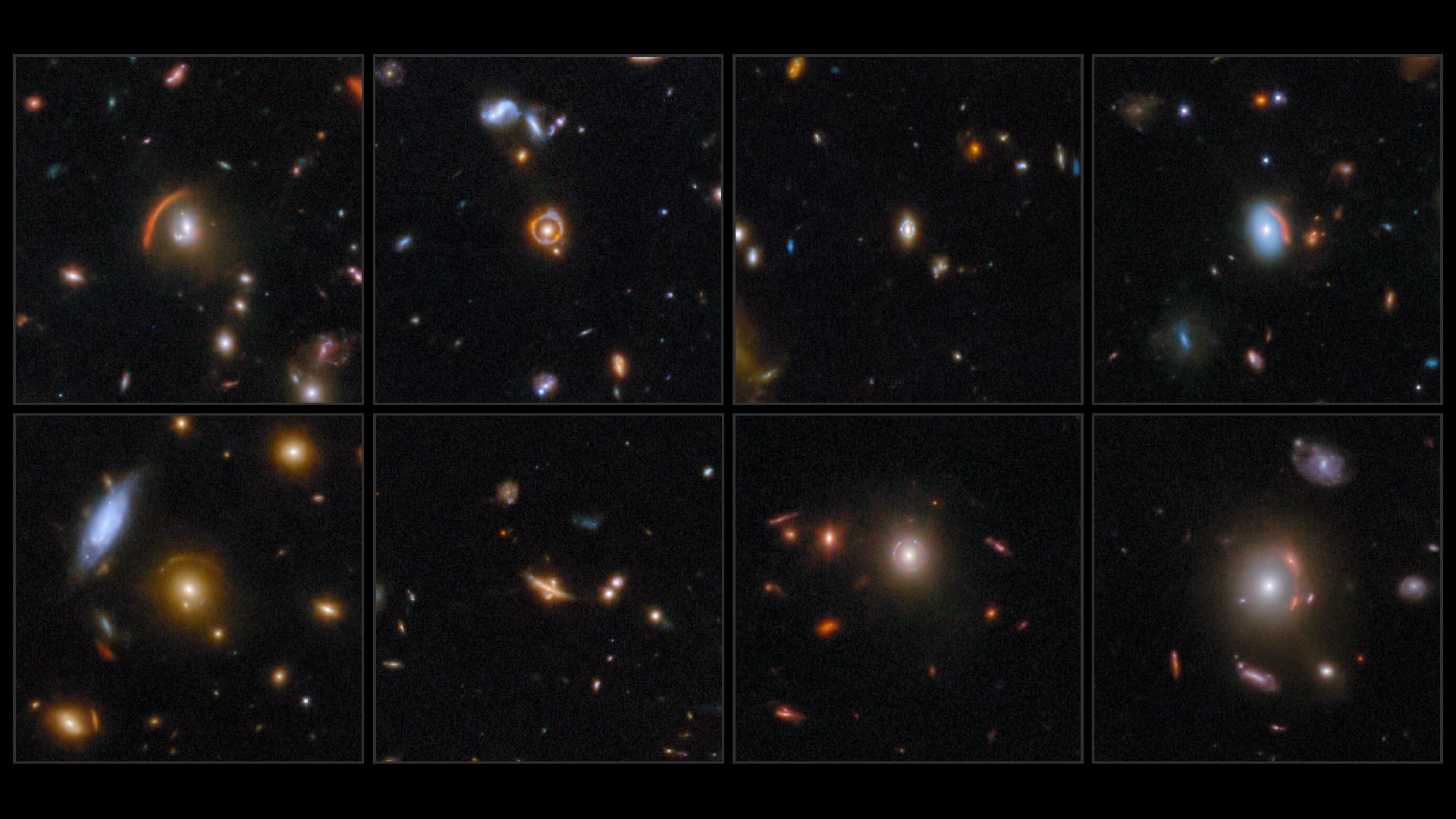
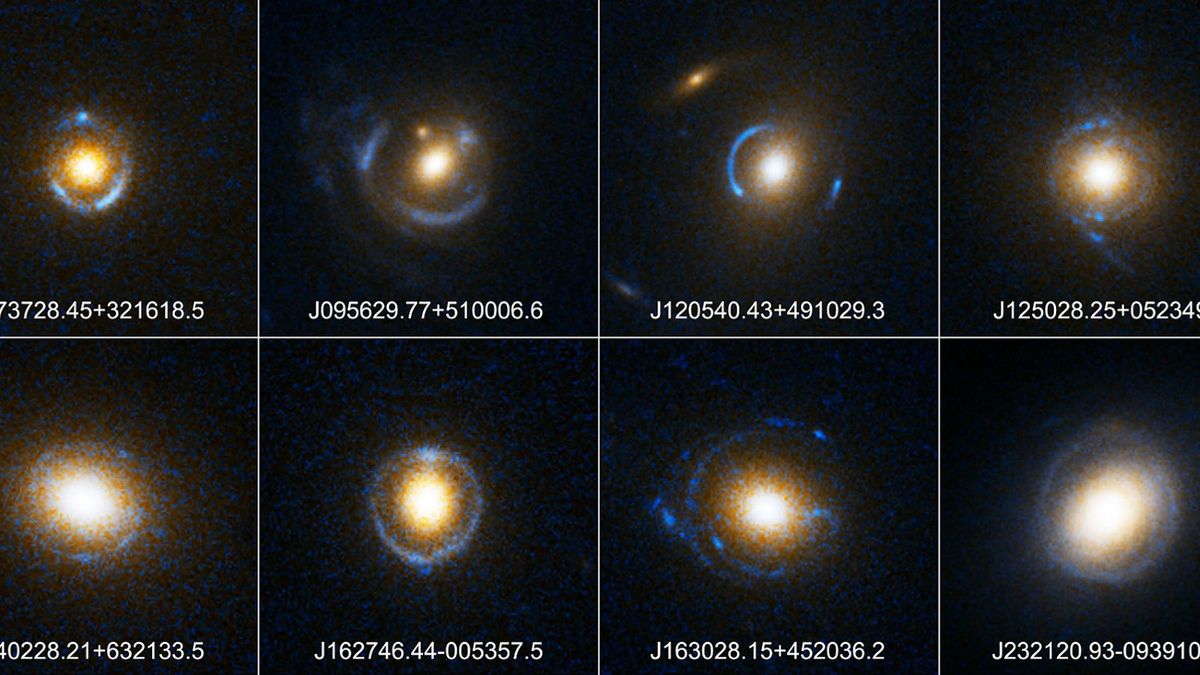
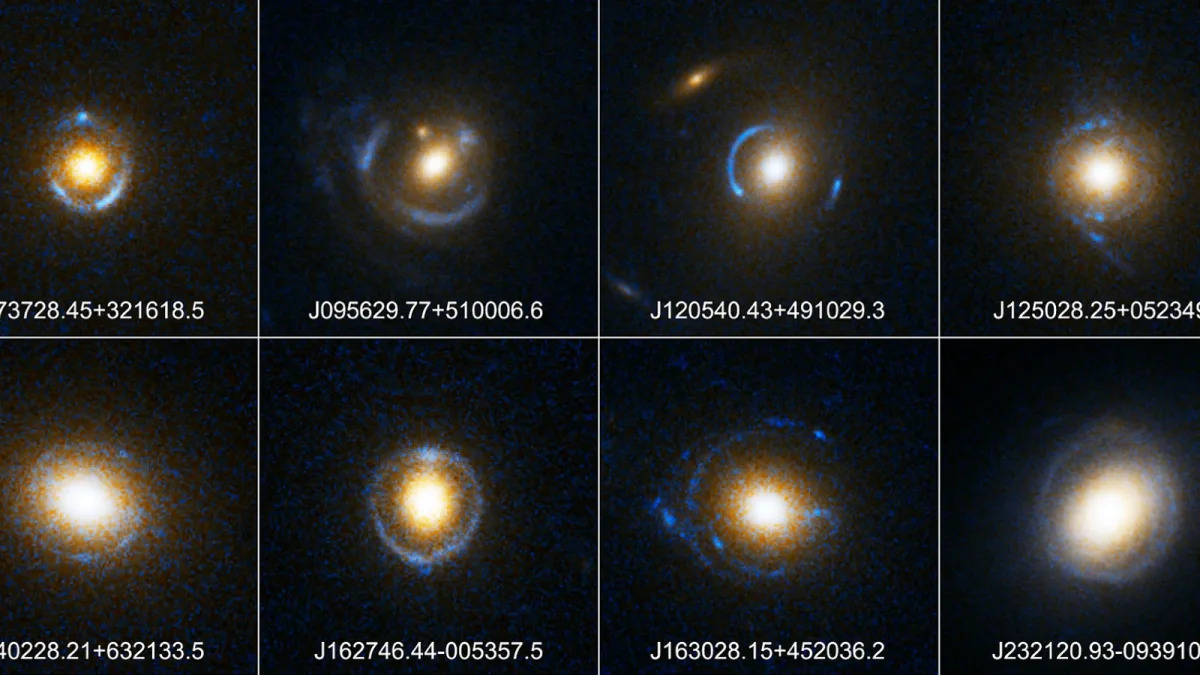
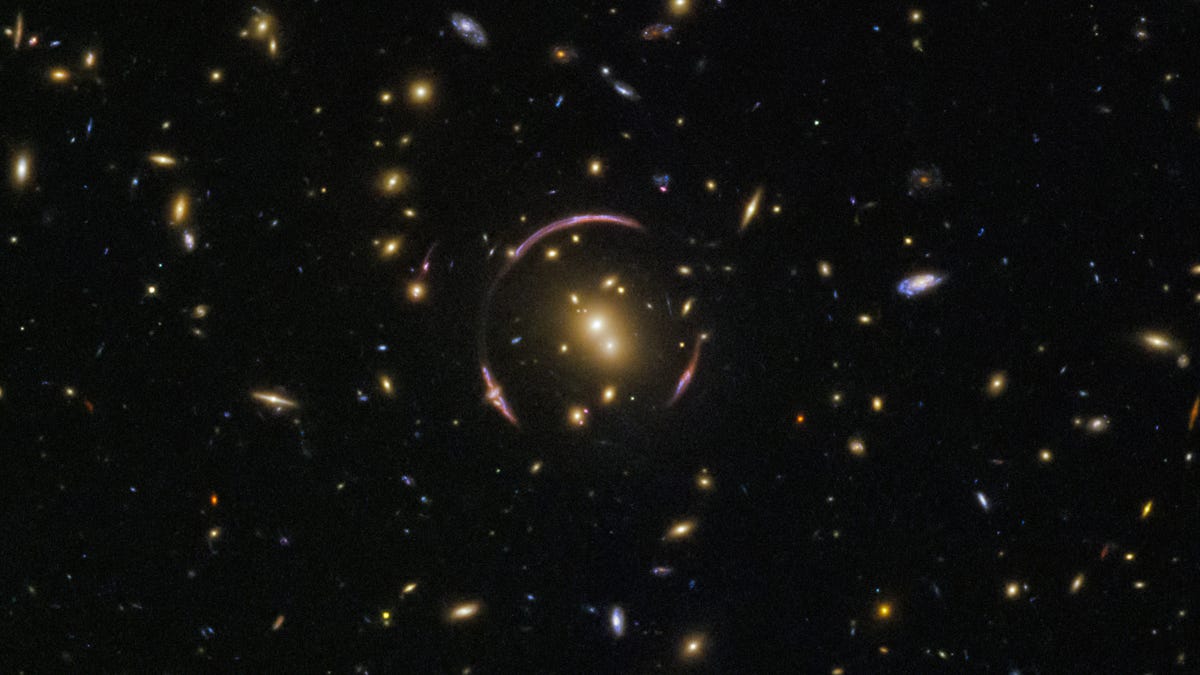
The James Webb Space Telescope has captured eight stunning images of Einstein rings caused by gravitational lensing, confirming Einstein's predictions and providing new insights into the universe's distant past, dark matter, and galaxy formation.
The James Webb Space Telescope has captured eight stunning Einstein rings caused by gravitational lensing, providing new insights into distant galaxies, dark matter, and the early universe, demonstrating Einstein's predictions and advancing our understanding of cosmology.
Scientists have analyzed several gravitationally lensed objects, including Einstein rings, to determine the true identity of dark matter. Dark matter makes up around 85% of the universe, but scientists still have no idea what it really is. The scientific community currently recognizes two hypothetical candidates as the most likely culprits: weakly interacting massive particles (WIMPs) and axions. In a new study, researchers analyzed several unusual gravitationally lensed objects and discovered that the images most closely matched the axion model, suggesting that axions are a more probable candidate for dark matter.
Researchers have analyzed several gravitationally lensed objects to determine the true identity of dark matter. By studying how light gets bent out of shape in weirdly warped Einstein rings, scientists have found that axions are a more probable candidate for dark matter than WIMPs. Axions are minute particles that likely behave like waves due to quantum interference. However, follow-up studies are required to prove this theory.
Researchers have analyzed several gravitationally lensed objects to determine the true identity of dark matter. By studying how light gets bent out of shape in warped Einstein rings, scientists have found that axions are a more probable candidate for dark matter than weakly interacting massive particles (WIMPs). Axions are minute particles that behave like waves due to quantum interference. Dark matter makes up around 85% of the universe, but scientists still have no idea what it really is.
Astrophysicists studying lensed ‘Einstein rings’ of light from the distant universe have found that signatures in the rings indicate the presence of wave-like dark matter. The researchers looked at lensed images of a distant quasar and found that wave-like dark matter was able to reliably reproduce the brightness anomalies of the quasar. The finding indicates that wave-like dark matter is probably generally applicable to the vast range of lensing anomalies seen in different systems, and forces people to consider new physics beyond the Standard Model of particle physics.