Ancient Greek and Roman scientists faced similar challenges with misinformation as today, emphasizing the importance of observation, critical thinking, acknowledging limits, understanding science as part of culture, and making science accessible to all, lessons that remain relevant in navigating modern misinformation.
A Nobel laureate warns that AI can create false confidence and diminish critical thinking, emphasizing the importance of using AI as a supportive tool rather than a substitute for human judgment. He advocates for skepticism, probabilistic thinking, and error-checking to avoid being misled by AI's often overly confident outputs.
Dartmouth professor Scott Anthony observes that many Gen Z students are deeply fearful of AI, worried about losing their humanity and critical thinking skills, despite some excitement about the technology. He emphasizes the importance of hard work and perseverance, citing examples like Julia Child, and advocates for teaching students to engage deeply with their work rather than rely solely on AI tools. The article highlights the ongoing disruption in education and the need to balance technological advances with foundational skills.
OpenAI has introduced Study Mode in ChatGPT to promote critical thinking among students by asking questions and limiting direct answers, aiming to enhance learning rather than just providing solutions. The feature is available to various ChatGPT plans and is part of OpenAI's effort to address concerns about AI's impact on students' critical skills. While it encourages active learning, students can switch back to regular mode, and future parental controls may be considered.
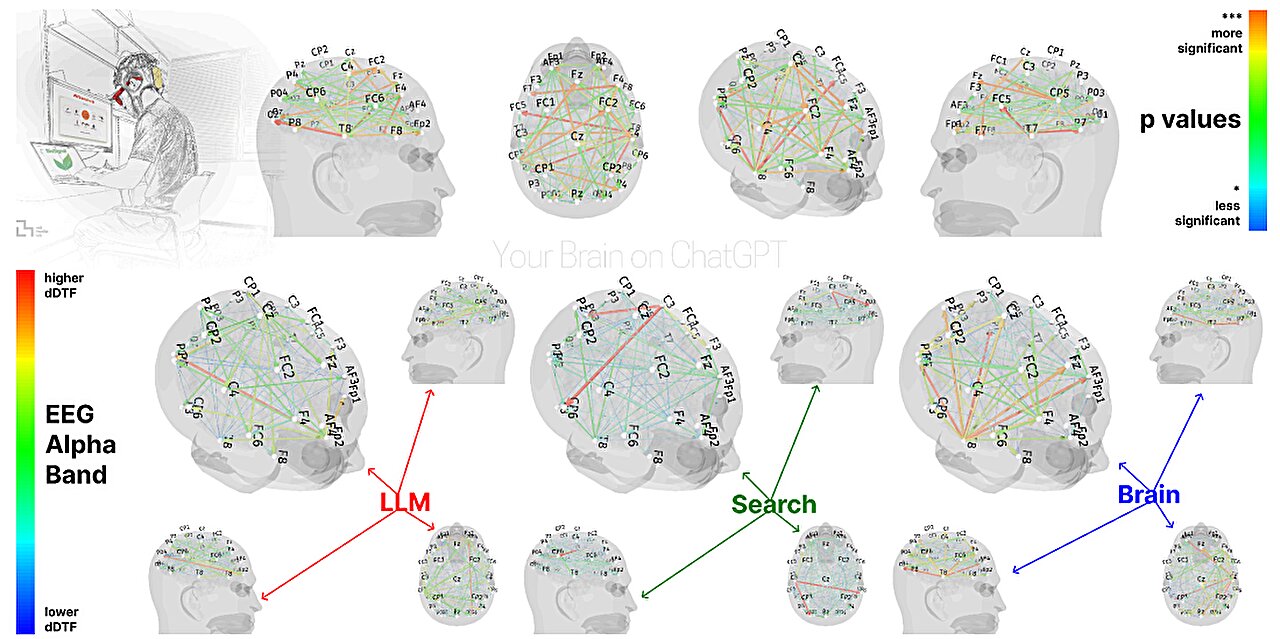
A study by MIT researchers found that using ChatGPT for essay writing may weaken neural connectivity and reduce critical thinking skills, as evidenced by EEG analysis and performance assessments, raising concerns about the long-term educational effects of relying on large language models.
A study by MIT researchers found that students using ChatGPT showed lower brain engagement and performed worse on essays compared to those using Google or no aid, suggesting that reliance on AI like ChatGPT may impair critical thinking skills and lead to 'cognitive debt.'
Automation bias, the tendency to favor automated decision-making systems and ignore contradictory information, poses significant risks in critical sectors such as aviation and finance. Overreliance on automation can lead to errors and complacency, potentially resulting in catastrophic outcomes. Mitigating automation bias requires fostering critical thinking, seeking diverse perspectives, and improving human-machine collaboration. By balancing the strengths of both human judgment and automated systems, organizations can enhance decision-making processes and ensure efficiency and resilience.
The Real Forno Show delves into the ongoing debate over Kirk Cousins' potential $90 million, fully guaranteed two-year contract, emphasizing the importance of critical thinking when interpreting contract news and rumors. The hosts analyze the financial implications, Cousins' Achilles injury, and the complexities of re-signing him at such a high price, while urging viewers to consider multiple factors and promising to revisit the topic as more information becomes available.
Family therapist Emily De La Torre suggests using alternative phrases instead of "be careful" when children engage in risky play. She emphasizes the importance of allowing children to take risks to develop body trust, resilience, confidence, and self-regulation. Instead of the generic "be careful," De La Torre recommends phrases that encourage critical thinking and provide specific observations or instructions. By using phrases like "What's your plan here?" and "Do you feel stable?", parents can empower their children to problem solve and develop a stronger sense of self-agency. While it may be challenging to break the habit of saying "be careful," these alternative phrases can help children feel more confident in their physical abilities.
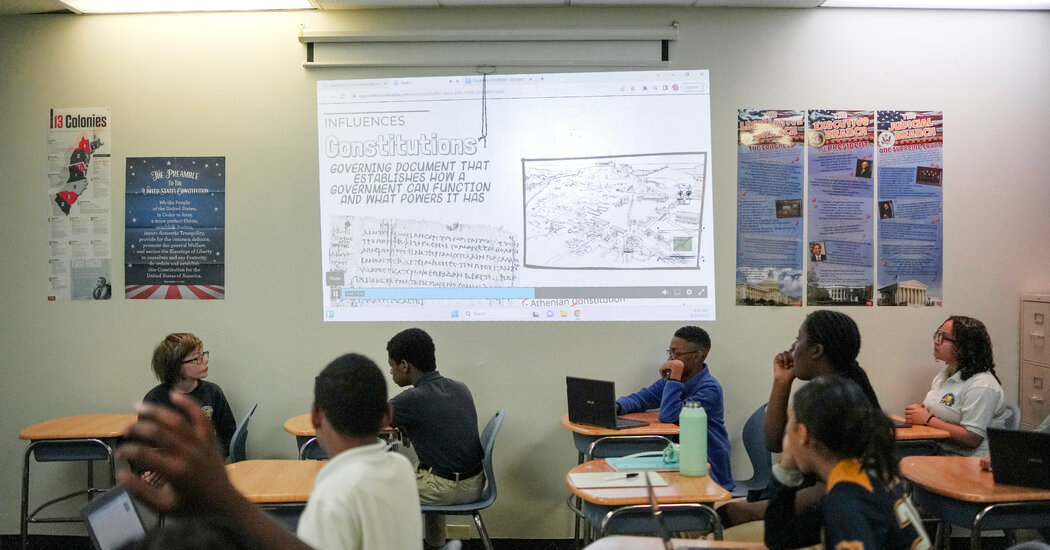
Republican governors in states like Florida, Virginia, and South Dakota are leading a controversial overhaul of civics education, emphasizing patriotism, Christianity, and anti-communism. The new standards restrict discussions on race and gender and discourage activities like mock elections and debates on current events. Critics argue that these changes may prevent students from gaining a full understanding of American government and hinder critical thinking. The standards also draw on experts affiliated with Hillsdale College, a Christian institution, and promote a particular interpretation of the founding fathers' beliefs. While the standards aim to address knowledge gaps, there are concerns about the reduction of critical thinking and the memorization-heavy approach. The civics standards reflect the ongoing divide in the nation's schools over what children should learn about their country.
Republican governors in states like Florida, Virginia, and South Dakota are leading a controversial overhaul of civics education, emphasizing patriotism, Christianity, and anti-communism. The new standards restrict discussions on race and gender and remove hands-on activities like mock elections and debates on current events. Critics argue that these changes may prevent students from gaining a full understanding of American government and limit critical thinking. The standards also draw on experts affiliated with Hillsdale College, a Christian institution, and present a particular perspective on the influence of Christianity in the founding of the nation. The divide over what children should learn about their country continues to deepen, with some states adopting ethnic studies requirements and adding LGBTQ history and critiques of capitalism to their curriculum.
University of Chicago psychology professor David Gallo suggests that thinking in a foreign language can improve critical thinking, decision-making skills, and memory. Speaking a second language exercises the brain in a way that monolinguals don't experience, leading to more rational and logical decision-making. Processing information in a secondary language can also enhance memory and reduce susceptibility to false memories and misinformation. Gallo recommends leveraging this brain hack by thinking in a different language when faced with tough decisions or trying to remember information. Learning multiple languages, especially from a young age, can have long-term cognitive benefits.
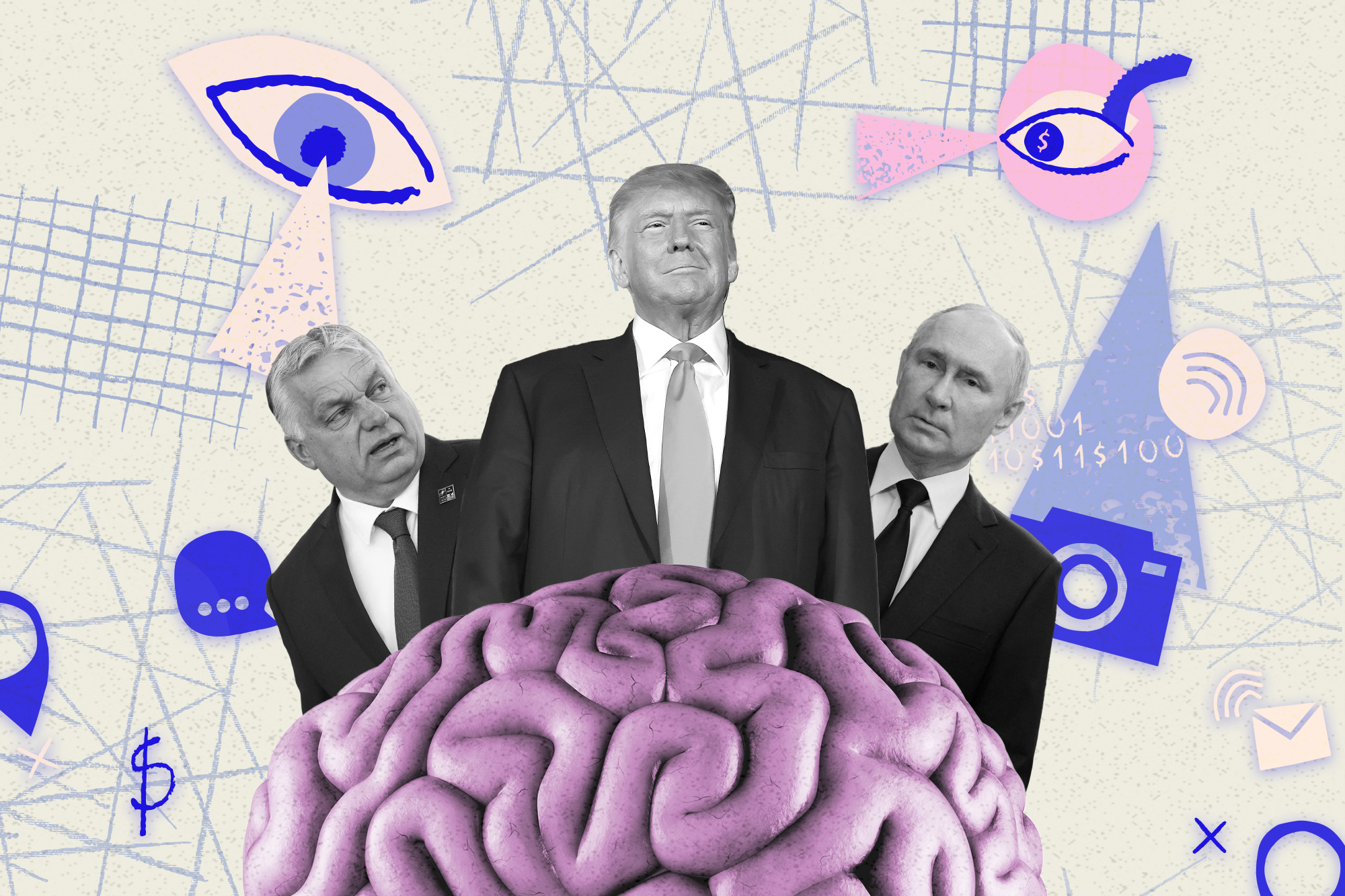
Research shows that dictators and autocrats, including Donald Trump, Vladimir Putin, and Viktor Orbán, use dehumanizing metaphors in their speeches to instill and propagate hatred of others. These metaphors tap into existing circuits in the brain, bypassing higher cognitive reasoning centers and making people more susceptible to believing lies and conspiracy theories. The repetitive use of these metaphors strengthens neural pathways, making it difficult for individuals to rethink their beliefs. The rise of populist and far-right movements has further spread the use of dehumanizing metaphors worldwide. Critical thinking and brain training are crucial in combating this manipulation, but once people believe lies, they are unlikely to change their minds. Disruptive events can force a new perspective, but without them, individuals with strong convictions may never change their beliefs, benefiting autocrats and endangering society.