Astronomers suggest Earth and our galaxy may reside in a giant cosmic void, which could explain discrepancies in measurements of the universe's expansion rate, potentially solving the long-standing Hubble tension, though this idea remains controversial within the scientific community.
Recent research suggests we may live in a large cosmic void with fewer galaxies, which could explain the faster-than-expected expansion rate of the universe known as the Hubble tension. The study uses baryon acoustic oscillations to support the void hypothesis, indicating that our local universe might be expanding more quickly due to residing in a low-density region, challenging the standard cosmological model.
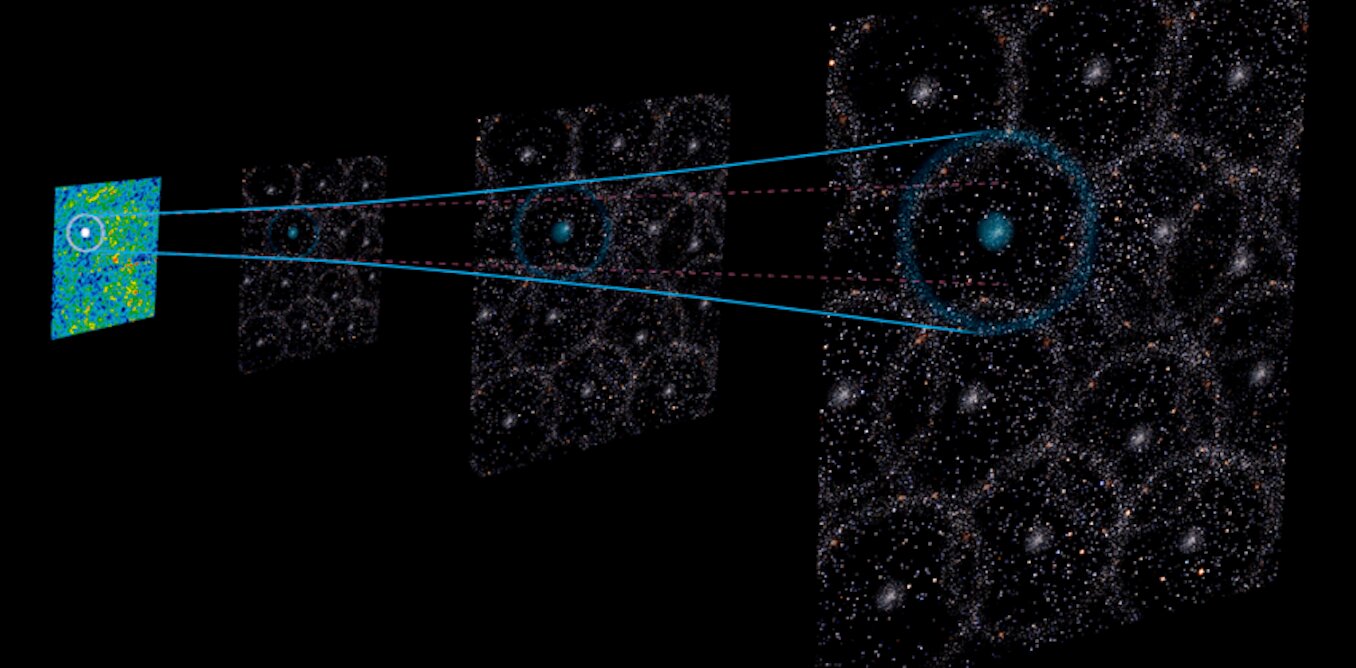
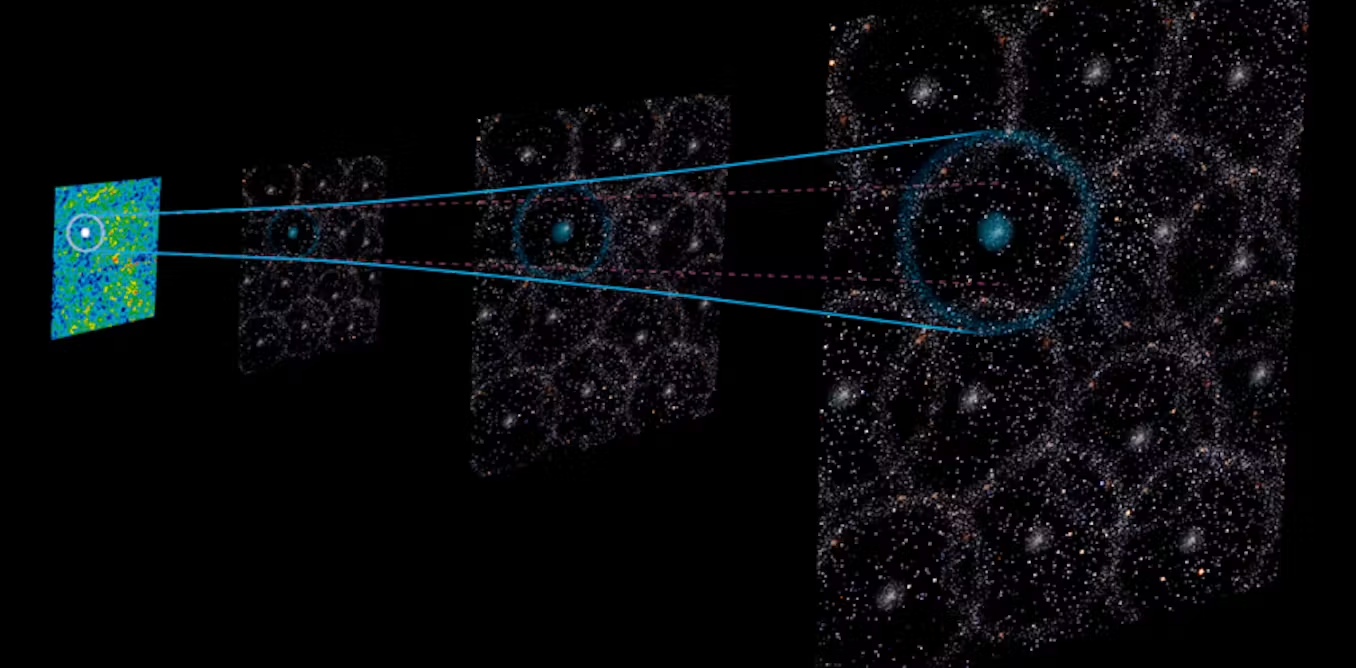
Recent research suggests we may live in a large cosmic void, which could explain the Hubble tension—the discrepancy in the universe's expansion rate—by showing that local measurements are affected by our position in a less dense region, supported by analysis of early universe sound patterns in the cosmic microwave background.
Scientists suggest we live in a large cosmic void, which could explain the faster-than-expected expansion rate of the universe (Hubble tension). Recent analysis of early universe sound waves and galaxy distribution supports this idea, making the void model significantly more likely than the standard cosmological model without a void. Further measurements are needed to confirm this hypothesis.
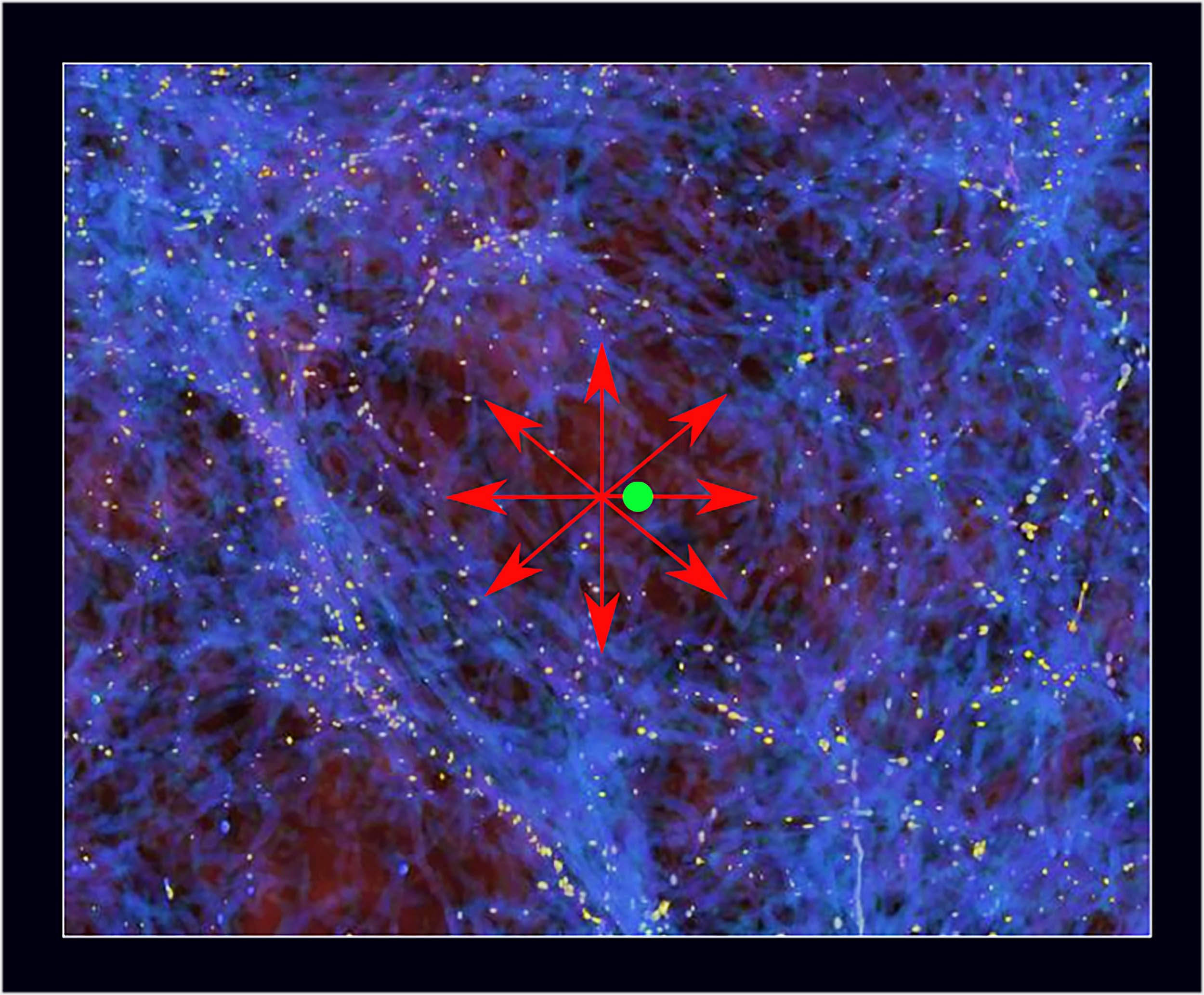
Scientists propose that our galaxy may reside in a massive under-dense region, or 'void,' which could explain the discrepancy in measurements of the universe's expansion rate known as the Hubble tension. This void, potentially spanning a billion light-years, might cause local galaxies to appear to recede faster, aligning local observations with cosmic microwave background data. While this hypothesis is supported by some galaxy surveys and baryon acoustic oscillation data, it remains controversial and requires further investigation with upcoming measurements to confirm or refute the idea.
Astronomers present evidence suggesting Earth resides in a large cosmic void, which could explain discrepancies in measurements of the universe's expansion rate and prompt revisions to current cosmological models.
New research suggests Earth may reside in a vast cosmic void, which could explain the Hubble tension—the discrepancy in measurements of the universe's expansion rate—by indicating we are in a low-density region expanding faster than the rest of the universe. This local void hypothesis is supported by baryon acoustic oscillations data, challenging the standard cosmological model and offering a potential solution to the longstanding problem.
Scientists suggest Earth may be inside a billion-light-year-wide cosmic void, which could explain the Hubble Tension—the discrepancy in measuring the universe's expansion rate—by making our local universe appear to expand faster. Evidence from baryon acoustic oscillations supports this theory, indicating our corner of the universe might be more isolated than previously thought.
Three rare white lion cubs are born at a zoo in Venezuela, marking the first white lions born in captivity in the country. Researchers discover spider pulsars that cause damage to their companion stars. Scientists propose the idea that we are living in a giant cosmic void, which could explain the Hubble tension. Japan inaugurates the world's largest experimental nuclear fusion reactor, aiming to generate carbon-free energy.
The vacuum of space is not truly empty. While the density of interstellar space is extremely low, it still contains charged particles, hydrogen atoms, and dust. Even in the cosmic voids, the emptiest regions of the universe, there are lightweight particles called neutrinos and the cosmic microwave background radiation. Additionally, quantum fields give rise to particles and have an intrinsic energy known as vacuum energy. So, even if one were to nullify the vacuum energy, they would still be surrounded by space itself, which is a dynamic entity that interacts with matter and gives rise to phenomena like gravitational waves. The question of whether true nothingness can exist remains unanswered.