A Nature study analyzing IVF embryo genetics links specific maternal gene variants to higher risk of aneuploidy—chromosomal errors that often cause miscarriage—showing the same genes governing crossover recombination also influence pregnancy loss risk, with implications for future risk prediction and therapies.
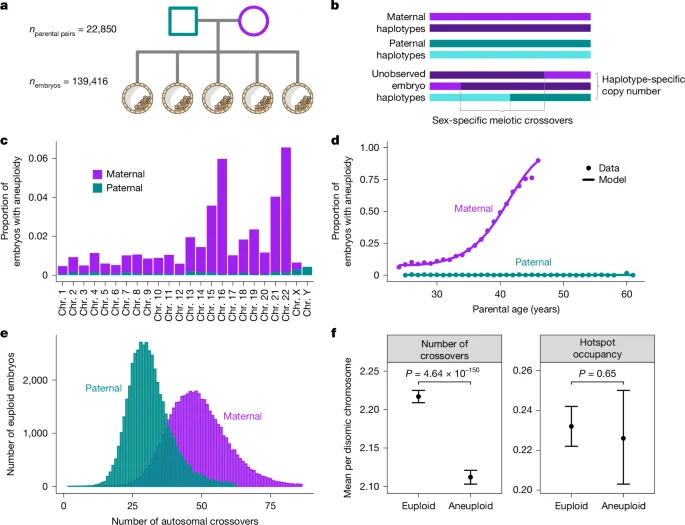
A Nature study analyzing 139,416 IVF embryos from 22,850 parental sets links maternal genetic variants to increased risk of embryonic chromosomal abnormalities (aneuploidy) that cause miscarriage; strongest ties involve meiotic genes such as SMC1B and others (C14orf39, CCNB1IP1, RNF212). While larger sample sizes clarify how inherited differences in meiosis influence risk, predicting individual outcomes remains difficult due to multiple factors beyond genetics. The work may inform reproductive genetics and drug development.
A large IVF-PGT analysis (139,416 embryos, 22,850 parental sets) maps crossovers and meiotic aneuploidy at scale and finds a common non-coding haplotype in SMC1B that associates with both lower maternal recombination and higher maternal meiotic aneuploidy, supported by functional assays and TWAS implicating C14orf39 and ubiquitin ligases CCNB1IP1/RNF212. SNP heritability for aneuploidy is negligible, suggesting environmental and rare-variant effects, while an inverse link between recombination rate and aneuploidy emerges. Evolutionary modelling suggests the risk allele is ancient and common, with complex fitness dynamics that can maintain it in populations. The work reveals a shared genetic basis for recombination and aneuploidy, with implications for fertility and genome evolution.
Researchers have identified the earliest known cases of two genetic disorders, Turner syndrome and Jacob's syndrome, in prehistoric individuals using a new technique to measure the number of chromosomes in ancient DNA. The study also revealed three people with Klinefelter syndrome and an infant with Down syndrome from different time periods. This method could provide insights into how perceptions of gender identity have evolved over time and may be applied to analyze incomplete ancient DNA in archaeological remains.
Yale researchers have discovered that cancer cells with extra chromosomes rely on those additional chromosomes for tumor growth, and removing them halts tumor formation. The study, published in the journal Science, suggests that selectively targeting these extra chromosomes may offer a new avenue for treating cancer. The researchers used the gene-engineering technique CRISPR to develop a new approach called ReDACT, which successfully eliminated aneuploidy in melanoma, gastric cancer, and ovarian cell lines. The findings indicate that aneuploidy may function as a therapeutic target for cancer, potentially allowing for targeted treatment while minimizing harm to normal cells. Further research is needed before this approach can be tested in clinical trials.