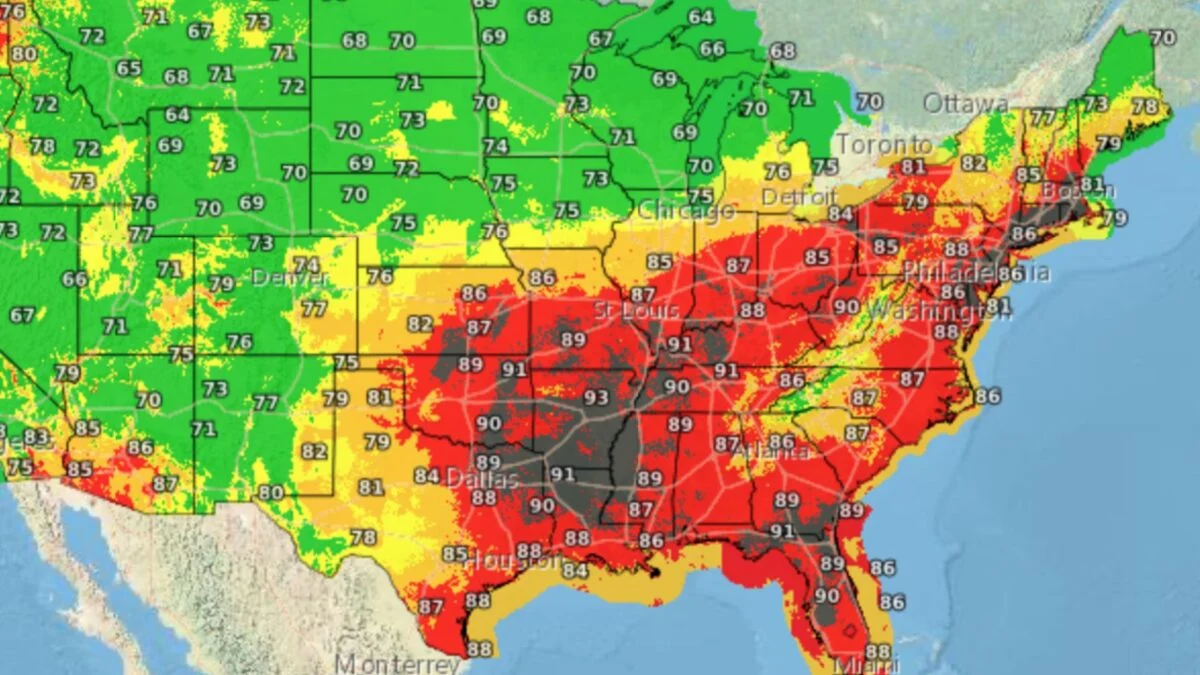
An intense heat dome and high humidity in the eastern U.S. are causing dangerous wet-bulb temperatures, nearing levels that threaten human survival, with climate change likely to make such conditions more common and severe in the future.
Scientists have determined that the maximum mix of heat and humidity a human body can survive is around 35 degrees Celsius (95 Fahrenheit) with 100 percent humidity, known as the "wet bulb temperature." At this point, sweat no longer evaporates off the skin, leading to heatstroke and organ failure. While this limit has been breached only a few times, extreme heat at lower levels can still be deadly. As global temperatures rise, dangerous wet bulb events are expected to become more common. Vulnerable populations, such as children, the elderly, and outdoor workers, are at higher risk. Climate change is a significant factor in the increase of wet bulb temperatures.
Scientists have determined that the maximum mix of heat and humidity a human body can survive is around 35 degrees Celsius (95 degrees Fahrenheit) when coupled with 100 percent humidity. At this point, sweat no longer evaporates off the skin, leading to heatstroke, organ failure, and death. While this critical limit has only been breached a few times, experts warn that as global temperatures rise, dangerous wet bulb events will become more common. The frequency of such events has already doubled in the last 40 years. Vulnerable populations, such as children and the elderly, are at higher risk, and those who work outside in extreme heat are particularly vulnerable.
Scientists have identified the maximum mix of heat and humidity, known as the "wet bulb temperature," that a human body can survive. At this critical limit, which occurs at 35 degrees Celsius (95 Fahrenheit) with 100 percent humidity, sweat no longer evaporates off the skin, leading to heatstroke and death. While this limit has only been breached a few times, experts warn that extreme heat events are becoming more common due to human-caused climate change. The frequency of such events has doubled over the last 40 years, and if global temperatures rise by 2.5 degrees Celsius, wet bulb temperatures will regularly exceed the survival limit. Vulnerable populations, such as children, the elderly, and outdoor workers, are at higher risk.
Scientists have determined that the maximum mix of heat and humidity a human body can survive is around 35 degrees Celsius (95 Fahrenheit) when coupled with 100 percent humidity. This critical limit, known as the "wet bulb temperature," has been breached only a few times and has never resulted in mass mortality events. However, as global temperatures rise due to climate change, dangerous wet bulb events are expected to become more common. Last summer, over 61,000 people died in Europe due to heat-related causes. The most vulnerable to extreme heat are children, the elderly, and those who work outside in high temperatures.
As extreme heatwaves become more frequent and intense due to climate change, scientists are studying the combination of temperature and humidity, known as wet-bulb temperature, to determine when it becomes too hot for normal daily activity. Recent experiments at Penn State University show that the upper limit for young, healthy adults is a wet-bulb temperature of about 87°F (31°C) at 50% relative humidity. Current heatwaves are already exceeding these limits, posing significant health risks, especially for vulnerable populations. Staying hydrated and seeking cool areas are important in high heat, but access to cooling centers and air conditioning remains a challenge for many. The evidence continues to mount that climate change is a pressing problem that requires immediate action.