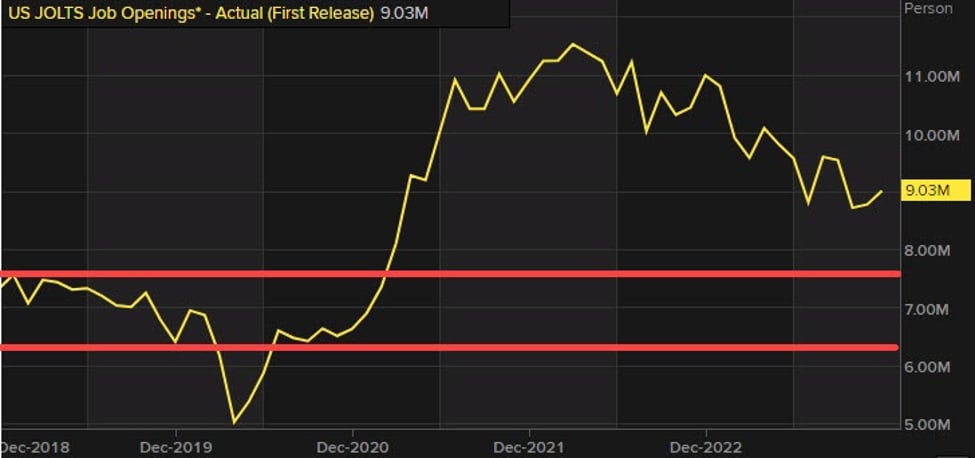
The latest JOLTS data for December showed job openings at 9.026 million, surpassing the 8.750 million estimate, with the quits rate remaining unchanged at 2.2%. Despite little change in layoffs and discharges, hires were also relatively stable. Total separations, including quits, layoffs, and discharges, remained at 5.4 million. The data, while near post-pandemic lows, exceeded expectations. US yields are trading near highs, with the 2-year yield at 4.346%, 5-year at 4.005%, 10-year at 4.083%, and 30-year at 4.306%.
Gold prices have pulled back as the US dollar strengthened and US yields rose following better-than-expected jobs data, reducing expectations of large-scale rate cuts. The upcoming US CPI print is expected to impact gold prices, with a softer-than-expected figure potentially weighing further on the dollar and providing a tailwind for gold. Gold has started the week testing a support level at $1985, with resistance levels at $2010 and $2050. The main catalyst for a bullish continuation would be if US CPI cools at a faster rate than anticipated.
The US dollar strengthened as US yields rebounded, leading to gains against the Japanese yen and Australian dollar. USD/JPY bounced off trendline support and reclaimed the 147.00 handle, with resistance levels at 147.15 and 147.30. On the downside, support is seen around 146.00 and 144.50. Meanwhile, AUD/USD turned lower after failing to break above trendline resistance near 0.6665, with support at 0.6575 and 0.6525. If the bulls regain control, a rally towards 0.6800 and 0.6900 could be possible.
After the focus on US inflation figures, attention now turns to China's producer and consumer price inflation, as investors analyze the extent to which they indicate a cooling of wider deflationary pressures. China's economy has faced challenges this year, including a low currency, stock and bond sell-offs, an imploding property sector, and the threat of deflation. The upcoming PPI and CPI readings will be closely watched for signs of economic reflation. Meanwhile, the bigger picture for markets continues to be dominated by US yields and the Federal Reserve's policy outlook.
The bond sell-off continues as long-term US yields reach a 16-year high, causing market volatility. Investors are concerned about rising interest rates and the potential impact on the economy.
The S&P 500 experienced a late recovery, but global markets continued to suffer losses as US yields surged and the US dollar strengthened. Gold slipped below $1900, reaching a session low of $1872, while the US Dollar Index hit fresh highs before encountering resistance. Hawkish comments from Fed policymakers and the ongoing United Auto Workers strike added to market concerns. The US economy faces potential pressure in Q4, with consumers likely to be affected by depleted savings, student debt repayments, and higher oil prices. US yields, particularly the 10-year, reached new highs. Gold recorded its worst day since July, and the S&P 500 remains in a bearish trend, with a potential short-term retracement facing selling pressure.
The US dollar remains at a 10-month high against major currencies, supported by rising US bond yields, which have reached their highest level in 16 years. Resilient economic data, hawkish Federal Reserve rhetoric, and a budget deficit to be financed by borrowing have contributed to the increase in Treasury yields. The euro and sterling have both experienced losses, with the euro on track for its worst quarterly percentage loss in a year. The yen has also weakened, approaching the 150-per-dollar mark, which could trigger intervention from the Japanese finance ministry. Rising commodity prices have provided some support to antipodean currencies, while the Chinese yuan remains close to the weak end of its trading band.
Asian markets are expected to be cautious and nervous due to the strengthening US dollar and rising US bond yields, which are tightening financial conditions and deepening concerns over China. The dollar has risen for the 18th time in the last 24 sessions and is on track for its fifth consecutive weekly gain. The twin rise in the dollar and US bond yields is a red flag for emerging markets, with Chinese and aggregate emerging market financial conditions tightening sharply this month. Oil prices are also retreating due to fears of faltering demand from China. Chinese and regional shares are feeling the heat, with Chinese blue chip shares falling for a fourth day and global indexes falling in recent sessions.
Asian shares stumbled as US bond yields reached nine-month highs, pushing the dollar higher. Investors awaited the earnings results of tech giants Apple and Amazon to see if they justified the sector's high valuations. European markets were expected to open subdued, with the Bank of England anticipated to raise interest rates later in the day. US futures were flat following a wave of selling on Wall Street, while Asian markets experienced declines. Long-term US Treasury yields continued to climb, curbing risk appetite. Chinese blue chips rose, and the US dollar remained buoyant.
Gold and silver prices fell as US yields surged following Bank of Canada's decision to resume its tightening campaign. Non-yielding precious metals tend to perform poorly when higher nominal rates boost returns on competing assets, such as government bonds. The resumption of tightening by the Bank of Canada was a wake-up call for markets, and if the Fed mistakenly employs a similar strategy, it could start hiking again in July and do so in a more aggressive manner. Gold's recent decline seems to be a corrective move within a medium-term uptrend, but the bias could turn bearish very quickly if prices breach the rising trendline that has been guiding the market higher since November of 2022.
Gold prices fell below $2,000 per ounce as US yields rose, with investors becoming more skeptical about potential US rate cuts later this year due to persistent inflation. The dollar strengthened as markets priced in an 85% chance of a 25-basis-points rate hike at the Federal Reserve's May 2-3 meeting. A stronger dollar weighs on overseas demand for gold, while higher rates blunt non-yielding bullion's appeal.
Gold prices fell over 1% due to higher US yields and the dollar, as some investors bet that a pause to the Federal Reserve's rate hike may take longer than previously thought. The correction was due to the markets readjusting expectations of the Fed's rate-hike path. Higher interest rates dim the non-yielding bullion's appeal.