Scientists have for the first time directly observed 'second sound,' a wave-like heat transfer phenomenon in superfluids, using a novel heat-mapping technique on ultracold lithium-6 atoms. This breakthrough could advance understanding of heat flow in extreme environments like neutron stars and improve high-temperature superconductor designs.
Scientists have achieved a breakthrough in quantum physics by observing quantized vortices in supersolids, a state of matter that exhibits both solid and superfluid properties. This discovery, made by rotating a supersolid, provides new insights into the coexistence of these characteristics and has potential implications for understanding exotic quantum matter and astrophysical phenomena, such as neutron stars. The research, published in Nature, marks a significant advancement in the study of modulated quantum matter.
Scientists at the University of Innsbruck have successfully stirred a supersolid, a state of matter that exhibits both solid and superfluid properties, providing direct evidence of its dual nature. This breakthrough, published in Nature, involved creating quantized vortices, which are indicative of superfluidity, by using magnetic fields to rotate the supersolid. The research could help simulate extreme phenomena like those in neutron stars, where superfluid vortices are believed to cause rotational speed changes.
Researchers from the University of California, Santa Barbara, have discovered a spin microemulsion phase in two-dimensional systems of spinor Bose-Einstein condensates. This phase transition is characterized by the loss of superfluidity, complex pseudospin textures, and the emergence of topological defects. The spin microemulsion phase occurs when the motion of each atom is coupled to its internal spin state, resulting in a spin-orbit coupling effect. The findings provide insights into the behavior of two-dimensional systems and have implications for both quantum physics and soft matter systems. Future research will focus on investigating the thermodynamic stability of the spin microemulsion and its response to different system parameters.
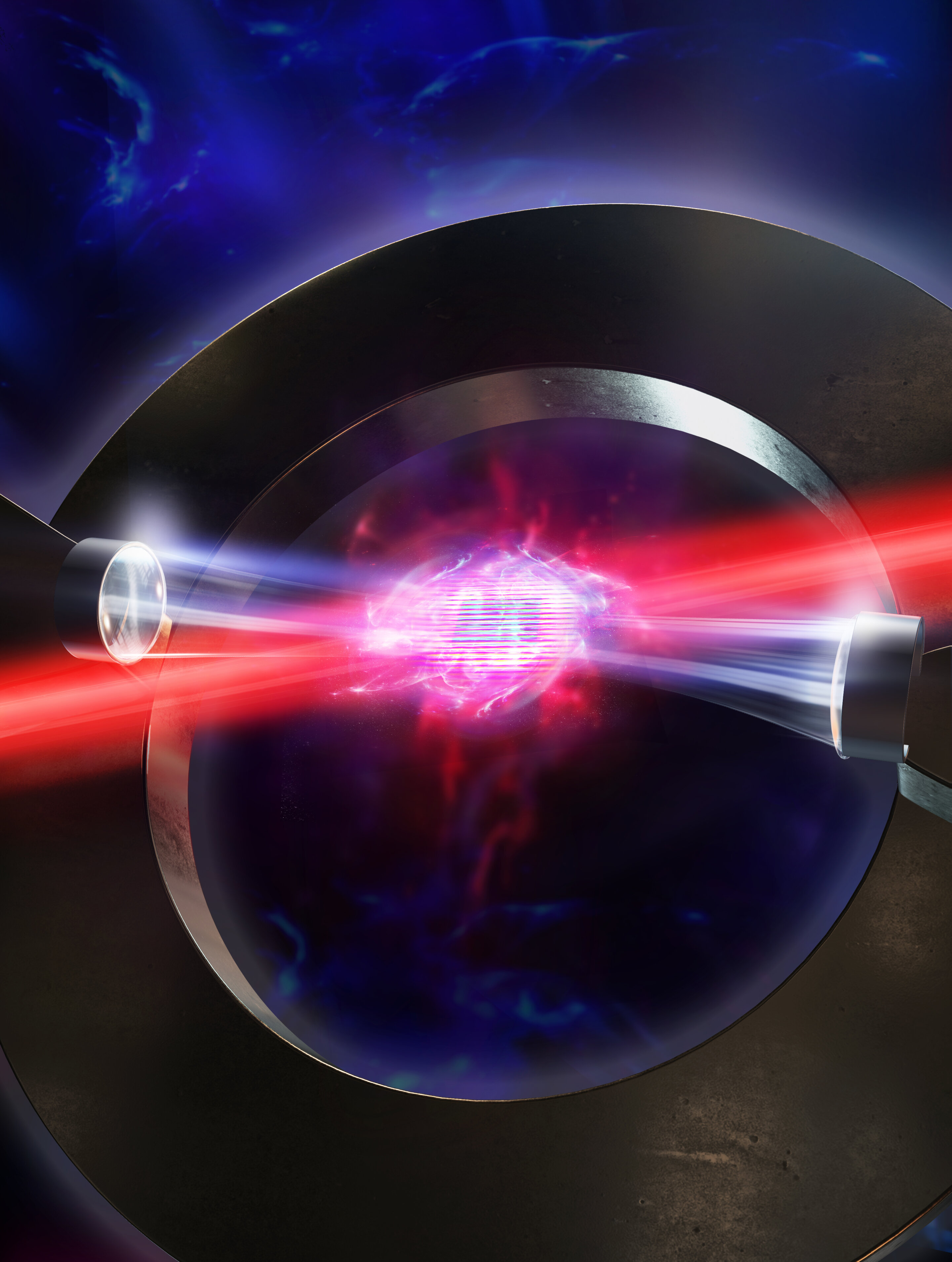
Scientists at EPFL and the University of Innsbruck have made a breakthrough in creating a crystalline structure called a "density wave" in an atomic gas, which can help us better understand the behavior of quantum matter. The researchers used an optical cavity to cause the particles in the Fermi gas to interact at long distance, allowing the atoms to collectively organize into a density wave pattern. This breakthrough can impact not only quantum research but quantum-based technologies in the future, such as high-temperature superconductivity and quantum computers.