Tag

Sn 1987a

All articles tagged with #sn 1987a

"The Mystery of the 'String of Pearls' Supernova Unraveled by Scientists"
astronomy1 year ago

"The Mystery of the 'String of Pearls' Supernova Unraveled by Scientists"

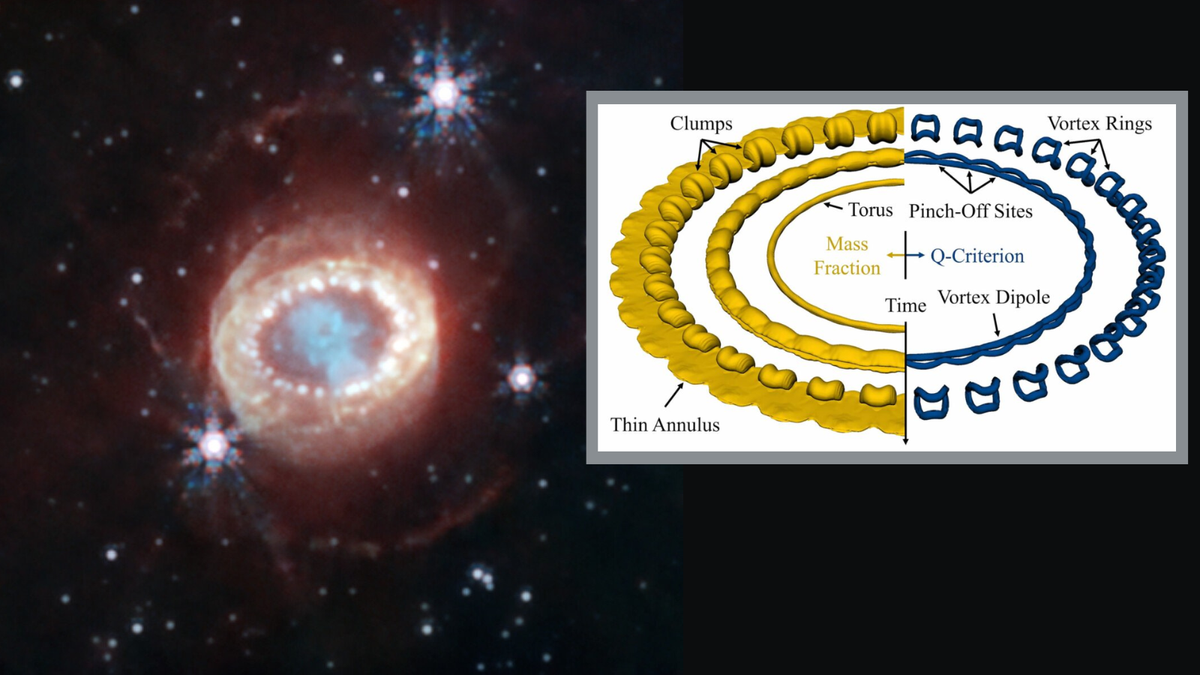
Scientists may have unraveled the mystery behind the "string of pearls" formation around supernova 1987A, suggesting that it may be connected to a phenomenon called "Crow instability," similar to the way airplane contrails are formed. This discovery sheds light on the cosmic jewelry surrounding the supernova and could help predict the number of clumps present. The proximity of SN 1987A to Earth and its well-studied nature make it an influential event in understanding the evolution and death of stars. The research, published in Physical Review Letters, also suggests that studying these hydrogen beads could provide insights into planet formation.
"James Webb Telescope Uncovers Neutron Star Remnants of Supernova 1987A"
astronomy1 year ago

"James Webb Telescope Uncovers Neutron Star Remnants of Supernova 1987A"

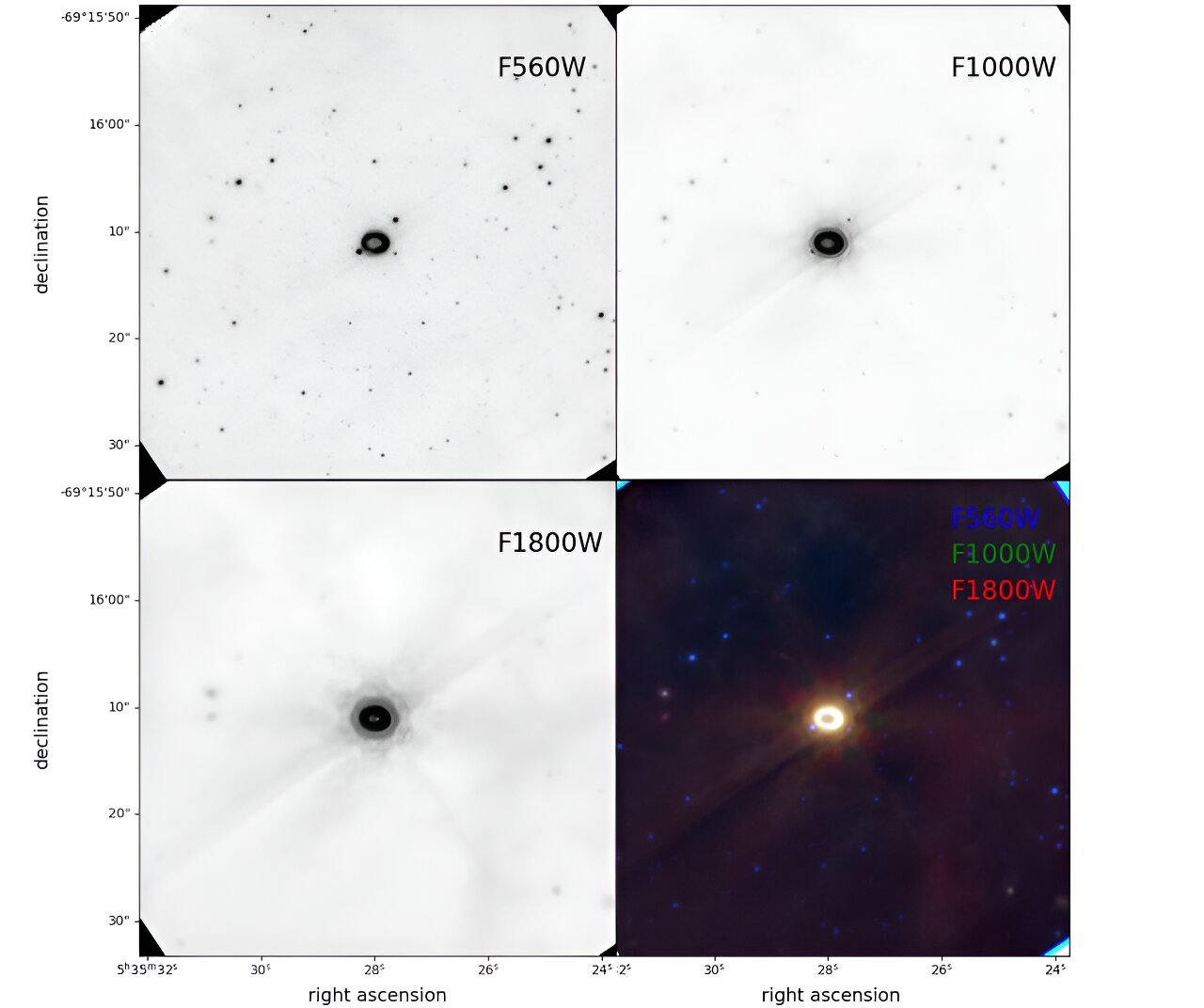
An international team of astronomers used the James Webb Space Telescope to conduct mid-infrared observations of the nearby supernova SN 1987A, shedding more light on its nature. The observations revealed the equatorial ring's morphology and composition, showing non-uniform dust temperatures and mass distribution. The data also suggested that the shock wave has affected the circumstellar medium on a larger scale. This study provides valuable insights into the evolution of supernovae and the processes involved in their transformation into supernova remnants.

"JWST Uncovers Neutron Star at Core of Famous Supernova"
astronomy1 year ago

"JWST Uncovers Neutron Star at Core of Famous Supernova"

The James Webb Space Telescope has found evidence of a newly born neutron star at the site of Supernova 1987A, a legendary event in the astronomy community. This discovery validates astronomers' understanding of supernovae and provides insight into the aftermath of massive star explosions. Despite recent irregularities in publication, the Daily Telescope continues to share real images of the universe, aiming to inspire wonder and appreciation for the cosmos.

"Webb Telescope Discovers Neutron Star in Famous Supernova Remnant"
astronomy1 year ago

"Webb Telescope Discovers Neutron Star in Famous Supernova Remnant"

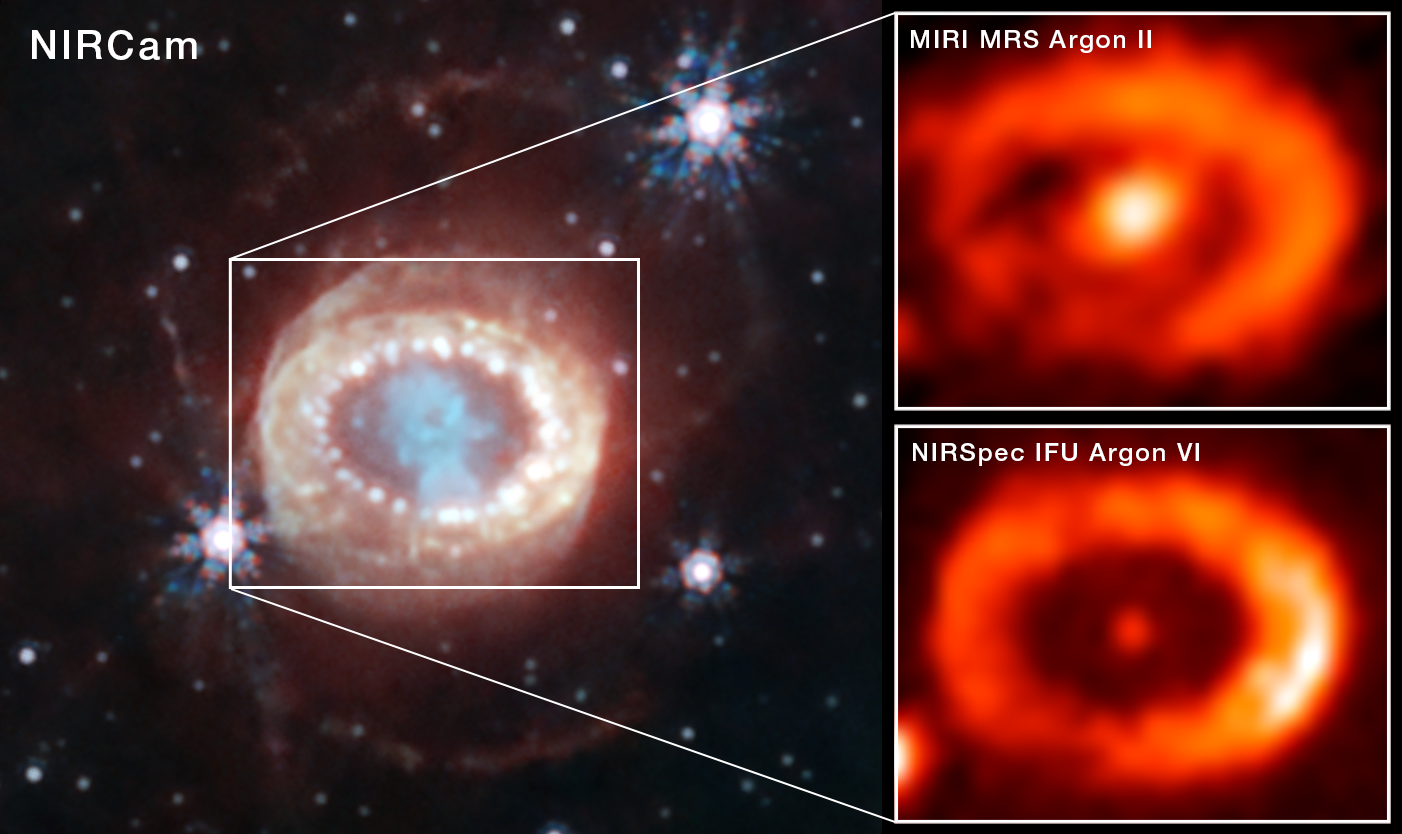
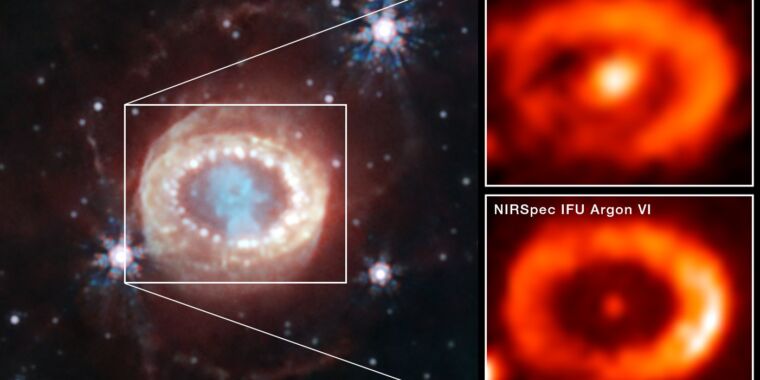
Using the James Webb Space Telescope, astronomers have discovered evidence of a neutron star in the remnants of supernova SN 1987A, which occurred 160,000 light-years from Earth in the Large Magellanic Cloud. The recent study provided the first direct evidence of the presence of a neutron star in the supernova remnant, resolving a mystery that has lasted for more than 30 years. The discovery was made by analyzing ionized argon atoms using Webb's Near-Infrared Spectrograph and Mid-Infrared Instrument, and the findings were published in the journal Science on Feb. 22, 2024.

"James Webb Space Telescope Uncovers Neutron Star in Famous Supernova Remnant"
astronomy1 year ago

"James Webb Space Telescope Uncovers Neutron Star in Famous Supernova Remnant"

The James Webb Space Telescope has provided the best evidence yet for the presence of a neutron star at the site of the supernova SN 1987A, offering direct evidence of high-energy emission from the probable young neutron star. This discovery, made using the Medium Resolution Spectrograph mode of Webb’s MIRI, marks a significant step in understanding core-collapse supernovae and the formation of compact objects such as neutron stars or black holes. Further observations are planned to gain more insight into the processes occurring in the heart of the SN 1987A remnant.

"Pulsar Formation Unveiled: JWST and ALMA Shed Light"
astronomy2 years ago

"Pulsar Formation Unveiled: JWST and ALMA Shed Light"

The combination of observations from the James Webb Space Telescope (JWST) and the Atacama Large Millimeter/submillimeter Array (ALMA) has provided new insights into the remnant of Supernova 1987A (SN 1987A), suggesting the possible formation of a pulsar. ALMA's high-resolution images revealed a hot spot within the remnant, indicating the presence of a young neutron star. JWST's observations unveiled previously unseen features, including crescent-like shapes, which have yet to be fully understood. As the remnant continues to evolve, future observations may reveal whether a pulsar is indeed forming within SN 1987A.

"Webb Telescope's Glimpse into a Nearby Supernova Remnant"
astronomy2 years ago

"Webb Telescope's Glimpse into a Nearby Supernova Remnant"

The James Webb Space Telescope (JWST) has provided new insights into the nearby supernova remnant SN 1987a, located 168,000 light-years away in the Large Magellanic Cloud. The JWST image reveals a bright equatorial ring of ionized gas, as well as a turbulent keyhole structure in the center where clumps of gas expand into space. However, the dense gas and dust in the inner keyhole region prevent observation of the remnant star, which is expected to have formed a neutron star. Further study is needed to understand the formation and interaction of neutron stars with surrounding material.

Unprecedented Supernova Image Unveils Astonishing Structures
astronomy2 years ago

Unprecedented Supernova Image Unveils Astonishing Structures

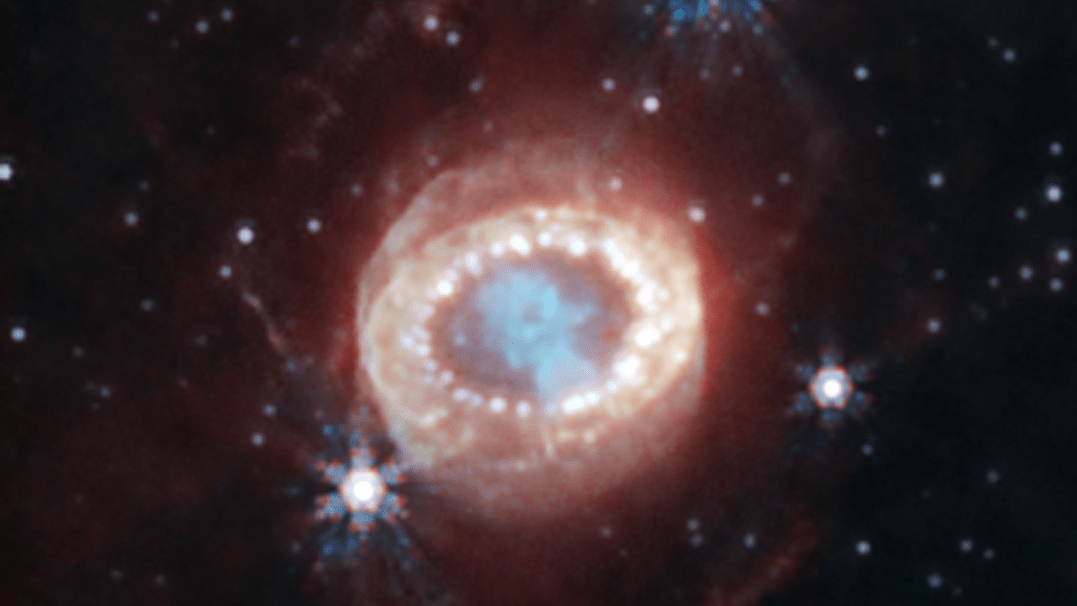
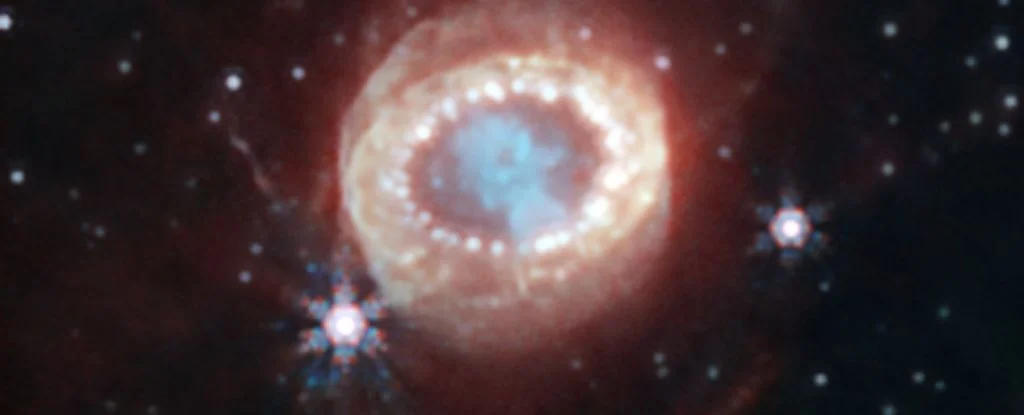
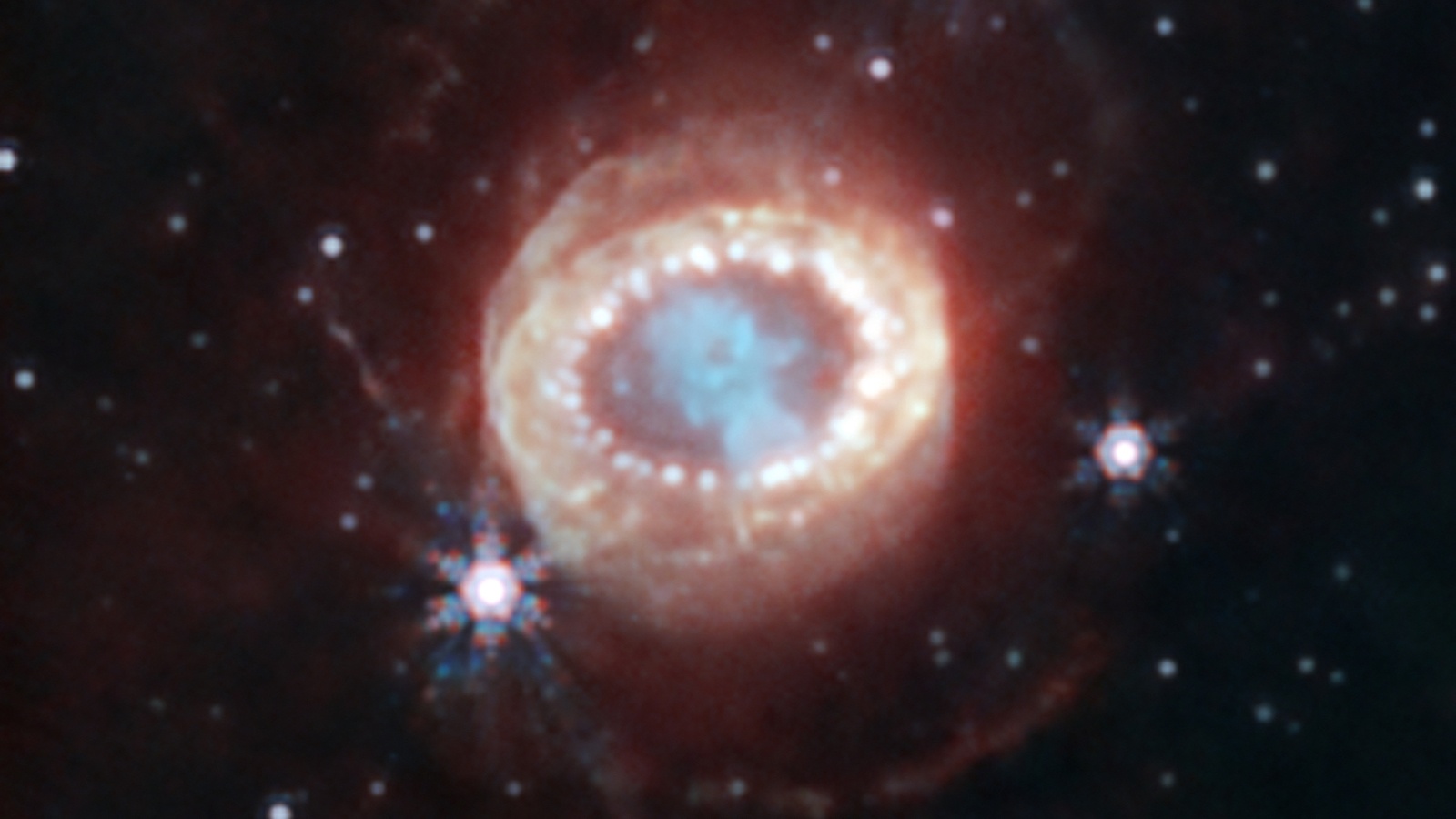
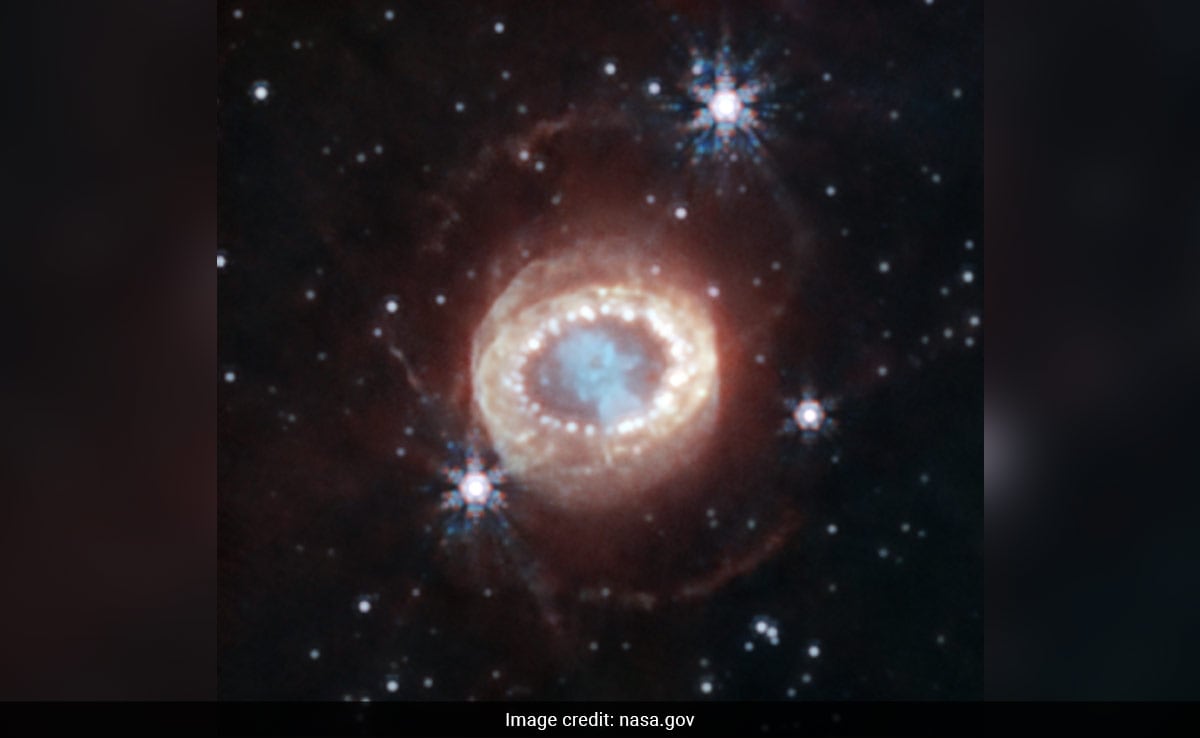
The James Webb Space Telescope has captured a stunning image of the supernova remnant SN 1987A, revealing never-before-seen structures within the exploded star's debris. The image shows an hourglass structure, a dark clump of dust concealing a possible neutron star, a bright ring with hot shocks, and crescent-like structures thought to be part of the outer layers of gas from the explosion. The observations were made in near-infrared, allowing the telescope to see through dusty regions. The telescope will continue to monitor the supernova's evolution and search for the missing neutron star.

JWST Analyzes the Closest Supernova of the Modern Era
astronomy2 years ago

JWST Analyzes the Closest Supernova of the Modern Era

The James Webb Space Telescope (JWST) has examined SN 1987a, the closest supernova observed in the modern era, located in the Large Magellanic Cloud about 168,000 light-years away. JWST's observations reveal a turbulent keyhole structure and rich chemical interactions in the center of the supernova. However, the dense gas and dust prevent the observation of the remnant star, which should have formed a neutron star. The formation of neutron stars and their interaction with surrounding matter remains a mystery that requires further study. SN 1987a is likely the closest supernova we will be able to study for some time, unless Betelgeuse explodes in the near future.

"James Webb Space Telescope Uncovers Unprecedented Detail of Famous Supernova's Expanding Remains"
astronomy2 years ago

"James Webb Space Telescope Uncovers Unprecedented Detail of Famous Supernova's Expanding Remains"

The James Webb Space Telescope (JWST) has captured a stunning image of the expanding remains of a supernova that exploded 36 years ago. The image, taken by the observatory's Near Infrared Camera (NIRCam), reveals intricate details of the supernova remnant, including a central structure resembling a keyhole. The image shows clumpy gas and dust ejected by the explosion, with a dense dust cloud shaping a dark "hole" in the keyhole. The observation of SN 1987A, located 168,000 light-years away, provides valuable insights into the development of supernovae and their remnants. The Webb telescope will continue to study the supernova over time, collaborating with other observatories to unravel the mysteries surrounding this legendary event.