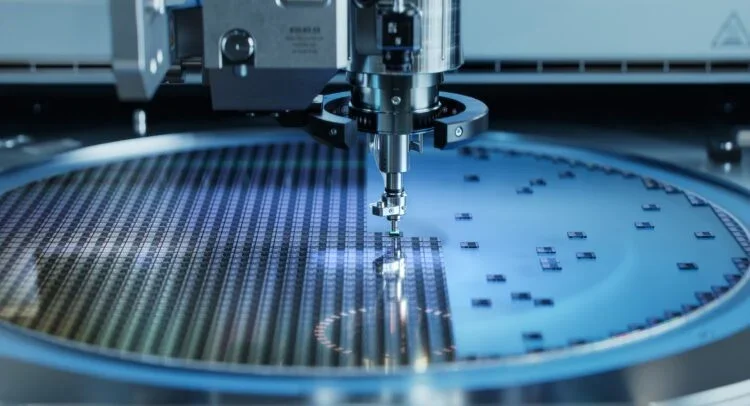
The article highlights three promising AI-related stocks—Axcelis Technologies, Bitfarms, and Western Digital—that have the potential to surge significantly by the end of the decade, emphasizing their roles in AI chip manufacturing, infrastructure, and memory solutions, respectively, and suggesting they could offer substantial returns for investors willing to look beyond the biggest players like Nvidia.
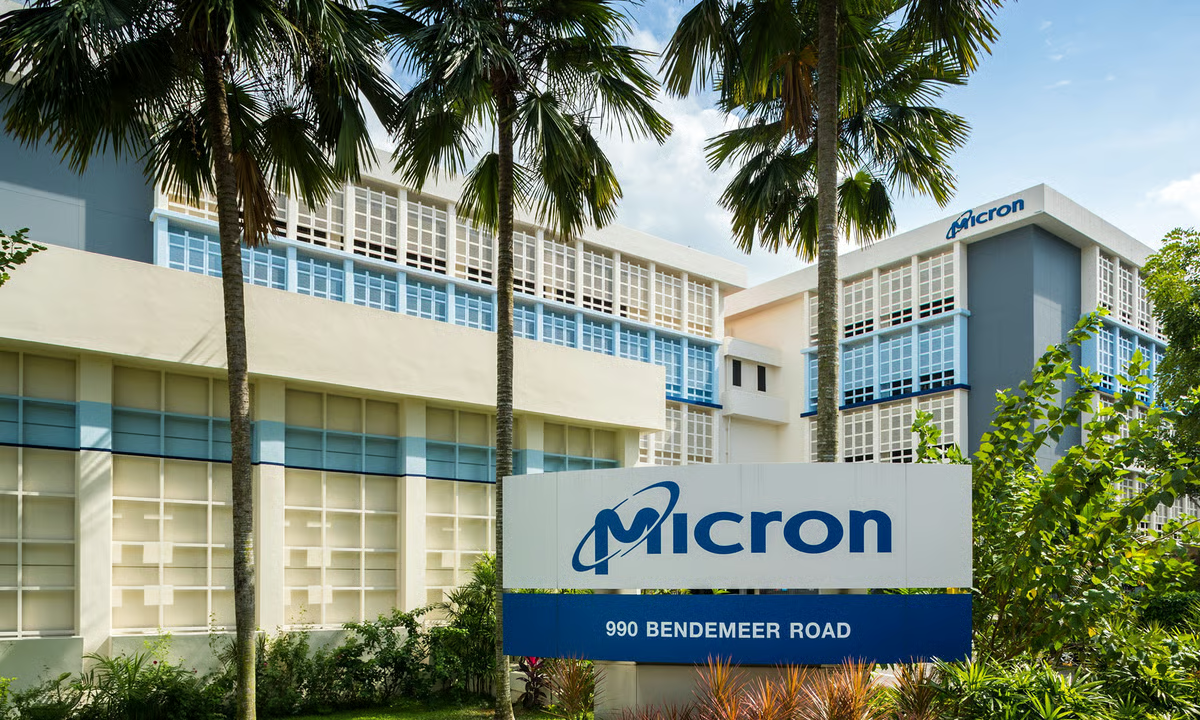
Micron stock rose 4.1% after Mizuho analyst Vijay Rakesh raised his 2026 price target to $390, citing attractive valuations and sector prospects, though concerns about cash flow and valuation multiples remain. Despite strong recent earnings and optimistic forecasts, some analysts advise caution, and Micron was not among the Motley Fool's top stock picks for future growth.
Intel's stock surged 6% after President Trump praised CEO Lip-Bu Tan and highlighted the U.S. government's stake in the company, boosting semiconductor and AI stocks amid a generally positive market response to economic data and corporate updates.
Mizuho Securities predicts strong AI-driven demand will boost semiconductor stocks in 2026, highlighting Nvidia, Broadcom, and Lumentum as top picks due to their roles in AI accelerators, optical networking, and advanced chips, while also noting potential growth in related sectors like wafer fabrication and memory, despite some sector weaknesses.
Memory chip stocks, led by Samsung, SK Hynix, and Micron, surged in 2024 due to strong AI-related demand and supply constraints, especially in DRAM, leading to expected price increases and positive earnings outlooks for these companies and their supply chain partners like ASML.
Texas Instruments, a manufacturer of analog chips crucial for AI infrastructure, has underperformed in recent years but is poised to benefit from the AI boom, especially in data centers and automotive industries, making it a potential undervalued investment opportunity.
TSMC shares surged to a record high after Goldman Sachs raised its price target, driven by strong optimism over AI demand and the company's growth prospects, with analysts viewing AI as a multi-year growth engine for the chipmaker.
The article explores the significance of ASML's $400 million EUV lithography machine, essential for GPU manufacturing and AI development, highlighting its complex technology, geopolitical implications, and the inevitable progression towards more advanced and expensive machines, reflecting on the fleeting nature of technological dominance.
Nvidia predicts a $65 billion revenue in Q4 2026, reflecting strong demand for AI infrastructure and positioning itself as a key player in the ongoing AI boom, which is expected to drive significant industry growth over the next decade.
The article recommends Nvidia and TSMC as top long-term AI stocks, highlighting Nvidia's dominant GPU position and recent acquisitions, and TSMC's crucial role in manufacturing advanced chips for AI infrastructure, both poised to benefit from the ongoing AI growth over the next decade.
Baidu's AI chip unit Kunlunxin has confidentially filed for a Hong Kong IPO, aiming for a spin-off and separate listing, as part of China's broader push to develop domestic semiconductor alternatives amid U.S. export restrictions. The company, valued at around $3 billion, will remain a subsidiary of Baidu after the IPO, with details yet to be finalized.
The semiconductor industry is projected to reach $1 trillion in revenue by 2026, driven by AI infrastructure spending, with Nvidia positioned as a leading player in AI chips and data center GPUs, making it a top stock to buy before the industry hits this milestone.
A Cardiff-based startup, Space Forge, has successfully sent a mini factory into orbit that can produce ultra-pure semiconductors in space, leveraging the vacuum and weightlessness to create higher quality materials than possible on Earth. The company plans to develop larger factories and test re-entry technology, opening new possibilities for manufacturing in space that could benefit electronics and other industries on Earth.
The article discusses the Silicon Controlled Rectifier (SCR), an old semiconductor device from the 1950s that acts as a latching electronic switch, now largely replaced by modern components like TRIACs and MOSFETs, but still found in vintage schematics and applications.