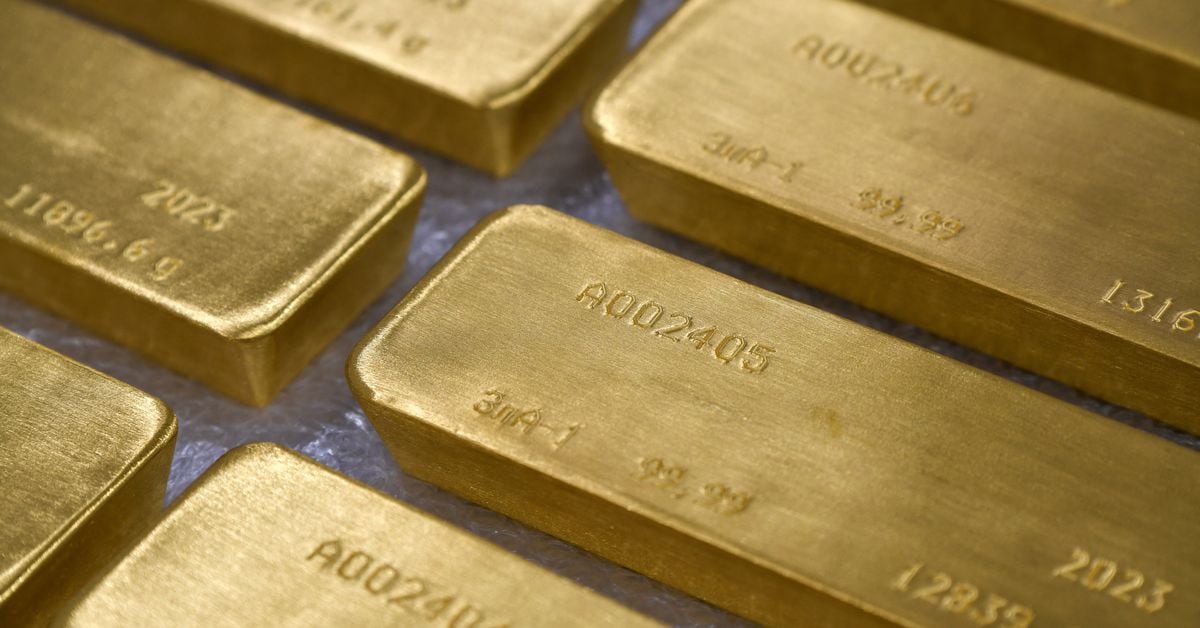
Gold prices rose by 0.9% to $4,368.30 per ounce following increased geopolitical tensions after the U.S. captured Venezuelan President Nicolás Maduro, supporting gold demand as a safe-haven asset amid global political unrest.
Despite a recent drop in gold prices from nearly $2,700 to under $2,600 per ounce, investors should consider this a temporary fluctuation and an opportunity to invest. Gold remains a safe-haven asset, providing stability against more volatile investments like stocks and real estate. While waiting for prices to fall further might be tempting, it's unlikely they will return to early 2024 levels, especially with inflation on the rise. Investors should maintain a balanced portfolio, keeping gold investments within 10% to avoid overshadowing other income-generating assets.
Gold prices have surged to record highs amid escalating Middle East tensions, with Citi projecting a potential rise to $3,000 per ounce over the next 6-18 months. The safe-haven appeal of gold has been bolstered by geopolitical heat and record equity index levels, with analysts remaining bullish on its outlook due to continued physical demand and its appeal as a geopolitical hedge. Goldman Sachs has also revised its price target for gold upward to $2,700 per ounce by the end of the year.
Gold prices reached a new all-time high as market speculators gain confidence in potential U.S. Federal Reserve interest rate cuts, with expectations for a cut in May or June. The metal's appeal as a safe haven asset and overseas demand, particularly from China, have also contributed to the rally. The surge in gold prices has been driven by robust purchases from central banks seeking to diversify reserve portfolios due to geopolitical risks, domestic inflation, and the weakness of the U.S. dollar.
Gold prices reached a new all-time high, driven by expectations of U.S. interest rate cuts and its status as a safe haven asset. Market speculators are gaining confidence in potential Federal Reserve cuts, with expectations for a rate cut in May or June. The recent rise in the Fed's inflation gauge may keep the central bank from considering rate cuts for now. Gold prices tend to move inversely to interest rates, making them more attractive in a low-interest-rate environment. Overseas demand, particularly from China, has also contributed to the surge in gold prices, fueled by central bank purchases and weak economic performance in the country.
Gold's surge above $2,000 per ounce has sparked predictions of a rally to a new all-time high, with prices at six-month highs and up for two consecutive weeks. Mark Newton, head of technical strategy at Fundstrat, believes that gold is showing signs of a rally back to new all-time highs, with a breakout level of $2,050. Michele Schneider, partner and director of trading education and research at MarketGauge.com, suggests that gold could reach $3,000, citing its resilience in the face of a stable dollar and higher rates. The rise in gold prices is attributed to escalating geopolitical tensions and anticipation of the end of the Federal Reserve's tightening cycle. Central banks have been significant buyers of gold, with China leading the way.
The reputation of US Treasurys as a safe-haven asset has been questioned due to a historic bond sell-off and rising default fears. Moody's recent downgrade of the US credit outlook to "negative" and concerns over massive deficits and rising debt have raised doubts about the safety of Treasurys. While some argue that Treasurys still serve as a safe haven, others point to liquidity and interest rate risks, as well as the increasing cost of insuring against default. As concerns over debt sustainability and bond prices mount, investors have become more cautious, demanding higher compensation for holding Treasurys. However, some analysts believe that in a risk-off environment, Treasurys would still attract safe-haven flows.
Gold prices are facing headwinds due to a strong US dollar, rising Treasury yields, the Federal Reserve's hawkish stance, a resilient US economy, and anticipation of tight monetary policy. These factors have dampened the appeal of gold as a safe-haven asset and led to a decline in investor sentiment. The near-term outlook for gold prices leans bearish, but upcoming US inflation figures and economic instability events could potentially reignite investor interest in gold as a safe-haven asset. Traders should closely monitor the Federal Reserve's policy updates, inflation numbers, and geopolitical risks to gauge the direction of gold prices.
Bitcoin's recent surge to a six-month high of $28,000, reflecting about $106 billion in added market value, is due to a loss of faith in the US banking system, according to JPMorgan. The surge is also due to the launch of bitcoin ordinals, which allow for non-fungible tokens to be minted on bitcoin's blockchain, and the upcoming "halving" next spring, which makes marginal bitcoin mining costs twice as expensive. Bitcoin rallied as much as 30% in the six months following its prior halving events in 2016 and 2020.
Gold prices fell on Monday after hitting a one-year peak of over $2,000 earlier in the day, as investors booked profits amid banking fears and increasing bets of a rate pause by the Federal Reserve. Gold is considered a safe-haven asset during times of financial uncertainty, while lower interest rates reduce the opportunity cost of holding the non-yielding bullion. Investors will keenly watch a Fed policy decision due on Wednesday. Fitch Solutions expects significant price volatility in the coming weeks, but gold prices to remain elevated.
Investors are rushing into gold late Friday due to fears of a potential banking crisis over the weekend, driving prices up more than 3% to a one-year high of $1,988.80 an ounce. Analysts attribute the surge to classic demand for a safe-haven asset and short-covering. Silver is also outperforming gold due to its potential for speculative positioning. The risks of a banking crisis can also be seen in gold-backed exchange-traded products, with 16 tonnes of gold flowing into global ETFs this week, valued at $1 billion, reversing ten consecutive weeks of outflows.