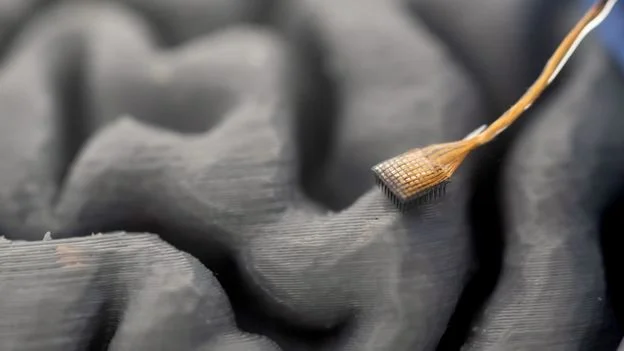
The article discusses a scalable, minimally invasive system of conformable, high-density cortical microelectrode arrays designed for neural recording, stimulation, and decoding, demonstrated in animal models and human patients, with potential to significantly advance brain-computer interface applications while prioritizing safety and reversibility.
Scientists have successfully decoded inner speech with up to 74% accuracy using brain-computer interfaces, enabling potential faster and more natural communication for people with speech impairments. The technology detects overlapping brain activity patterns between attempted and imagined speech, with a privacy feature using a password to control decoding. This breakthrough could significantly improve communication methods for those unable to speak audibly.
Researchers at Kobe University have developed an AI algorithm that can predict mouse movement with 95% accuracy by analyzing whole-cortex functional imaging data, without the need for data preprocessing. The AI model can make accurate predictions based on just 0.17 seconds of imaging data and has the potential to contribute to the development of non-invasive, near real-time brain-machine interfaces. The researchers also devised a technique to identify which parts of the data were pivotal for the prediction, offering insights into the AI's decision-making process and enhancing the interpretability of deep learning in neuroscience.
Researchers have used deep learning to decode mouse neural activity, accurately predicting the location and orientation of mice based on the firing patterns of "head direction" neurons and "grid cells." This collaboration with the US Army Research Laboratory aims to improve autonomous navigation in intelligent systems without GPS, potentially revolutionizing AI navigation. The study's findings could inform the design of AI systems capable of navigating autonomously in unknown environments by leveraging the neural mechanisms underlying spatial awareness and navigation found in biological systems.
Neuroscientists are developing technologies known as "thought decoders" that aim to decode and translate our thoughts into coherent sentences. While these technologies are not yet capable of reading our minds completely, they raise concerns about privacy and the potential for manipulation. The traditional view of the mind as a self-contained entity is being challenged by the idea that thoughts are shaped by external factors and social interactions. As these thought decoders evolve, it is crucial to recognize their formative potential and consider the ethical implications of their use.