Researchers have enhanced the BARseq technique to map millions of neurons, revealing how vision loss alters the visual cortex to resemble neighboring brain areas. This advancement could inform treatments for brain disorders like Alzheimer’s and schizophrenia by providing deeper insights into neural connections.
A study conducted at the Max Planck Institute for Human Cognitive and Brain Sciences reveals that adult learners of a second language experience dynamic changes in brain connectivity, particularly in the strengthening of white matter connections within the language network and the involvement of additional regions in the right hemisphere. The research, which involved intensive German learning for native Arabic speakers, suggests that the brain adapts to new cognitive demands by modulating the structural connectome within and across hemispheres, shedding light on how first and second languages are learned and processed.
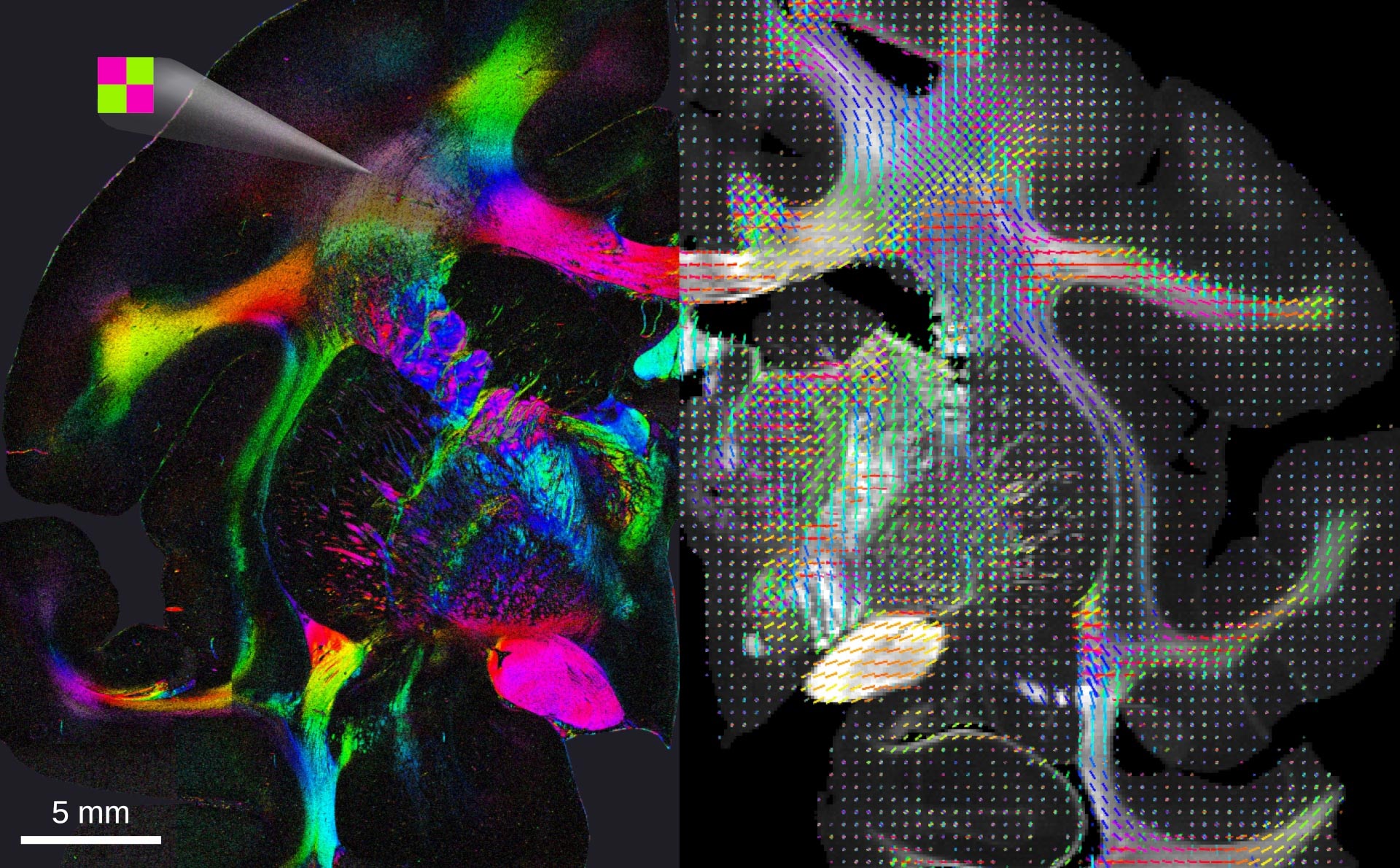
Researchers have developed a new brain imaging technique called Scattered Light Imaging (SLI) that combines light and X-ray scattering with MRI to map neural connections in the brain. SLI provides high-resolution results, particularly in regions with densely packed and interwoven nerve fibers, and is faster, cheaper, and more accessible than existing techniques like small-angle X-ray scattering (SAXS) and diffusion magnetic resonance imaging (dMRI). The technique could aid in understanding brain function and dysfunction and has potential applications in clinical research.
Researchers have discovered a specific type of neuronal connection in the prefrontal cortex, formed by inhibitory neurons, that plays a crucial role in updating our understanding of the world and its rules. These inhibitory neurons were found to communicate with neurons located far away in the opposite hemisphere of the prefrontal cortex. When these long-distance inhibitory neuronal connections were deactivated in mice, the mice were unable to adapt to changes, providing insights into conditions such as schizophrenia, bipolar disorder, and autism spectrum disorder, where patients struggle with adapting to change. This finding enhances our understanding of brain function and could have implications for studying and treating these psychiatric conditions.