
The debate over offering algebra to middle school students has become a national flashpoint, with concerns about equity and academic opportunity at the forefront. While top students can benefit from early exposure to the subject, many districts offer few opportunities for Black and Latino eighth graders to study it. The struggle to make algebra more equitable has sparked contentious debates over whether bias and inequality are keeping certain children off the fast track, leading to questions about eliminating algebra in middle schools to level the playing field. However, algebra serves as a crucial crossroads in the education system, with early exposure potentially leading to academic advantages and access to high-status professions, highlighting the need to address racial and economic gaps in math achievement.
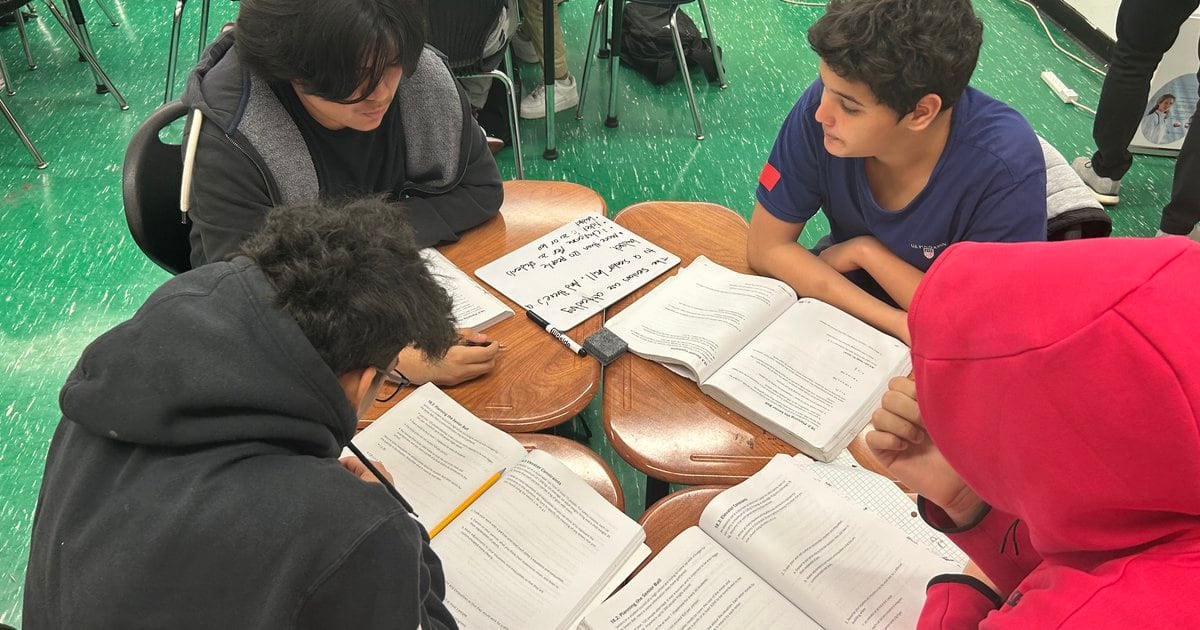
New York City officials have introduced the Illustrative Math curriculum in an effort to improve and standardize the way algebra is taught in the city's high schools. The curriculum emphasizes conceptual understanding over rote practice and memorization, but it has divided educators. Some argue that it engages students and promotes deep learning, while others believe it lacks structure and fails to support struggling students. The curriculum is being piloted in over 260 schools this year, with plans to expand next year. The success of the curriculum in improving math achievement and performance on Regents exams remains to be seen.
This opinion piece discusses the controversy surrounding California's proposal to eliminate the requirement of algebra as a prerequisite for high school graduation. The author argues that this move is misguided and will have negative consequences for students, as algebra is a fundamental skill necessary for success in higher education and many careers.
Hyperdimensional computing, a new approach to computation, is reimagining artificial intelligence. It uses hypervectors, high-dimensional vectors that can represent complex information, and a formal algebra to manipulate them for symbolic reasoning. Hyperdimensional computing is more resilient to hardware faults and offers transparency in decision-making. It is also compatible with low-power hardware and in-memory computing systems. While still in its infancy, hyperdimensional computing shows potential for solving real-world problems at scale.