The Thwaites Glacier in Antarctica, known as the 'Doomsday Glacier,' is experiencing rapid structural weakening due to crack growth, which accelerates ice flow and risks irreversible collapse, potentially raising global sea levels by 65 centimeters. The process involves a feedback loop where cracks lead to faster ice movement, further cracking, and destabilization, with patterns that could threaten other ice shelves as well.
A comprehensive study using 20 years of satellite data reveals that the Thwaites Glacier's Eastern Ice Shelf is rapidly destabilizing due to expanding fractures and a shift in the stabilizing pinning point, creating a self-reinforcing feedback loop that accelerates ice loss and poses a significant threat to global sea levels.
Scientists warn that Antarctica is experiencing unprecedented and rapid changes due to global warming, including ice shelf collapse and ecosystem disruption, which could lead to significant sea level rise and global climate impacts. Urgent action to reduce greenhouse gases is essential to prevent crossing dangerous thresholds and mitigate future disasters.
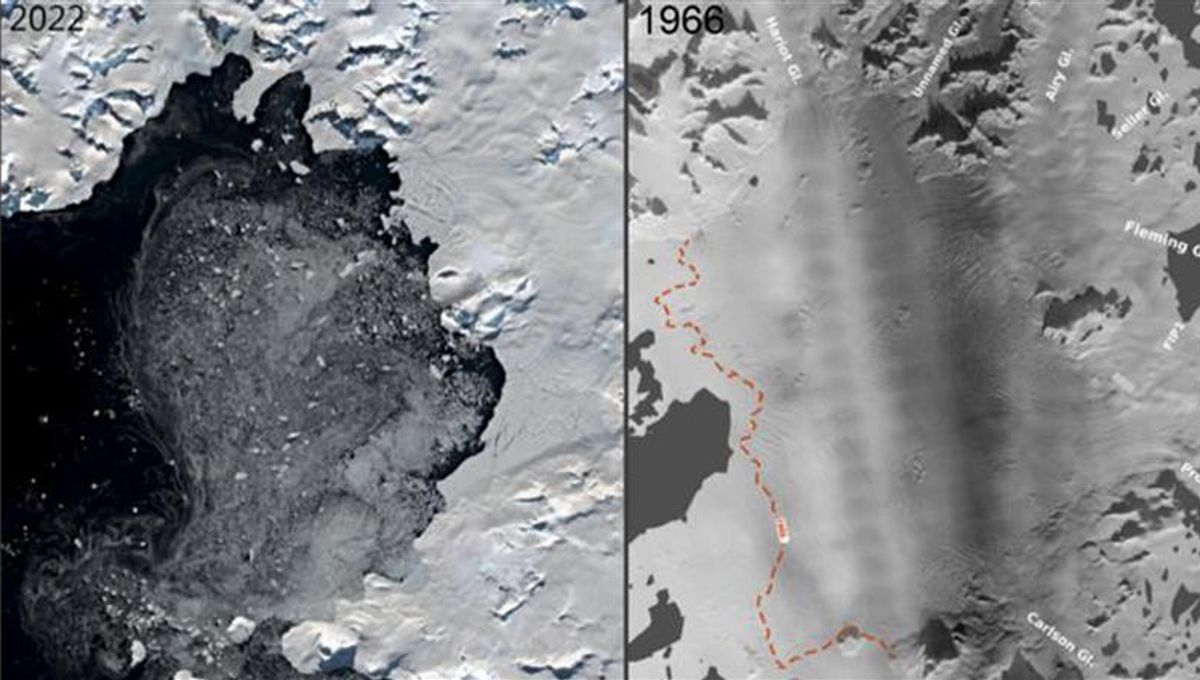
Researchers using historical aerial photos and modern satellite data have gained new insights into the collapse of Antarctic ice shelves, revealing that rising sea temperatures primarily cause melting beneath the ice, which suggests that ice shelf collapse may be slower than previously thought, emphasizing the urgent need to reduce greenhouse gas emissions to prevent irreversible sea level rise.
Scientists detected mysterious radio signals above Antarctica that cannot be explained by known particle physics, possibly hinting at new particles or interactions, with some speculation about dark matter; meanwhile, an ice shelf in East Antarctica has collapsed unexpectedly, raising concerns about climate stability.
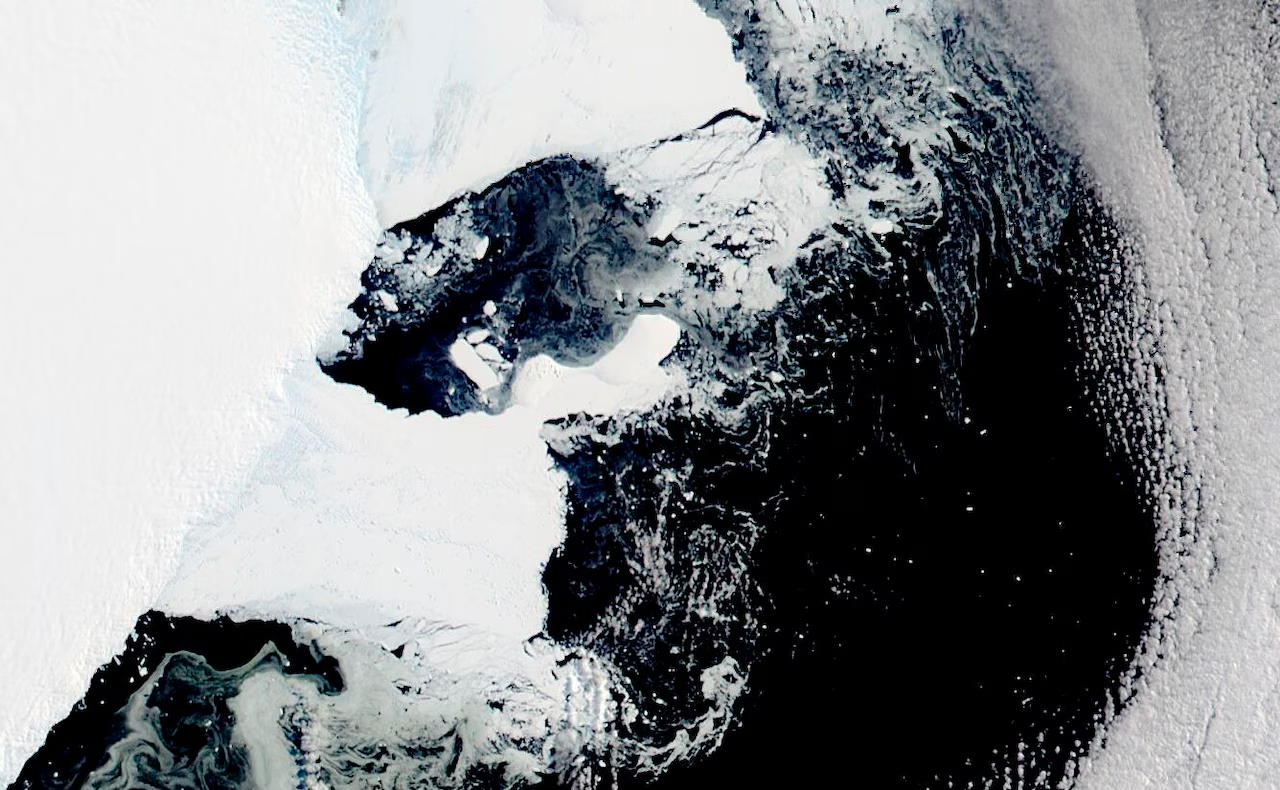
Satellite images and oceanographic measurements have revealed that Antarctica's Cadman Glacier on the western coast of the Antarctic Peninsula has experienced a dramatic retreat of 5 miles (8 kilometers) over a span of 2.5 years, followed by the complete collapse of its ice shelf. Warmer ocean temperatures, likely influenced by human-driven global warming, accelerated the process. The collapse of the ice shelf is expected to result in a faster loss of water from the glacier, contributing to sea level rise. The neighboring glaciers in the region did not react in the same way, suggesting the presence of underwater ridges acting as protective barriers. However, with rising ocean temperatures, these glaciers may also be at risk. The findings highlight the need for comprehensive ocean observing networks in Antarctica to better understand and predict the impact of climate change on the region.
Satellite images and oceanographic measurements have revealed the dramatic retreat of Antarctica's Cadman Glacier, located on the western coast of the Antarctic Peninsula. Over a period of just 2.5 years, the glacier retreated 5 miles (8 kilometers) and its ice shelf, which floats on the ocean's surface, completely collapsed. Warmer ocean temperatures, likely influenced by human-driven global warming, accelerated the process. The collapse of the ice shelf is expected to result in a faster loss of water from the glacier, contributing to sea level rise. The neighboring glaciers did not react in the same way, suggesting the importance of understanding the impact of climate change on this sensitive polar region. The study highlights the need for comprehensive ocean observations around Antarctica to better understand glacial dynamics.