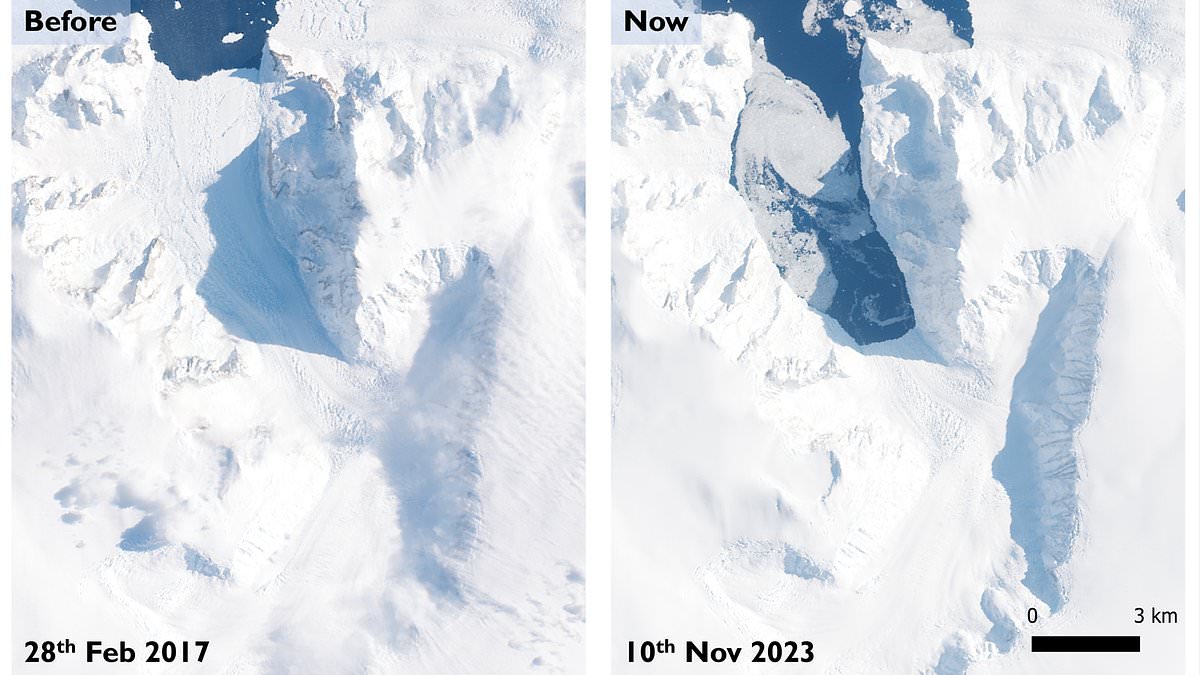
Satellite images and oceanographic measurements have revealed that Antarctica's Cadman Glacier on the western coast of the Antarctic Peninsula has experienced a dramatic retreat of 5 miles (8 kilometers) over a span of 2.5 years, followed by the complete collapse of its ice shelf. Warmer ocean temperatures, likely influenced by human-driven global warming, accelerated the process. The collapse of the ice shelf is expected to result in a faster loss of water from the glacier, contributing to sea level rise. The neighboring glaciers in the region did not react in the same way, suggesting the presence of underwater ridges acting as protective barriers. However, with rising ocean temperatures, these glaciers may also be at risk. The findings highlight the need for comprehensive ocean observing networks in Antarctica to better understand and predict the impact of climate change on the region.
Satellite images and oceanographic measurements have revealed the dramatic retreat of Antarctica's Cadman Glacier, located on the western coast of the Antarctic Peninsula. Over a period of just 2.5 years, the glacier retreated 5 miles (8 kilometers) and its ice shelf, which floats on the ocean's surface, completely collapsed. Warmer ocean temperatures, likely influenced by human-driven global warming, accelerated the process. The collapse of the ice shelf is expected to result in a faster loss of water from the glacier, contributing to sea level rise. The neighboring glaciers did not react in the same way, suggesting the importance of understanding the impact of climate change on this sensitive polar region. The study highlights the need for comprehensive ocean observations around Antarctica to better understand glacial dynamics.
The Cadman Glacier in Western Antarctica is losing mass at an alarming rate, releasing 2.16 billion tonnes of ice into the ocean annually. Its thickness is decreasing by about 65 feet per year, equivalent to a five-storey building. The glacier's retreat and ice loss were observed between November 2018 and May 2021, with the collapse of its ice shelf contributing to increased ice discharge. Warmer ocean waters, likely caused by climate change, have been thinning the glacier's ice shelf since the early 2000s. The study highlights the sensitivity of the Antarctic Peninsula to future climate variability and the potential impact on rising sea levels.