Tag

Holography

All articles tagged with #holography

Quantum Extensions of Black Hole Inequalities

Originally Published 1 year ago — by Phys.org

Featured image for Quantum Extensions of Black Hole Inequalities
Source: Phys.org

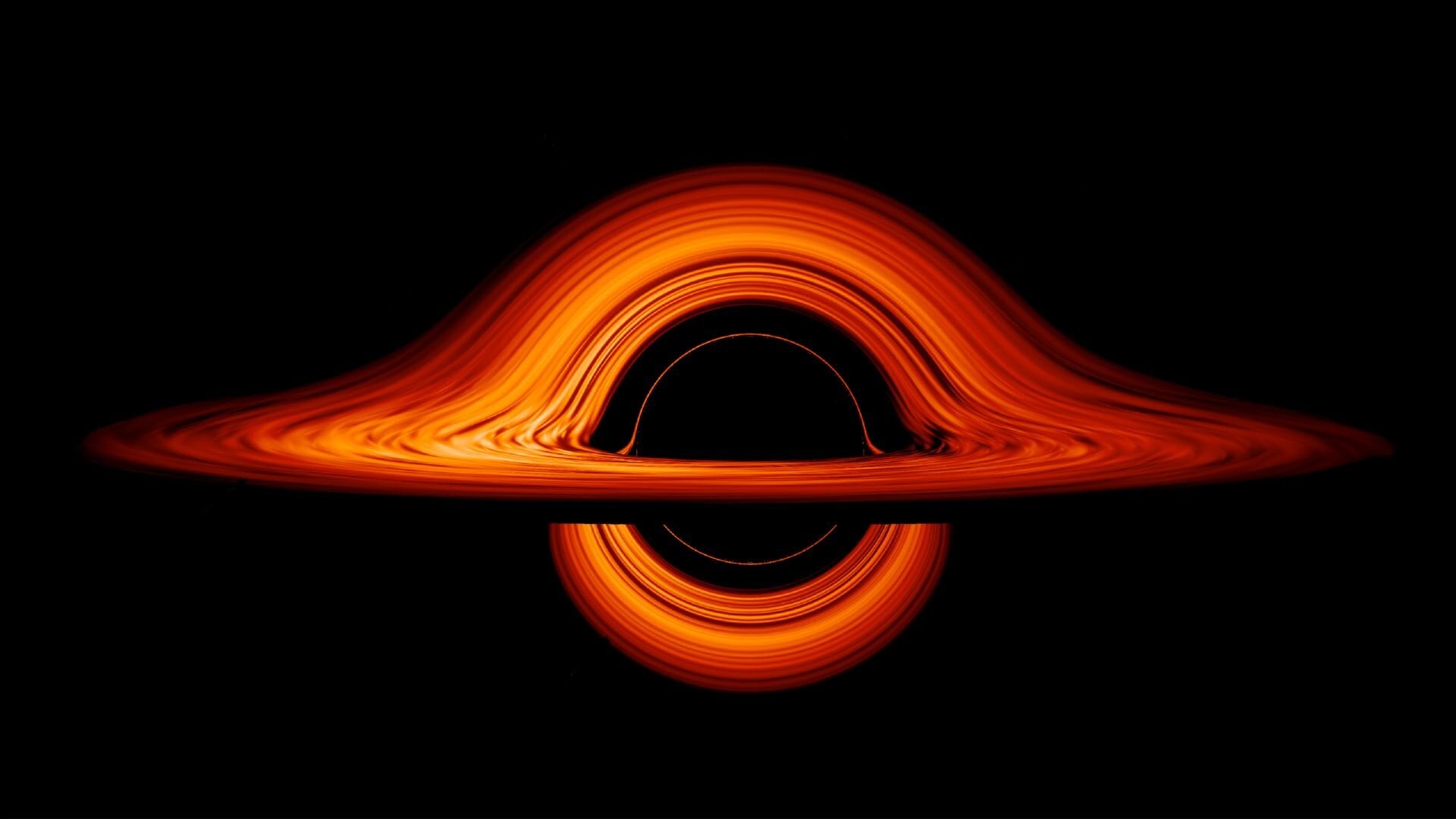
Researchers have extended classical black hole inequalities, such as the Penrose and reverse isoperimetric inequalities, into the quantum realm, using braneworld holography to account for quantum effects. This study, published in Physical Review Letters, explores how quantum phenomena influence black hole dynamics, potentially offering insights into quantum gravity. The work suggests that quantum effects could enforce cosmic censorship by preventing naked singularities, and provides new entropy bounds relevant to quantum information theory.

"Groundbreaking Visualization of Quantum Entanglement Achieved"

Originally Published 2 years ago — by Advanced Science News

Featured image for "Groundbreaking Visualization of Quantum Entanglement Achieved"
Source: Advanced Science News

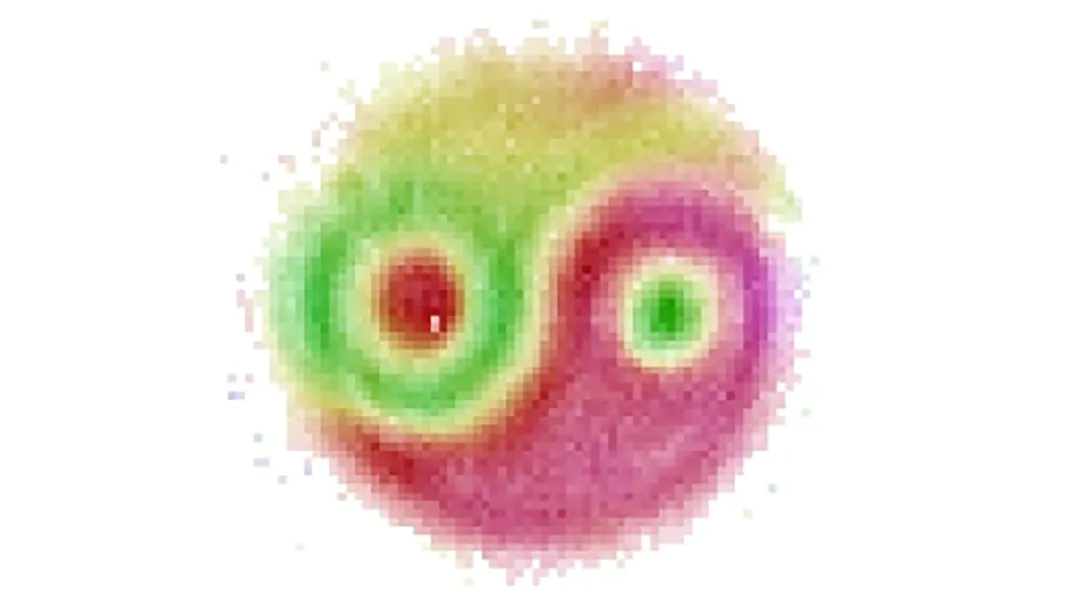
Researchers from the University of Ottawa and the Sapienza University of Rome have developed a technique using digital holography to visualize the wavefunction of an entangled pair of photons, demonstrating the reality of quantum entanglement. The technique involves superimposing the wave of the entangled photons with a reference wave and analyzing the distribution of coincidences. The resulting image resembles a Yin and Yang symbol and has implications for quantum technologies such as quantum computers. The technique also has the potential to inspire new imaging techniques beyond the limits of classical optics.

"Quantum Yin-Yang: Physicists Unveil Groundbreaking Visualization of Entangled Light"

Originally Published 2 years ago — by ScienceAlert

Featured image for "Quantum Yin-Yang: Physicists Unveil Groundbreaking Visualization of Entangled Light"
Source: ScienceAlert

Physicists have developed a new analytical technique using biphoton digital holography to measure multiple quantum states in entangled particles more efficiently. By applying holographic principles, researchers were able to infer additional dimensions from just a few details carried between a pair of photons, allowing them to recreate a yin-and-yang symbol programmed into the photon-generating apparatus. This method is exponentially faster than previous techniques, providing a solution to the scalability challenge in projective tomography and offering potential advancements in quantum computing and imaging technologies.

Metamaterials Revolutionize Holography's Spectrum Possibilities.

Originally Published 2 years ago — by SciTechDaily

Featured image for Metamaterials Revolutionize Holography's Spectrum Possibilities.
Source: SciTechDaily

Researchers at Pohang University of Science and Technology have developed a method for generating meta-holograms in both the visible and ultraviolet spectral regions, overcoming prior limitations. They also devised a way to encode two distinct holographic phase profiles onto a single metasurface, leveraging polarization characteristics and liquid crystal, leading to potential applications in security technologies such as anti-counterfeiting measures, identifications, and passports.

Exploring holographic quantum gravity models for cosmological acceleration.

Originally Published 2 years ago — by Phys.org

Featured image for Exploring holographic quantum gravity models for cosmological acceleration.
Source: Phys.org

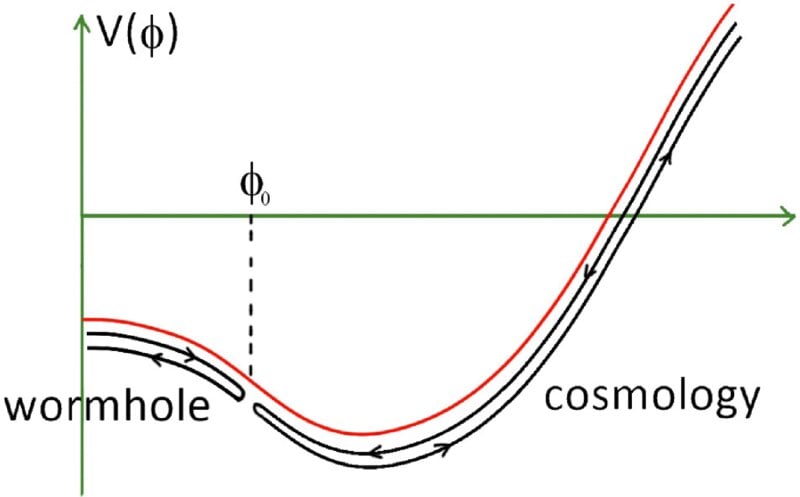
Theoretical physicists have proposed that holography, an approach to quantum gravity, could be used to describe quantum mechanical phenomena and explain cosmological acceleration. Holographic models suggest that dark energy density changes with time, eventually becoming negative, which could cause a deceleration and eventual re-collapse of the universe. The researchers have compared their predictions with available cosmological observations and found that most of the models that fit the data acceptably do have decreasing dark energy at present. Further research is needed to better understand the predictions of the class of models and compare them to recent observations.

Exploring de Sitter space to explain early universe gravity.

Originally Published 2 years ago — by Phys.org

Featured image for Exploring de Sitter space to explain early universe gravity.
Source: Phys.org

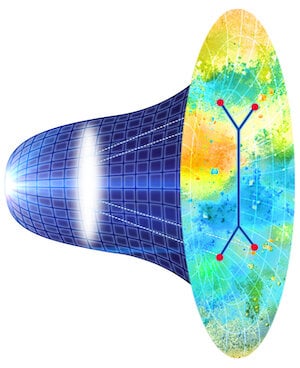
Researchers from Kyoto University are exploring 'de Sitter space' to explain gravity in the expanding early universe by invoking a higher dimension. They have developed a method to compute correlation functions among fluctuations on the expanding universe by making use of holography. The team's calculations only considered a three-dimensional universe as a test case, but the analysis may easily be extended to a four-dimensional universe, allowing for the extraction of information from our real world. The approach possibly contributes to validating superstring theory and allows for practical calculations about the subtle changes that rippled across the fabric of our early universe.