Tag

Geomagnetism

All articles tagged with #geomagnetism

A Haunting Audio Recreates Earth's Near-Collapse of Its Magnetic Shield
science1 month ago

A Haunting Audio Recreates Earth's Near-Collapse of Its Magnetic Shield

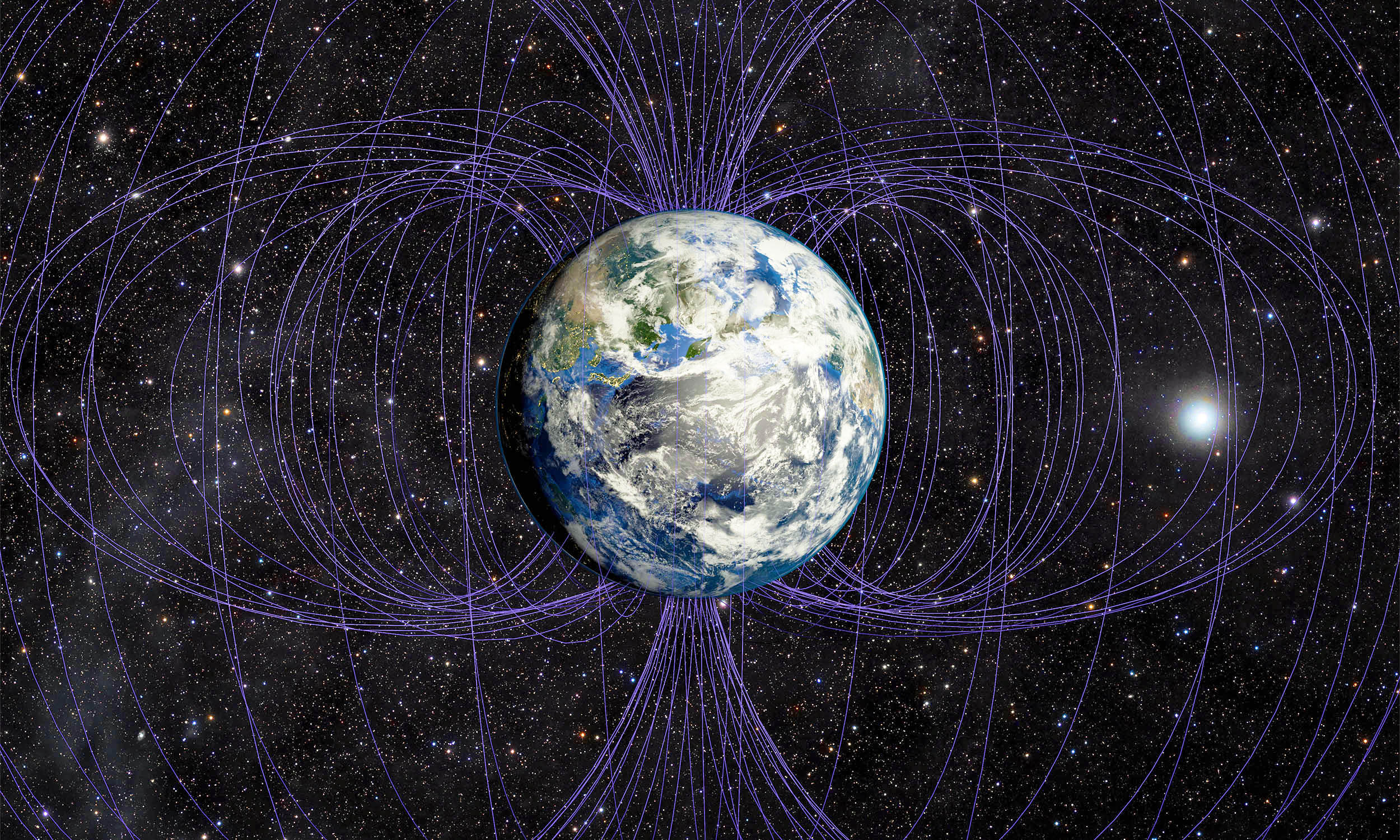
Researchers converted ESA Swarm satellite data and geological records into sound to recreate the Laschamps geomagnetic reversal (~41,000 years ago), when Earth's magnetic field weakened to about 5% of its current strength, potentially increasing cosmic radiation and affecting climate and early human life; the eerie audio illustrates chaotic magnetic shifts and underscores current concerns about weakening regions like the South Atlantic Anomaly.

Hear Earth's Ancient Magnetic Flip: A Haunting Audio
science1 month ago

Hear Earth's Ancient Magnetic Flip: A Haunting Audio

Scientists reconstructed the Laschamps magnetic reversal (about 41,000 years ago) by merging ESA’s Swarm satellite data with geomagnetic records, turning the upheaval into an eerie audio track that suggests the field briefly weakened to around 5% of its current strength for about 440 years. The work, highlighted by DTU and GFZ researchers and published in 2024, underscores the importance of understanding past extreme geomagnetic events to anticipate future space weather and environmental effects, especially amid ongoing pole drift and the South Atlantic Anomaly.

Earth's Ancient Magnetic Flip Reimagined as Haunting Audio
science1 month ago

Earth's Ancient Magnetic Flip Reimagined as Haunting Audio

Scientists used ESA’s Swarm satellite data to turn the 41,000-year-old Laschamps magnetic reversal into an eerie audio track, illustrating a dramatic field flip when the magnetosphere weakened by roughly 5–25% of its current strength over about 250 years and remained abnormally oriented for around 440 years. The event increased cosmic-ray exposure, leaving isotopic fingerprints like higher beryllium-10 and potentially impacting climate and megafauna; ongoing Swarm measurements aim to better predict future geomagnetic fluctuations.

Growing Weak Spot in Earth's Magnetic Field Detected by Satellites
science4 months ago

Growing Weak Spot in Earth's Magnetic Field Detected by Satellites

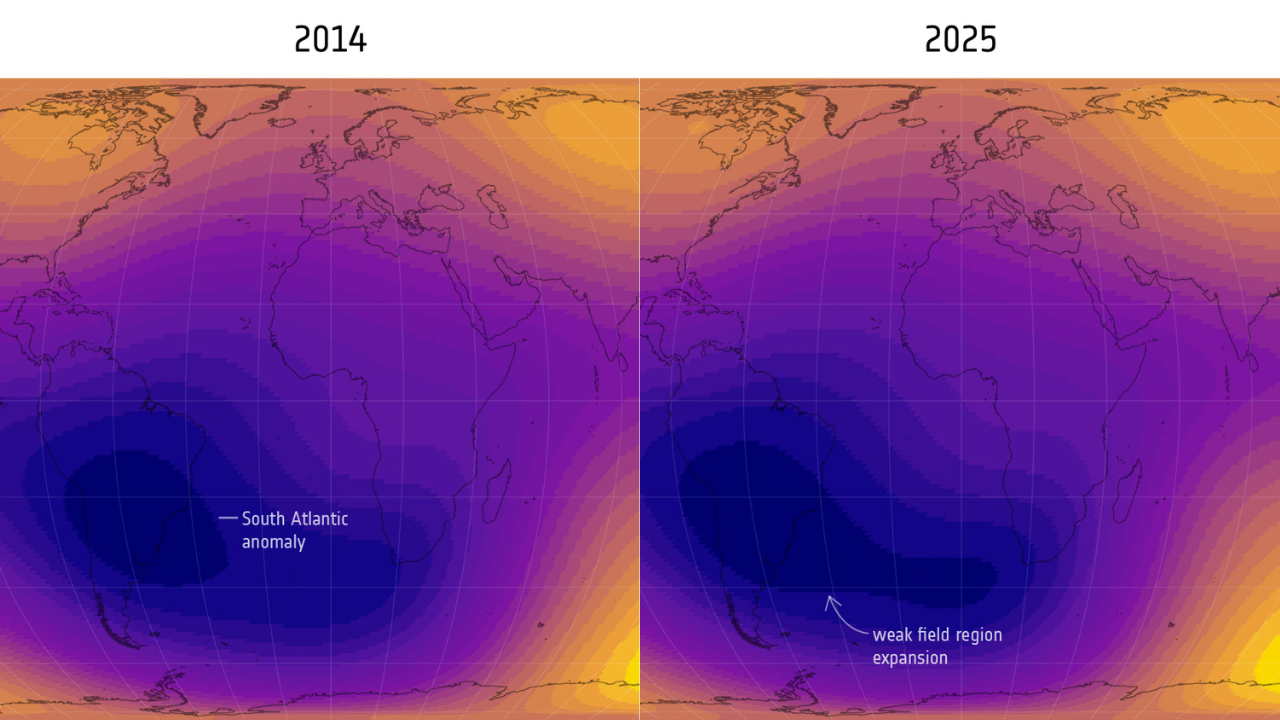
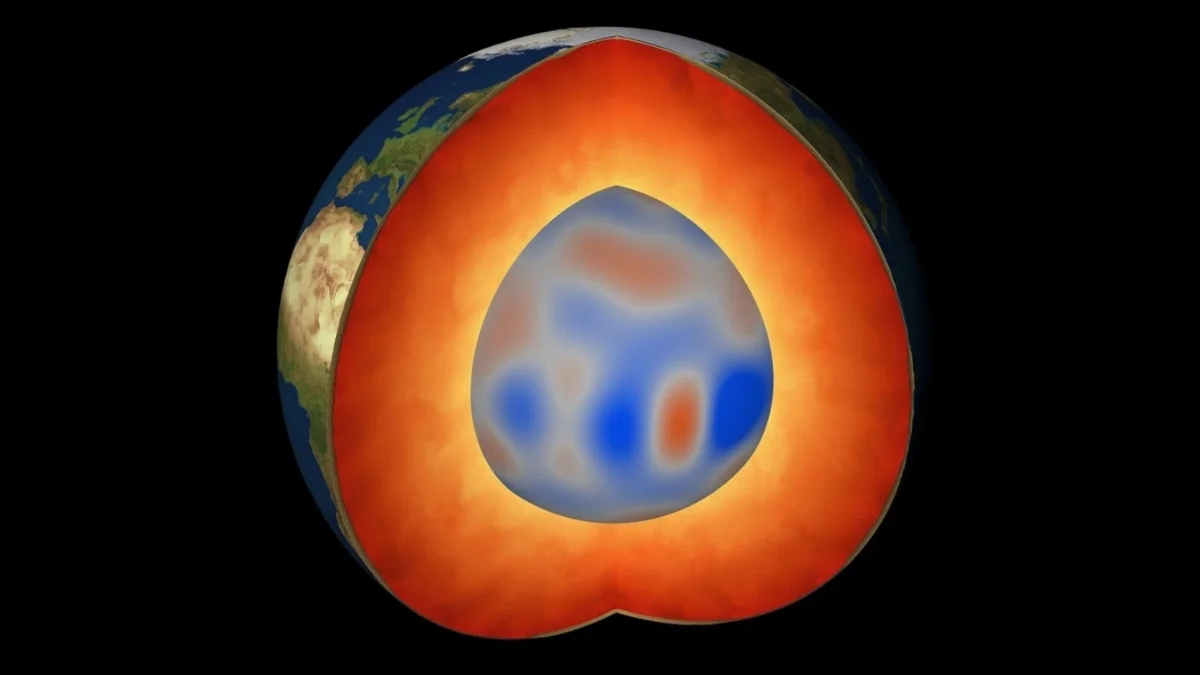
A significant and growing weak spot in Earth's magnetic field, known as the South Atlantic Anomaly, has expanded since 2014, posing risks to satellites and spacecraft. This growth is linked to complex flux patterns at Earth's outer core, with changes also observed over Canada and Siberia, indicating ongoing shifts in Earth's magnetic dynamics.

Magnetic North Pole's Unprecedented Shift Towards Russia Stuns Scientists
science1 year ago

Magnetic North Pole's Unprecedented Shift Towards Russia Stuns Scientists

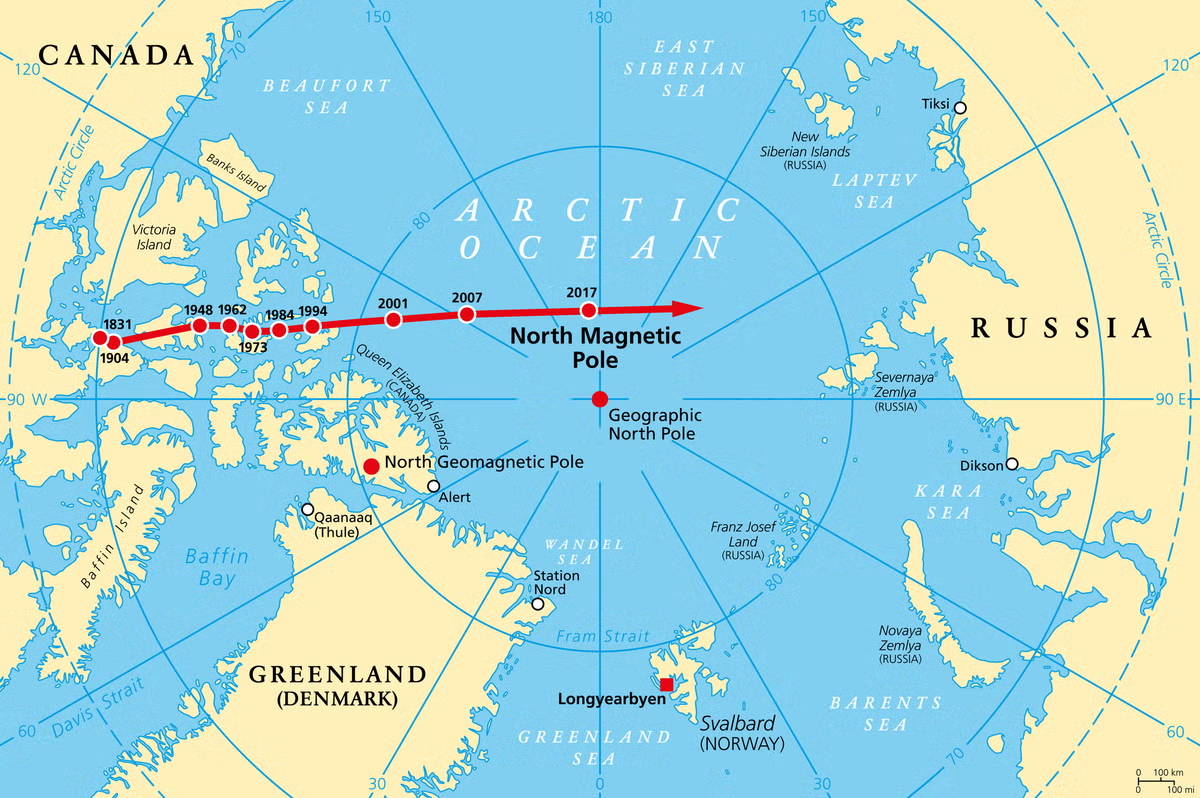
The magnetic North Pole is moving towards Russia at an unprecedented speed, raising concerns about its impact on navigation systems and technology. This rapid shift, influenced by changes in Earth's molten core and solar interactions, could disrupt devices reliant on magnetic orientation. Scientists are monitoring the situation closely, as it may also indicate a potential magnetic pole reversal, which could expose Earth to increased cosmic radiation. Efforts are underway to update navigation models and understand the underlying geodynamic processes.

Magnetic North Pole's Unprecedented Shift Towards Russia May Impact Smartphones
science1 year ago

Magnetic North Pole's Unprecedented Shift Towards Russia May Impact Smartphones

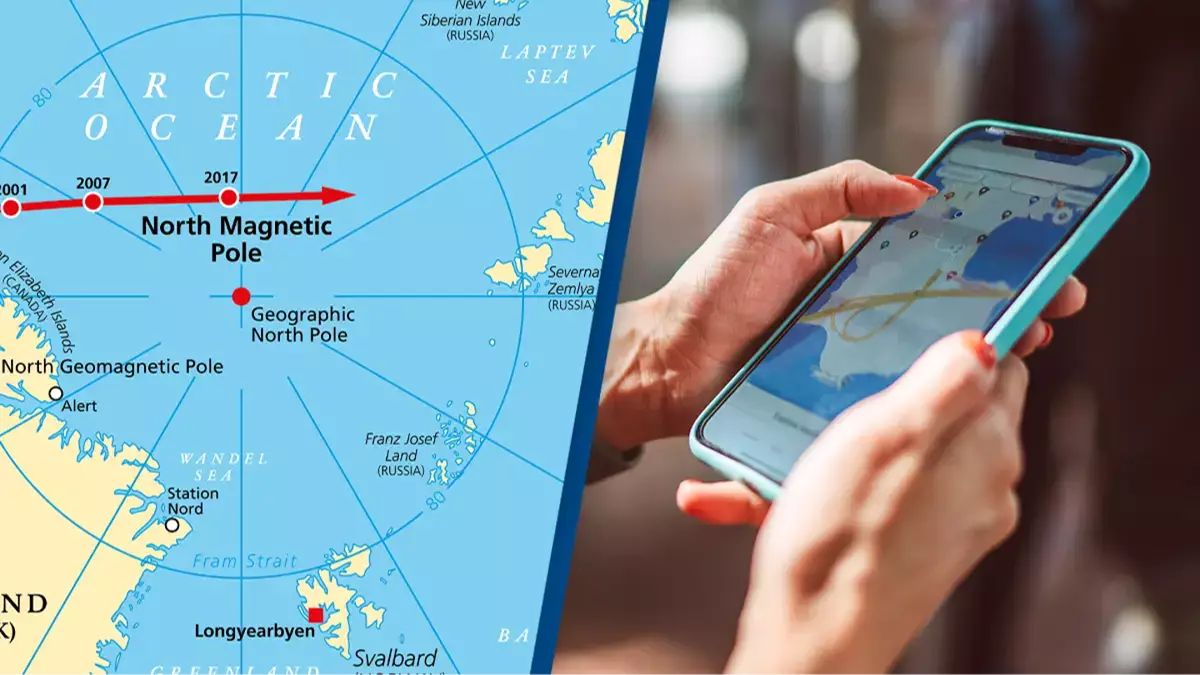
The Earth's magnetic North Pole is moving from northern Canada towards Russia at an unprecedented speed, which could impact smartphone navigation systems. This movement is due to changes in the Earth's molten iron core and is part of a natural process that has seen nearly 200 pole switches in the last 100 million years. The World Magnetic Model, used in various technologies, helps adjust for these changes to maintain accurate navigation.

Magnetic North Pole's Unprecedented Shift Towards Russia Baffles Scientists
science1 year ago

Magnetic North Pole's Unprecedented Shift Towards Russia Baffles Scientists

The magnetic North Pole is moving towards Russia at an unprecedented rate, having accelerated from 10-15 km per year to 55 km per year in the early 2000s, before slowing to 25 km per year recently. This movement is driven by unpredictable fluctuations in the Earth's molten iron core, which generates the planet's magnetic field. The British Geological Survey, in collaboration with the US National Oceanic and Atmospheric Administration, monitors these changes using the World Magnetic Model, which is crucial for navigation technologies like GPS and military systems.