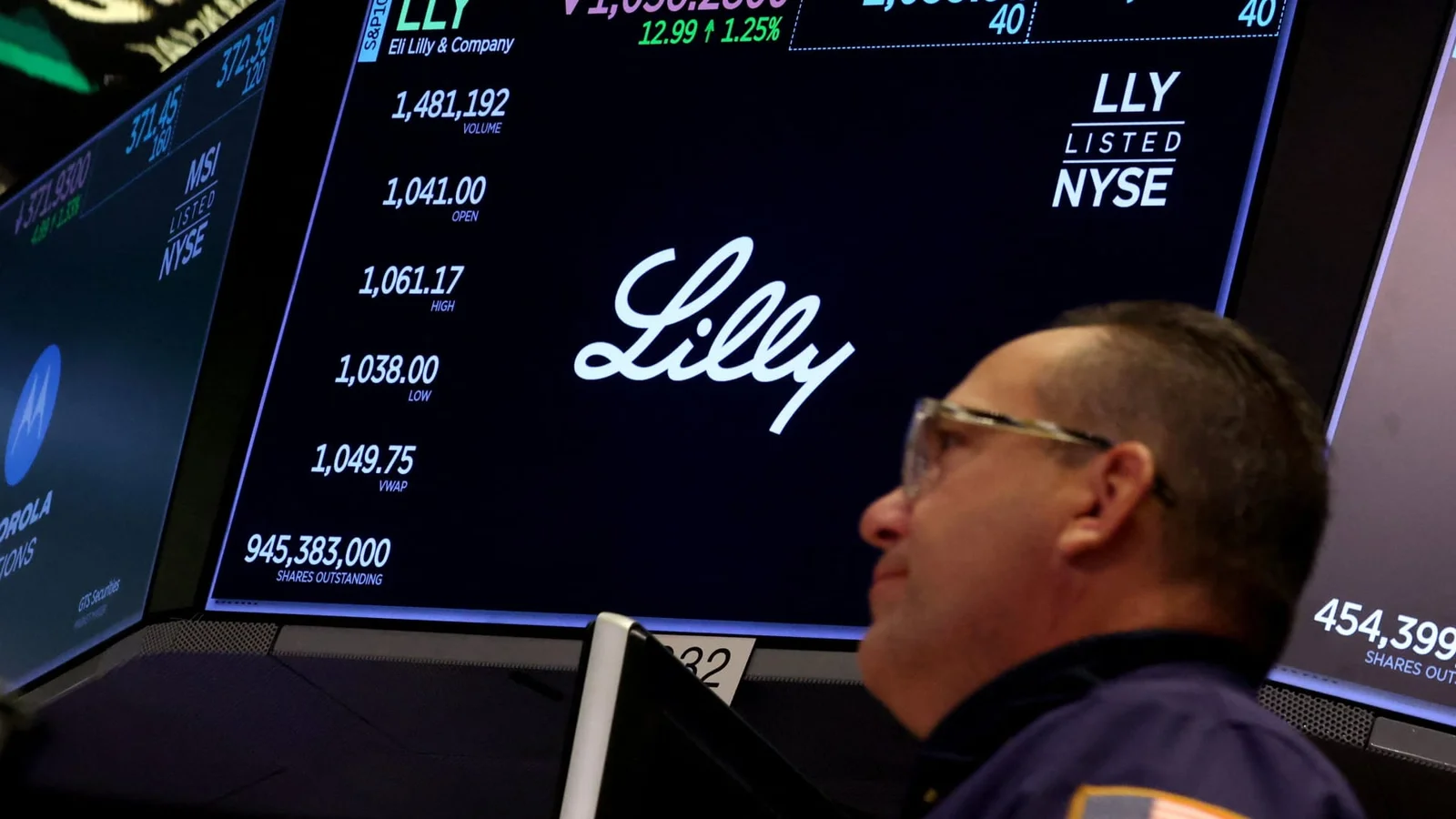
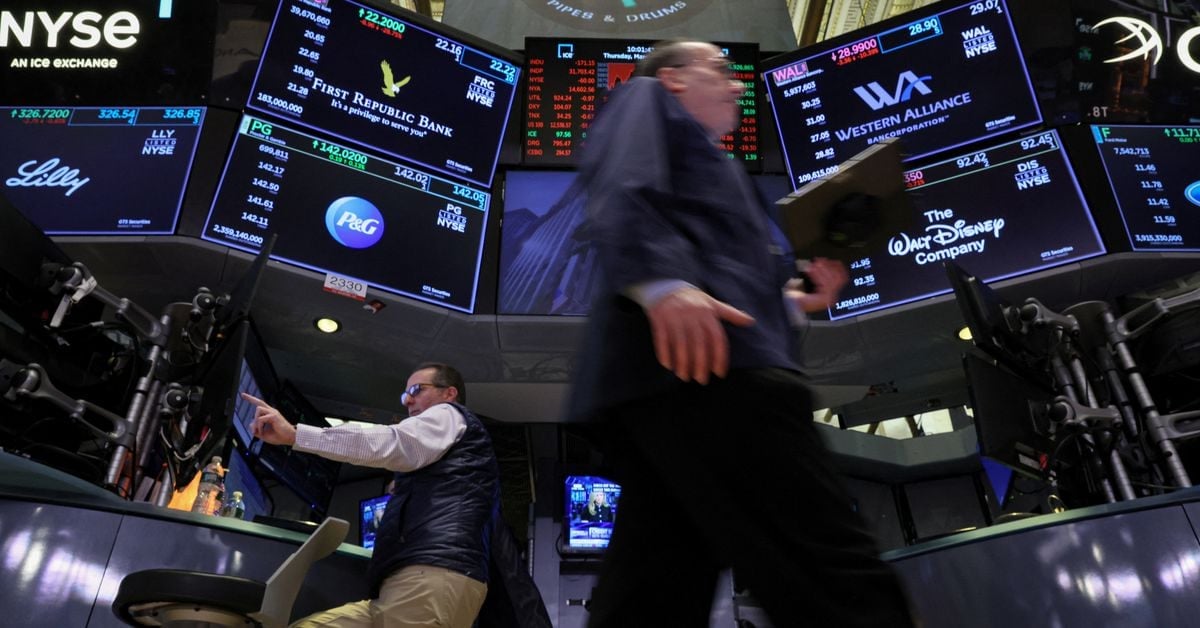
Eli Lilly shares are declining, possibly due to specific company or sector factors, while oil and financial stocks are experiencing a rally, reflecting mixed market movements on January 5, 2023.
Major financial stocks, including JPMorgan and others, are preparing to report earnings amid near-record high indexes. JPMorgan's stock has performed well despite CEO Jamie Dimon's cautious outlook on the economy. The article also discusses upcoming earnings reports from other financial and semiconductor companies, and provides strategies for options trading around earnings reports.
An analyst predicts the stock market will continue climbing, with the S&P 500 reaching 7000 by 2026, driven by strong earnings, AI productivity gains, and growth in financial and healthcare sectors, while advising caution on consumer discretionary stocks due to tariffs.
Financial stocks are experiencing significant inflows following Donald Trump's election win, driven by investor optimism over potential deregulation and tax cuts. The Financials Select Sector SPDR Fund saw record inflows, with regional banks particularly benefiting. Goldman Sachs analysts have identified top stock picks in anticipation of these changes, including major banks, consumer finance companies, and capital markets firms. A steeper yield curve and increased M&A activity are expected to further boost the sector, with regional banks poised to gain from potential tax cuts.
Analysts are optimistic about the continued success of 'Trump trades,' which include stocks like Tesla, energy, and financial sectors. These stocks have been performing well, and experts predict further gains, especially as market volatility is expected to decrease following the election results.
Bank of America stock rose 3.8% after the bank reported Q2 earnings that slightly beat expectations despite a 5.7% profit decline. Revenue increased by 1% to $25.4 billion, surpassing analyst estimates. Other financial firms like PNC Financial Services, Morgan Stanley, and State Street also reported earnings, with mixed stock performance.
Goldman Sachs reported strong Q1 results, with analysts highlighting the company's core strengths in investment banking and capital markets. Analysts from Argus Research, JPMorgan, BMO Capital Markets, Keefe, Bruyette & Woods, and Oppenheimer provided positive ratings and raised price targets, citing strong operating leverage, higher-than-expected revenues, and improved earnings estimates for 2024 and 2025. Despite a slight decline in share price, Goldman Sachs' performance was lauded as near-perfect, showcasing its resilience and potential for increased market activity.
Michael Burry, the investor famous for shorting subprime mortgages before the 2008 financial crisis, has exited stakes in six banks, including Western Alliance, Huntington Bank, PacWest, and First Republic, after betting big on regional banks during a period of crisis. Burry's hedge fund, Scion Asset Management, also closed out positions in Capital One and Wells Fargo, while trimming holdings in New York Community Bancorp. Other notable investors, such as Bridgewater Associates and Renaissance Technologies, also adjusted their banking exposure in the second quarter.
Traders and commentators are challenging Federal Reserve Chair Jerome Powell's assessment of the economy, with the bond market adding to bets that the US central bank's next move will be to cut its benchmark interest rate. Financial stocks tumbled even after Powell had seen a line being drawn under US bank turmoil. Meanwhile, crude oil prices sank 4.3% reflecting concerns about weakening economic growth in major economies. Jeffrey Gundlach, co-founder of DoubleLine Capital, told CNBC there's an increased likelihood of a recession and the Fed likely won't lift interest rates again following its latest increase.
The Dow Jones and S&P 500 rallied back close to the flatline, with the Nasdaq composite down 0.3%. Several financial stocks rallied off lows, lifting the iShares Russell 2000 ETF (IWM) to a modest gain. Deutsche Bank recovered off lows despite reports that default insurance costs are rising at the German bank. Baidu outperformed in the MarketSmith Growth 250. Elf Beauty jumped to an all-time high and remains a bona fide stock market leader.
Regional banks, including First Republic Bank, suffered significant losses as traders worried about the health of the banking space after the failures of Silicon Valley Bank and Signature Bank. Meanwhile, cryptocurrency exchange Coinbase was the biggest gainer, soaring 40.3% as bitcoin surged during the week. Overall, financial stocks with a market cap of $2B+ suffered from continued bearish sentiment, with the Financial Select Sector SPDR ETF falling 5.9% during the week.
Wall Street closed lower on Friday amid fears of a banking crisis contagion and the possibility of a recession. Financial stocks were down the most among the major sectors of the S&P 500, with the S&P Banking index and the KBW Regional Banking index both plunging by about 21% over the last two weeks. Investors are now looking to the Federal Reserve's two-day monetary policy meeting next week. The Dow Jones Industrial Average fell 1.31%, the S&P 500 lost 1.17%, and the Nasdaq Composite dropped 0.8%.
Retail investors are buying the dip in financial stocks in unprecedented amounts amid market volatility, according to data. This trend is driven by the belief that the economy will recover and interest rates will rise, benefiting financial companies.
Despite the ongoing banking crisis, almost every Wall Street analyst covering financial stocks is frozen in time and afraid to become more cautious on scores of names. Among the financial stocks contained in the S&P 500, 92% are rated either a buy or hold as of March 16. The percentage of buy-rated financials has only declined by four percentage points since Feb. 28 despite the rolling banking crisis. If analysts don't step up and change their tune on financials, clients could be left holding the bag.