Tag

Fecal Microbiota Transplantation

All articles tagged with #fecal microbiota transplantation

health1 year ago

"Fecal Microbiota Transplant Improves Parkinson's Symptoms"

A groundbreaking clinical study conducted by researchers at Ghent University Hospital in Belgium has shown promising evidence that fecal microbiota transplantation (FMT) could improve symptoms in patients with Parkinson's disease. The study, named the GUT-PARFECT trial, demonstrated that participants who received healthy donor stool transplants showed significant improvement in motor symptoms and experienced less constipation after 12 months. The researchers believe that FMT could be a valuable new treatment for Parkinson's disease and are seeking funding for further research to determine which bacteria have a positive influence, potentially leading to the development of targeted therapies.

health1 year ago

"Parkinson's Symptoms Improved with Fecal Bacteria Transplant"

A clinical trial has shown that fecal microbiota transplantation (FMT) may significantly improve motor symptoms in patients with Parkinson’s disease (PD) by transplanting healthy donor stool into patients with early-stage PD, leading to marked improvements in motor functions and reductions in constipation over 12 months. The study highlights the potential of FMT as a new treatment for PD and underscores the emerging link between the gut microbiome and neurodegenerative diseases, suggesting that gut bacteria play a crucial role in the development and symptomatology of PD.

health1 year ago

"Promising Results: Stool Transplant as Treatment for Parkinson's Disease"

A clinical study conducted by researchers at Ghent University Hospital, VIB, and Ghent University has shown promising results for using fecal microbiota transplantation (FMT) to improve symptoms in patients with Parkinson's disease. The study, named GUT-PARFECT, demonstrated that participants who received healthy donor stool transplants showed significant improvement in motor symptoms and reduced constipation over a 12-month period. This research suggests that FMT could be a valuable new treatment for Parkinson's disease, offering a potentially safe, effective, and cost-effective way to improve symptoms and quality of life for millions of people worldwide. Further research is needed to determine the long-term effects and potential development of targeted therapies.

health2 years ago

Success Story: Woman Cures Ulcerative Colitis with Over 100 Stool Transplants

Saffron Cassaday, who had been suffering from ulcerative colitis for 15 years, successfully treated her condition by performing over 100 DIY fecal microbiota transplants (FMT) using her partner's stool. FMT involves transferring a screened donor's healthy microbes and bacteria to a patient via an enema. While FMT has been proven effective for treating C. diff infections, its efficacy for ulcerative colitis is lower, with only about 25% of patients experiencing improvement. FMT is currently being studied in over 200 clinical trials for various conditions, but caution is advised, and it should only be done in a clinical setting.

health2 years ago

FDA Approves Revolutionary Fecal Transplant Pill for Gut Infections.

The FDA has approved Vowst, an oral capsule containing beneficial bacteria derived from human fecal matter, to treat recurrent infections of Clostridioides difficile by balancing out the gut microbiome. Vowst was approved on the basis of two studies conducted in the U.S. and Canada, including a randomized, double-blinded placebo-controlled trial. The drug is intended to be used in conjunction with antibiotics to prevent recurrent C. difficile infections and is taken four capsules at a time daily for three days.

health2 years ago

The Gut Microbiome's Role in Anorexia Nervosa.

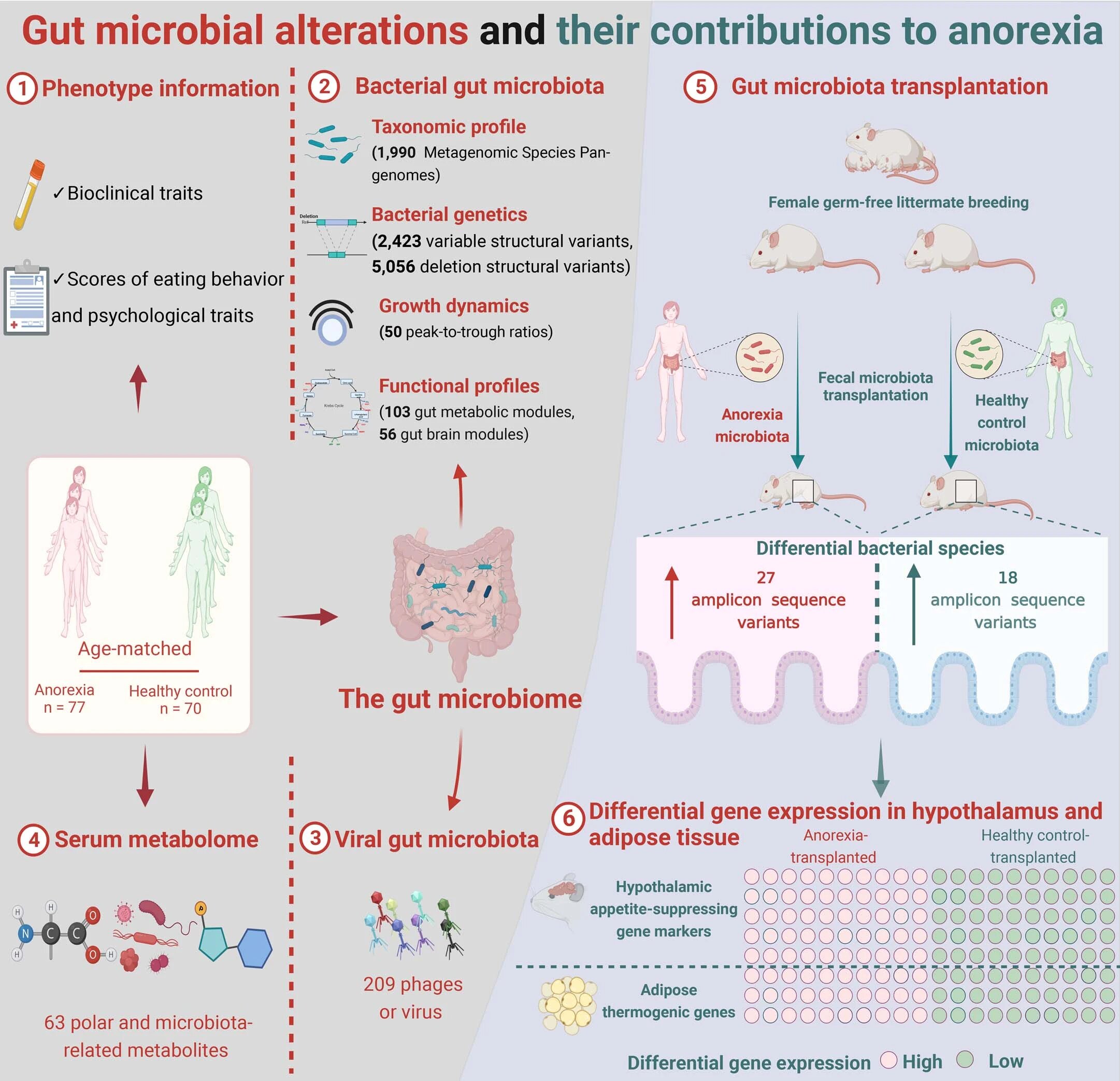
A study published in Nature Microbiology has identified the mechanistic interplay between restricted eating habits and how the gut microbiota's natural response negatively accentuates the pathology of anorexia nervosa (AN). The study found that altered serum metabolite compounds could indicate the compounds are operating via blood circulation, affecting brain regulation of appetite, emotions, and behavior. Additionally, fecal microbiota transplantation from AN cases to germ-free mice under energy-restricted feeding mirrored AN eating behaviors. The gut virome was also altered in the AN group, as researchers noted a reduction in viral–bacterial interactions.