Tag

Economicindicators

All articles tagged with #economicindicators

Rising Inflation and Treasury Yields Signal Economic Challenges Ahead
finance1 year ago

Rising Inflation and Treasury Yields Signal Economic Challenges Ahead

U.S. Treasury yields rose slightly as investors processed recent inflation data and awaited further economic reports, including the producer price index and jobless claims. The 10-year Treasury yield increased by nearly 3 basis points to 4.3%, while the 2-year yield rose over 2 basis points to 4.184%. The recent consumer price index showed a 2.7% annual inflation rate, aligning with expectations. With the Federal Reserve's policy meeting approaching, there's a strong anticipation of a quarter-point rate cut, as traders are nearly certain of this move.

"Unprecedented U.S. Money Supply Shift Echoes Great Depression, Signals Major Stock Market Activity"
finance-and-economy2 years ago

"Unprecedented U.S. Money Supply Shift Echoes Great Depression, Signals Major Stock Market Activity"

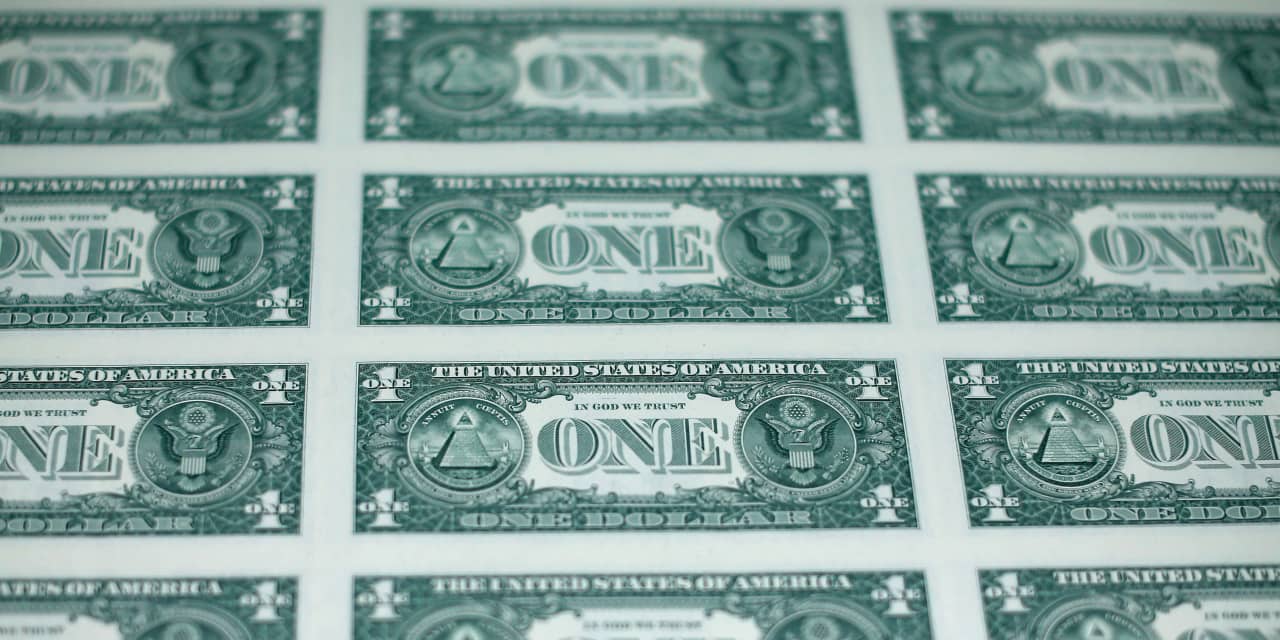
The U.S. M2 money supply has experienced a notable decline for the first time since the Great Depression, dropping over 4% from its mid-2022 peak. Historically, such declines have often preceded economic downturns and increased unemployment. Additionally, commercial bank credit has also decreased, suggesting tighter lending standards and potential impacts on corporate earnings. While these indicators may signal a challenging year ahead for investors, historical data emphasizes the benefits of a long-term, optimistic investment approach, with the average bull market outlasting bear markets and 100% of 20-year rolling periods in the S&P 500 yielding positive returns.

"Dollar's Rollercoaster: Strong Start, Sector Data Dip, and Pre-Payroll Comeback"
finance-and-economy2 years ago

"Dollar's Rollercoaster: Strong Start, Sector Data Dip, and Pre-Payroll Comeback"

The U.S. dollar is experiencing a strong start to 2024, with the ICE U.S. Dollar Index rising 0.7% to 102.3, marking its best opening performance since 2015. This rebound follows a decline in 2023 when the Federal Reserve indicated potential interest rate cuts, which typically decrease a currency's appeal. Analysts suggest the current surge is due to a market correction from previous positions that were short on the dollar. Despite this uptick, the Fed's meeting minutes reveal that rate cuts are still expected, though the timing is uncertain, and rate hikes remain on the table. Economic data showing a slowdown in service sectors and mixed signals from the labor market have influenced market dynamics, impacting the dollar's value.

"December ISM Services Dip to 50.6 Signals Sharp Activity Decline and Employment Low, Impacting Gold and Bonds"
economy2 years ago

"December ISM Services Dip to 50.6 Signals Sharp Activity Decline and Employment Low, Impacting Gold and Bonds"

The US December ISM services index came in at 50.6, lower than the expected 52.6, indicating a slower expansion in the service sector than anticipated. Key components such as the employment index and prices paid index also showed a decline, suggesting dovish economic conditions. Comments from various sectors highlighted issues like high beef prices, Panama Canal congestion, labor constraints, and the need for expense reduction. Despite these challenges, some areas like mining and retail trade reported positive trends, and there is a general sense of stability returning to supply chains. The report is considered a forward-looking indicator, contrasting with the lagging nature of non-farm payrolls data.

"December Jobs Report: Market Implications Amid Hiring Slowdown and Economic Signals"
economy2 years ago

"December Jobs Report: Market Implications Amid Hiring Slowdown and Economic Signals"

The December jobs report is expected to show a slight cooling in the labor market with the addition of 170,000 jobs, a decrease from November's 199,000, and a slight uptick in the unemployment rate to 3.8% from 3.7%. Despite this, the labor market remains strong with low unemployment and layoffs, and job vacancies still higher than pre-pandemic levels, indicating continued demand for workers and potential for a 'soft landing' for the economy.

"Asian Stocks Retreat Amid Fed Rate Speculation and Wall Street's Shaky Start to 2024"
finance-and-business2 years ago

"Asian Stocks Retreat Amid Fed Rate Speculation and Wall Street's Shaky Start to 2024"

Asian stocks declined as traders scaled back expectations for early and significant U.S. Federal Reserve rate cuts, following the release of the Fed's December meeting minutes which suggested a cautious approach to monetary policy. The minutes indicated concerns about overly restrictive policy impacting the economy and a lack of clear signals on when rate cuts might commence. This led to a decrease in the probability of a March rate cut from 90% to 70%, as per the CME FedWatch tool. Investors are now anticipating less easing this year, with futures pricing in under 150 basis points of cuts compared to 160 bps previously expected. Meanwhile, U.S. nonfarm payrolls data is awaited for further labor market insights, and China's service sector showed expansion, contrasting with official data indicating a contraction.

"2024 Market Woes Continue: Stocks Dip Globally as Wall Street's Slump Persists"
finance-and-business2 years ago

"2024 Market Woes Continue: Stocks Dip Globally as Wall Street's Slump Persists"

Wall Street experienced another day of losses, with major indices like the S&P 500, Dow Jones, and Nasdaq falling, continuing a weak start to 2024. The decline was partly due to adjustments in tech stocks like Tesla, which had previously seen significant gains. Economic reports suggest a cooling job market and a contracting manufacturing sector, aligning with the Federal Reserve's goal to curb inflation without causing widespread layoffs. Despite this, there's uncertainty about the Fed's interest rate plans, with some anticipation of rate cuts in 2024, though the extent of such cuts remains debated among experts. Global stock markets also saw declines, with notable drops in France and South Korea, while Shanghai's market saw a slight increase.

"Markets Flinch as Bonds, Stocks Stumble and Yields Eye 4% Amid New Year Volatility"
finance-and-business2 years ago

"Markets Flinch as Bonds, Stocks Stumble and Yields Eye 4% Amid New Year Volatility"

U.S. bonds and stock futures fell as markets anticipated key economic data that could influence interest rate expectations. The drop follows a significant global market slump on the first full trading day of the year. Investors await the Federal Reserve's meeting minutes and data on manufacturing and job openings, while tech stocks, particularly Nvidia Corp., face a sell-off. The dollar strengthened, and yields on 10-year Treasury notes increased. This week is packed with economic events, including various PMI readings, jobless claims, and nonfarm payrolls, which will provide further insight into the economic landscape and potential monetary policy shifts.

"10-Year Treasury Yield Nears 4% Amid Bond Market Fluctuations and Financial Sector Response"
finance-and-economy2 years ago

"10-Year Treasury Yield Nears 4% Amid Bond Market Fluctuations and Financial Sector Response"

The 10-year Treasury yield briefly surpassed the 4% threshold before settling at 3.911%, reflecting investor uncertainty about the Federal Reserve's rate cut timeline. Despite a year-end decline in yields and a subsequent stock rally, 2023 has seen a shift in expectations as the Fed signaled potential rate cuts in 2024, but recent minutes suggest a short-term restrictive stance. Economic reports indicate a mixed picture, with stable job listings and a manufacturing index suggesting expanding demand. Markets are pricing in a significant chance of a rate cut by March, according to the CME Group's FedWatch tool.

"2024: A Year of Economic Surprises and Transition Amid Market Volatility"
finance2 years ago

"2024: A Year of Economic Surprises and Transition Amid Market Volatility"

The article warns of a potential stock market crash as we enter 2024, suggesting that recent gains may be part of a bear market rally rather than the start of a new bull market. Indicators such as the performance of the Nasdaq 100 and S&P 500 below inflation-adjusted highs, the Russell 2000's stagnation, and the rise in traditional safe-haven assets like gold and Treasurys point to investor caution and a non-traditional risk-on environment. Investors are advised to remain vigilant and not to assume a sustained upward market trajectory without broader sector participation.

finance-and-business2 years ago

"Markets Fluctuate: Tech Stocks Tumble and Dow Hits Record Amid Rate Cut Speculation"

U.S. Treasury yields have seen a significant increase while the stock market has taken a downturn as expectations for rate cuts by the Federal Reserve have diminished. This shift in investor sentiment reflects a reassessment of the economic landscape and the potential for continued monetary policy tightening to combat inflation.

"Asia-Pacific Markets in 2024: Trends, Risks, and Investor Sentiment"
business-and-finance2 years ago

"Asia-Pacific Markets in 2024: Trends, Risks, and Investor Sentiment"

Asian-Pacific markets had a mixed start to the year, with Chinese stocks opening lower due to a further contraction in manufacturing activity, as indicated by the official manufacturing PMI dropping to 49 in December. In contrast, a private survey by Caixin showed a slight expansion. Japan's markets remained closed following a significant earthquake, while Australia's manufacturing sector also experienced a sharp contraction. U.S. stock futures were flat as markets were closed for New Year's Day. Energy stocks and the outlook for Big Oil were also discussed, with Goldman Sachs highlighting potential in European Big Oil companies.

"US 10-Year Treasury Yields Close 2023 Unchanged After a Turbulent Year"
finance-and-economics2 years ago

"US 10-Year Treasury Yields Close 2023 Unchanged After a Turbulent Year"

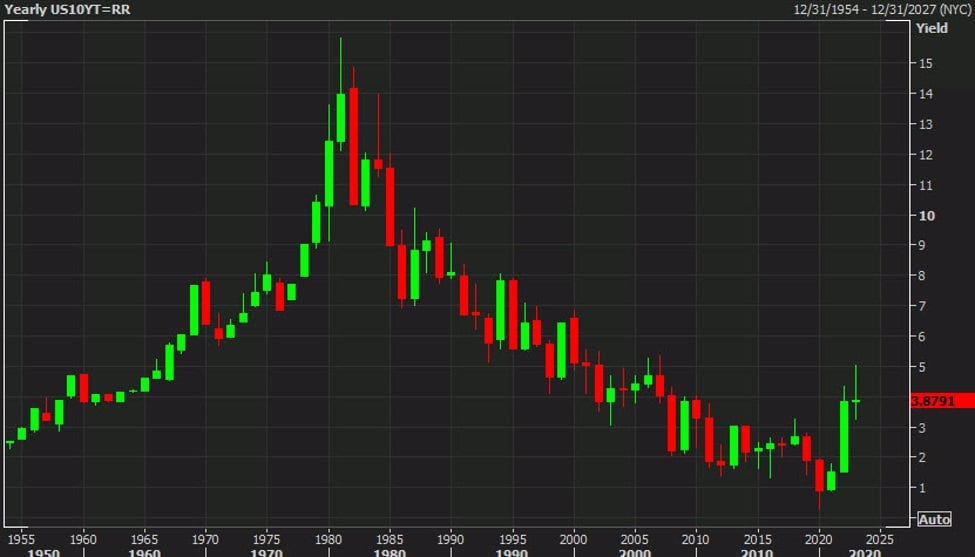
Despite a year marked by significant fluctuations, the US 10-year Treasury yield ended 2023 nearly where it started, closing at 3.87% compared to the previous year's 3.83%. The yield experienced a low of 3.25% during a regional banking crisis in the spring and a peak of 5.02% during an October debt rout, indicating potential volatility ahead. Other notable changes in the bond curve include a decrease in two-year yields by 11.3 basis points and an increase in 30-year yields by 9 basis points over the year.