New research suggests that the universe's expansion may be slowing down and dark energy might not be accelerating it anymore, potentially marking a major shift in cosmological understanding. This conclusion is based on findings that challenge the standard model of dark energy, indicating the universe has already entered a phase of decelerated expansion, with future observations from the Vera C. Rubin Observatory expected to further test these results.
Scientists have developed Effort.jl, a fast and accurate emulator that mimics complex models of the universe's large-scale structure, enabling faster analysis of cosmic data from surveys like DESI and Euclid without sacrificing precision.
New research using DESI suggests dark energy may not be constant over time and could be generated by black holes consuming stellar matter, which also helps resolve the neutrino mass puzzle and offers a new perspective on cosmic expansion.
A new hypothesis suggests black holes might convert dead star matter into dark energy, potentially explaining observed variations in the universe's expansion rate and resolving related cosmological puzzles. This idea links the formation of black holes to the emergence of dark energy over cosmic history, supported by recent DESI data indicating changes in dark energy's strength over time.
A new study suggests black holes may be the source of dark energy, proposing that dark energy is produced by black holes converting dead star matter, which links the universe's star formation history to its accelerated expansion, potentially resolving previous cosmological tensions.
Recent research using data from the Dark Energy Spectrometer (DESI) suggests that dark energy may not be a static cosmological constant, but rather exhibits dynamic behavior, supporting the quintom-B model. This study, led by Professor Yi-Fu Cai, utilized baryon acoustic oscillation data to reconstruct the universe's background evolution, revealing that dark energy's equation-of-state parameter changes over time. The findings challenge traditional views and align with modified gravity theories, potentially reshaping our understanding of the universe's accelerated expansion.
An international team of scientists has found new evidence supporting Einstein's general theory of relativity through a study of the universe's structure over the past 11 billion years. Using data from the Dark Energy Spectroscopic Instrument (DESI), researchers observed that gravity behaves as predicted by Einstein, even as the universe's expansion accelerates due to dark energy. The findings, which align with the standard model of cosmology, suggest that dark energy might be dynamic, challenging previous assumptions of it being a constant force.
An international team of researchers using the Dark Energy Spectroscopic Instrument (DESI) has confirmed Einstein's General Relativity on a cosmic scale by analyzing the clustering of nearly six million galaxies over 11 billion years. This study provides one of the most rigorous tests of gravity at vast scales, supporting the standard model of gravity and limiting alternative theories. The research also offers new insights into neutrino masses and the universe's structure, with DESI's data setting a ceiling on neutrino mass close to laboratory measurements.
Einstein's theory of general relativity has passed one of its largest tests yet, as astronomers mapped nearly 6 million galaxies over 11 billion years, confirming the theory's predictions on a cosmic scale. The study, conducted by the Dark Energy Spectroscopic Instrument (DESI) collaboration, supports general relativity's accuracy in describing the Universe's structure and expansion. The findings, which also place constraints on neutrino mass, aim to shed light on dark matter and dark energy, and are available on arXiv.
An international team of scientists using the Dark Energy Spectroscopic Instrument (DESI) has provided the most precise test of gravity at large scales, confirming that it behaves as predicted by Einstein's theory of general relativity. The study, which analyzed the cosmic structure over the past 11 billion years, suggests that dark energy, responsible for the universe's accelerated expansion, may be dynamic and weakening. This finding could alter the understanding of the universe's future expansion. The research supports the current standard model of cosmology.
The Dark Energy Spectroscopic Instrument (DESI) has confirmed Einstein's general relativity on the largest cosmic scales ever tested, mapping 11 billion years of cosmic history through millions of galaxies and quasars. This breakthrough not only validates our understanding of gravity but also provides insights into dark energy, suggesting its strength may evolve over time. Additionally, DESI has set tighter limits on neutrino masses, contributing to a more precise understanding of these elusive particles. The project represents a significant advancement in precision cosmology, utilizing cutting-edge technology to create the largest-ever 3D map of the universe.
The Dark Energy Spectroscopic Instrument (DESI) has provided one of the most precise tests of Einstein's general relativity on a cosmic scale, confirming its predictions over 11 billion years of cosmic evolution. By observing nearly 6 million galaxies and quasars, DESI supports the Lambda Cold Dark Matter model and challenges modified gravity theories. The findings also set an upper limit on neutrino mass and suggest changes in dark energy's strength over time. These results, from DESI's first year of data, contribute to the largest 3D map of the universe.
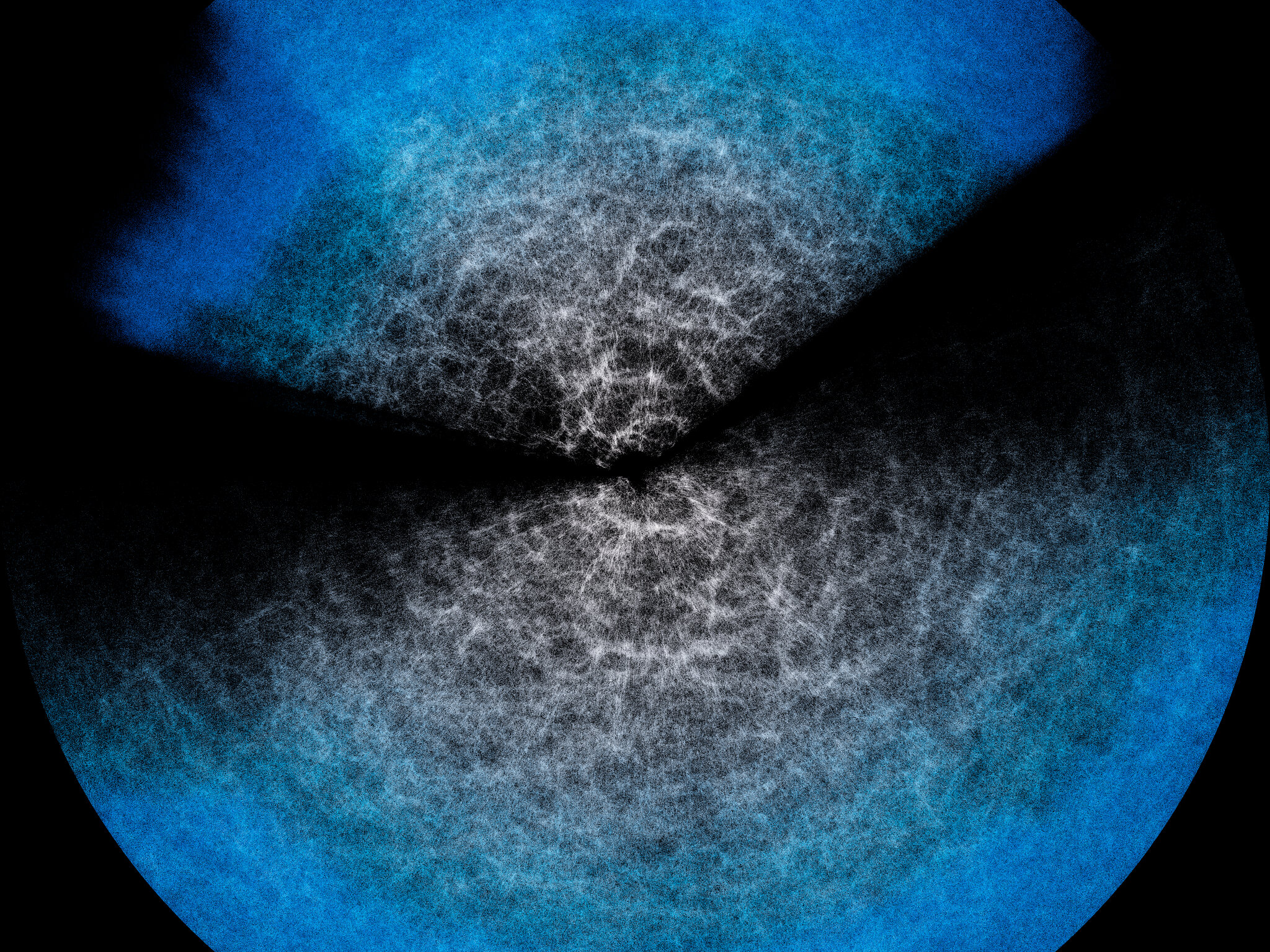
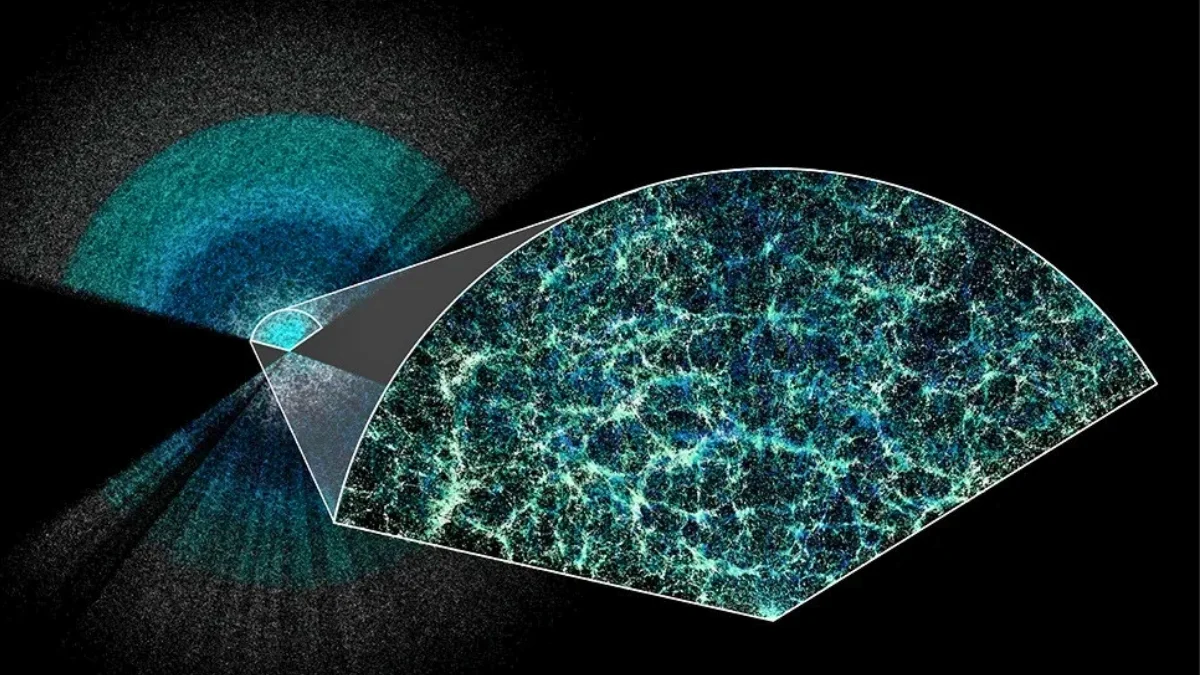
An international team, including the Perimeter Institute and the University of Waterloo in Canada, has created a detailed three-dimensional map of the universe, charting its expansion over 11 billion years. Using the Dark Energy Spectroscopic Instrument (DESI), the map provides new insights into dark energy and offers the most precise measurements to date of the universe’s expansion by observing galaxies and gas clouds. DESI aims to enhance scientists’ understanding of neutrinos and has made the largest 3D map of the universe to date, shedding light on the fundamental question of dark energy.
Recent data from the Dark Energy Spectroscopic Instrument (DESI) suggests that dark energy, the force driving the expansion of the Universe, may not be constant as previously thought. While the current data is consistent with the prevailing theory of constant dark energy, when combined with earlier data, a model in which dark energy changes over time fits the data better. Further analysis of DESI's data over the next few years will provide a clearer understanding of whether dark energy is indeed constant or dynamic, potentially revolutionizing our understanding of cosmology.
New observations from the Dark Energy Spectroscopic Instrument (DESI) suggest that dark energy, the force driving the universe's accelerated expansion, may be weakening, challenging the standard Lambda Cold Dark Matter (LCDM) model. This finding could lead to a paradigm shift in cosmology, potentially indicating a "Big Crunch" end for the universe instead of a "Big Rip" or "Big Chill." The discovery of evolving dark energy would be as revolutionary as the initial discovery of the universe's accelerated expansion. Further observations from DESI and the Euclid space telescope are expected to provide a more comprehensive understanding of dark energy and the universe's fate.