A large-scale, cross-cultural study found that spouses tend to show consistent similarities across nine psychiatric disorders over generations, with patterns influenced by genetics and environmental factors, highlighting the role of assortative mating in psychiatric risk.
A study from the University of Birmingham reveals a strong cross-cultural association between the trilled R sound and rough textures or jagged shapes, and the L sound with smooth textures or straight lines. This pattern was observed in 94% of participants for the R sound and 84% for the L sound across 28 languages, surpassing the bouba/kiki effect in consistency. The findings suggest these sound-symbolic associations may have influenced language evolution, making trilled R sounds common despite their articulation difficulty.
A study published in Social Psychological and Personality Science reveals a universal stereotype across eight countries that associates wealth with trustworthiness, showing that individuals with fewer resources are perceived as less trustworthy. This stereotype persists regardless of the perceiver's own socioeconomic status and highlights the role of socioeconomic background in shaping perceptions, alongside gender and race. The findings suggest that awareness of this bias could help address social trust issues and discrimination linked to socioeconomic status.
A cross-cultural study involving over 3,100 participants from 22 countries revealed that lower voice pitch is universally preferred for long-term relationships and associated with increased formidability and prestige in males. The study's findings are consistent across different cultures, suggesting a universal aspect of human psychology related to voice pitch perceptions. Voice pitch's impact on social evaluations is influenced by societal factors such as relational mobility and violence rates, indicating its adaptability to social environments and highlighting its importance in human interaction and social mobility.
A cross-cultural study found that lower voice pitch makes individuals sound more attractive for long-term relationships and confers a sense of formidability and prestige, particularly among men. The study, published in Psychological Science, suggests that voice pitch influences social perceptions and status evaluation, with lower pitches being preferred for long-term relationships and higher pitches being perceived as more flirtatious. The findings also indicate that perceptions of voice pitch vary across societies based on factors such as relational mobility and homicide rates, shedding light on the evolutionary significance of voice pitch in human social interactions.
A cross-cultural study by Penn State researchers found that lower voice pitch makes both men and women sound more attractive for long-term relationships, while lower voice pitch in males also makes them sound more formidable and prestigious among other men. The study, published in Psychological Science, suggests that voice pitch influences social perceptions and has implications for understanding human evolution and how people confer and evaluate social status. The research also indicates that perceptions of voice pitch vary across societies and are responsive to relevant sociocultural variables.
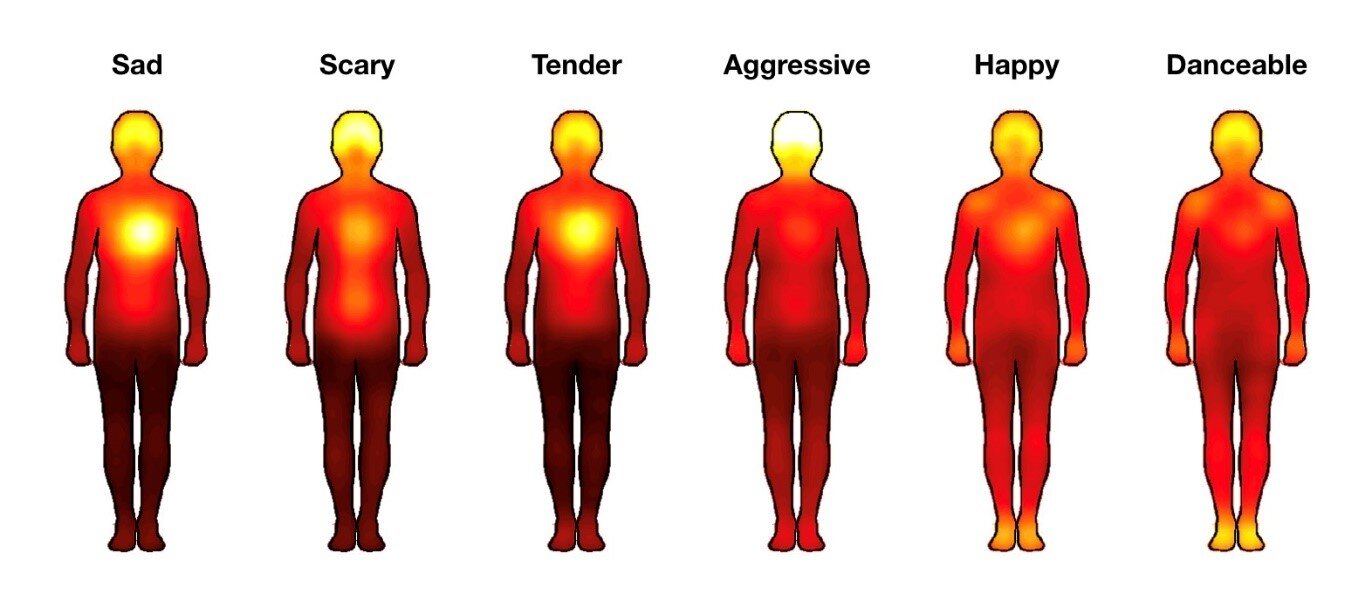
A recent study involving 1,500 participants from Western and Asian cultures reveals that music's emotional impact transcends cultural boundaries, evoking similar bodily sensations globally, with happy music energizing arms and legs and sad tunes resonating in the chest. The study suggests that music's ability to synchronize emotions and physical responses across listeners may have evolved to enhance social interaction and community, and that music-induced emotions are likely independent of culture and based on inherited biological mechanisms.
A study from the Turku PET Center in Finland has found that music evokes similar emotions and bodily sensations across Western and Asian cultures. The research suggests that music's influence on the body is universal and may have emerged during human evolution to promote social interaction and a sense of community. The study, conducted in collaboration with Aalto University and the University of Electronic Science and Technology of China, involved 1,500 participants who rated the emotions and bodily sensations evoked by Western and Asian songs.