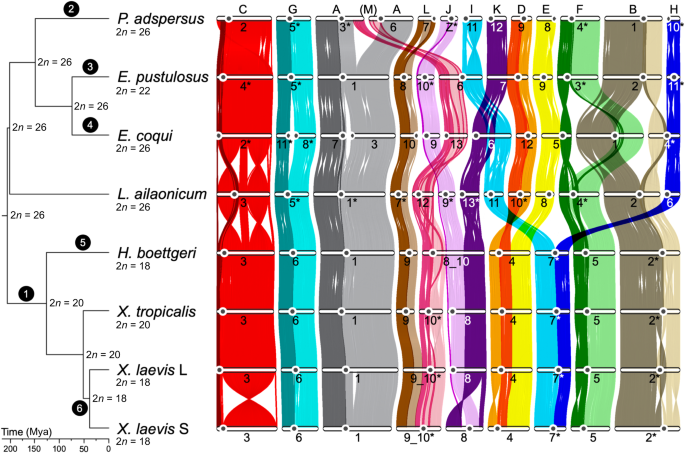
A study reports a high-quality reference genome sequence for the western clawed frog, Xenopus tropicalis, along with draft chromosome-scale sequences of three distantly related emerging model frog species, revealing that frog chromosomes have remained remarkably stable since the Mesozoic Era with limited translocations and fusions. The study explores the structure of chromosomes across frogs, using a dense meiotic linkage map for X. tropicalis and chromatin conformation capture (Hi-C) data for all species, revealing conserved ancestral anuran chromosomes from which contemporary frog genomes were constructed. The findings provide essential resources for further work to exploit the experimental possibilities of these diverse animals and make anurans ripe for comparative genomic and evolutionary analysis.
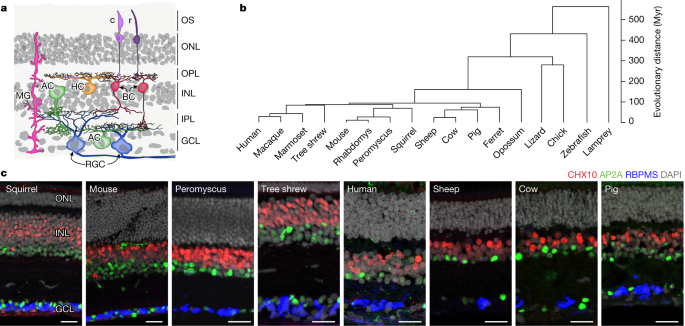
Researchers have used single-cell transcriptomics to compare retinal cell classes, subclasses, and types in 17 vertebrate species. They found that the functional and morphological characteristics of retinal cell classes are conserved across species, with marked similarities in gene expression. The study also revealed the evolutionary variation among cell types within photoreceptors, horizontal cells, bipolar cells, and retinal ganglion cells (RGCs). While many types were conserved, RGCs showed more extensive variation, suggesting that natural selection plays a role in shaping the retinal output. The identification of non-primate orthologues of midget RGCs, responsible for high-acuity vision, suggests that these cell types evolved from ancestral cell types present in the common mammalian ancestor.
Researchers analyzed the DNA sequences from 240 mammalian species, showing how comparative genomics can shed light on how certain species achieve extraordinary feats and help scientists better understand the functional parts of the human genome. They pinpointed the genetic basis for uncommon mammalian traits, such as the ability to hibernate or detect faint scents from miles away. They also found genetic variants that are more likely to play causal roles in rare and common human diseases. The findings come from analyses of DNA samples collected by more than 50 different institutions worldwide, including many from the San Diego Wildlife Alliance, which provided many genomes from species that are threatened or endangered.
The Zoonomia Project, an international effort comparing the genetic blueprints of an array of animals, has revealed that certain passages in the instructions for life have persisted across evolutionary time, representing a through line that binds all mammals, including humans. The project offers clues about human traits and diseases, animal abilities like hibernation, and even the genetics behind a sled dog named Balto who helped save lives a century ago. The findings come from 11 papers published in the journal Science, which tackle deep questions about the wonder of biology and how we are similar and dissimilar to all the things around us.
The Zoonomia Project has compared DNA sequences from 240 mammalian species to identify key parts of the human genome that have remained unchanged for millions of years, shedding light on disease susceptibility and unique mammalian traits. The findings offer potential for improved disease understanding and biodiversity conservation. The researchers identified regions of the genomes that are most conserved across mammalian species and millions of years of evolution, pinpointed species that may be particularly susceptible to extinction, and identified genetic variants that are more likely to play causal roles in rare and common human diseases.