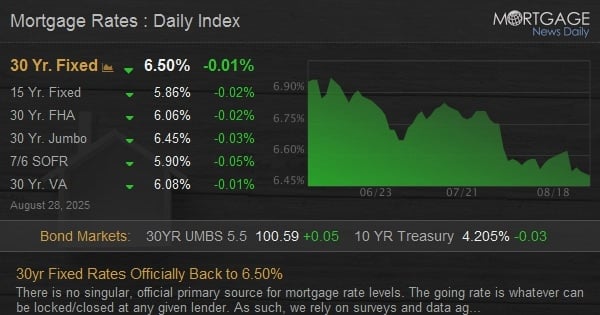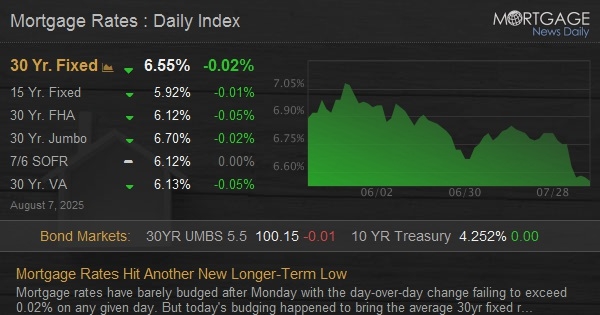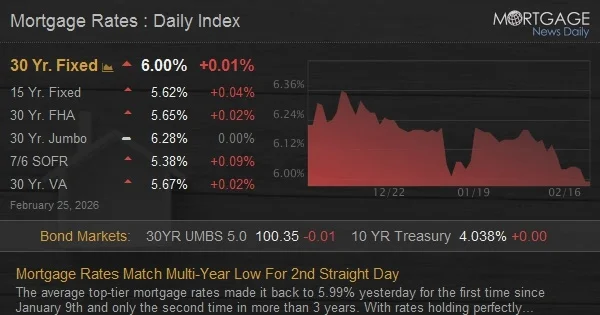
Mortgage rates for 30-year fixed loans have dropped to 6.50%, the lowest since October 2024, driven by recent market movements and Federal Reserve speeches, with actual rates varying based on lender and borrower specifics.
Mortgage rates have reached a 10-month low, remaining largely unchanged despite minor daily fluctuations, influenced mainly by bond market movements and economic data, with lenders offering rates in the mid 6% range for top-tier scenarios.
As of July 15, 2024, mortgage rates for 15- and 30-year fixed-rate loans remain steady at 5.875% and 6.625%, respectively. It's crucial to compare different lenders' rates, terms, and fees to secure the best deal. Factors influencing mortgage rates include credit score, loan type, and economic conditions.
As of May 23, 2024, the interest rate for a 30-year fixed-rate mortgage remains steady at 6.875%, while the rate for a 15-year fixed-rate mortgage has increased to 6.125%. Mortgage rates fluctuate daily based on economic conditions, so it's important to compare different lenders' rates, terms, and fees to secure the best deal.
As of May 22, 2024, the interest rate for a 30-year fixed-rate mortgage remains steady at 6.875%, while the rate for a 15-year fixed-rate mortgage has increased slightly to 6.000%. Mortgage rates fluctuate daily based on economic conditions, so it's important to compare different lenders' rates, terms, and fees to secure the best deal.
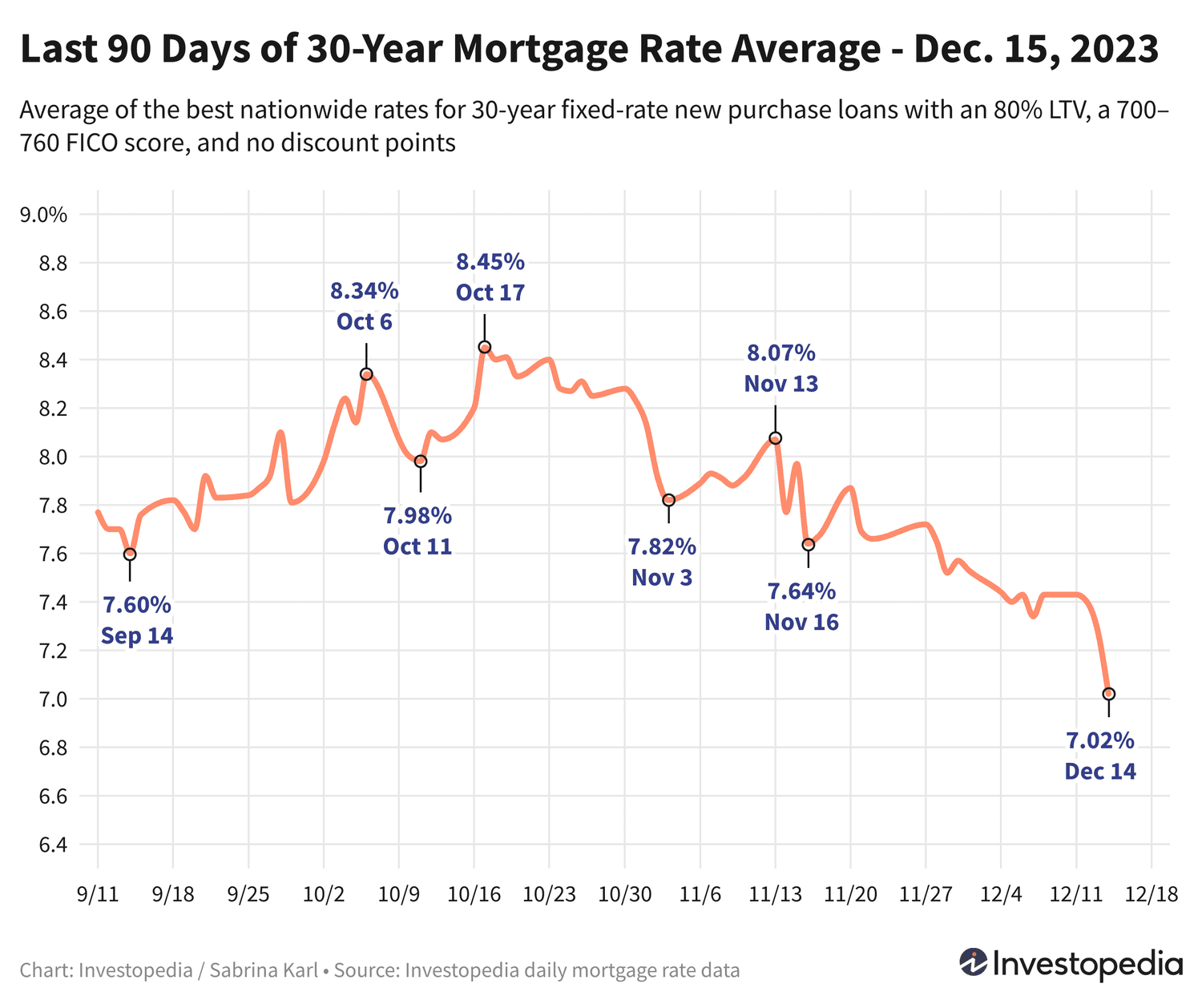
A significant drop in 30-year mortgage rates has led to a 7-month low, with the average decreasing to 7.02%. Rates for various loan types, including new purchase and refinance, have also dropped. The decline in rates is attributed to factors such as the bond market, the Federal Reserve's monetary policy, and competition among lenders. It is advised to shop around for the best mortgage option and regularly compare rates.
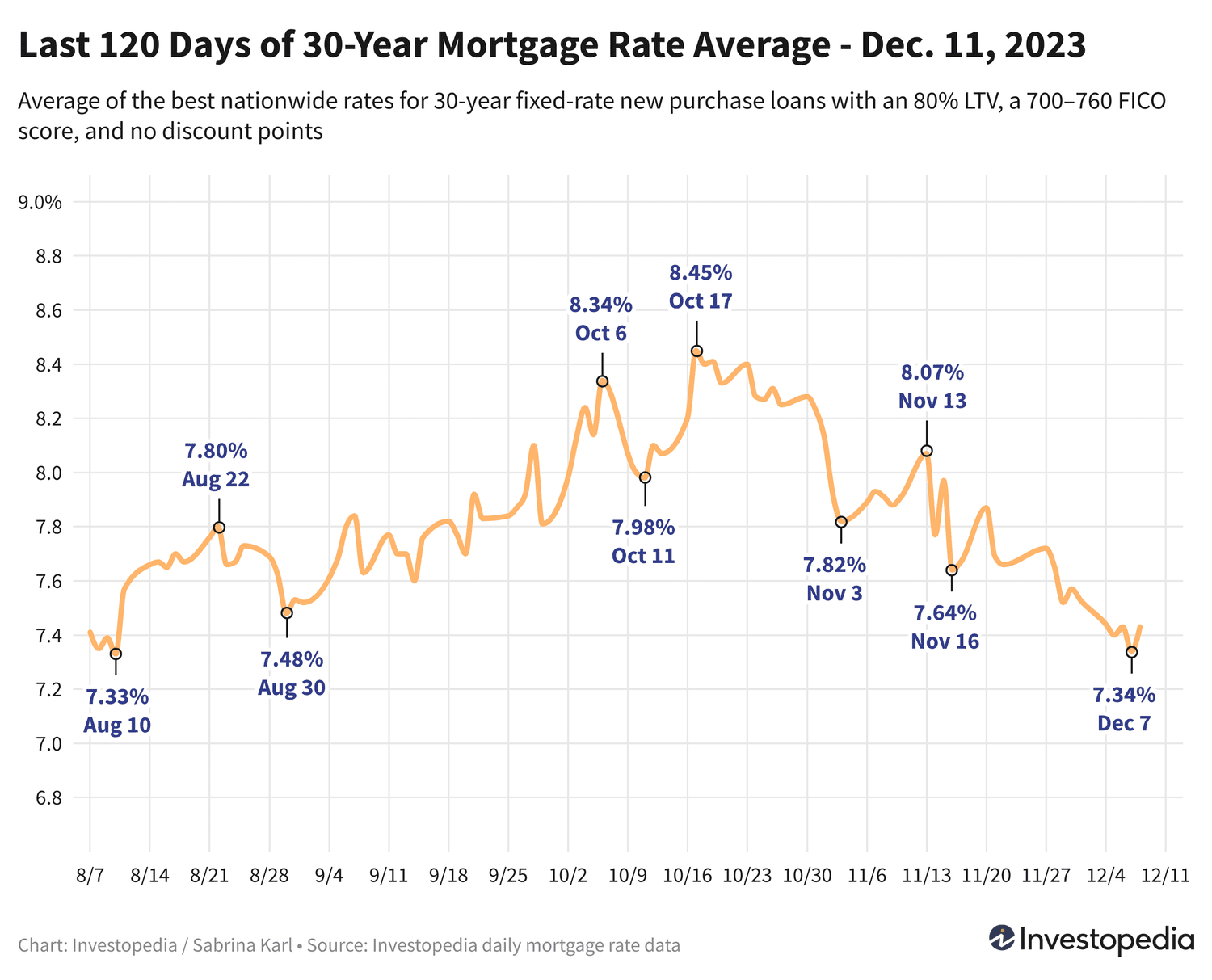
30-year mortgage rates rose moderately on Friday but remain near their lowest level in four months, with an average of 7.43%. Rates for other loan types also increased. Freddie Mac's weekly mortgage data showed rates climbing to a 7.79% average in October, the highest since 2000, but have since fallen. The lowest mortgage rates vary by state, with Vermont, Mississippi, Delaware, Louisiana, and North Dakota having the lowest averages, while Oregon, Nevada, Arizona, Minnesota, and Washington have the most expensive averages. Mortgage rates are influenced by factors such as bond market performance, the Federal Reserve's monetary policy, and competition among lenders.
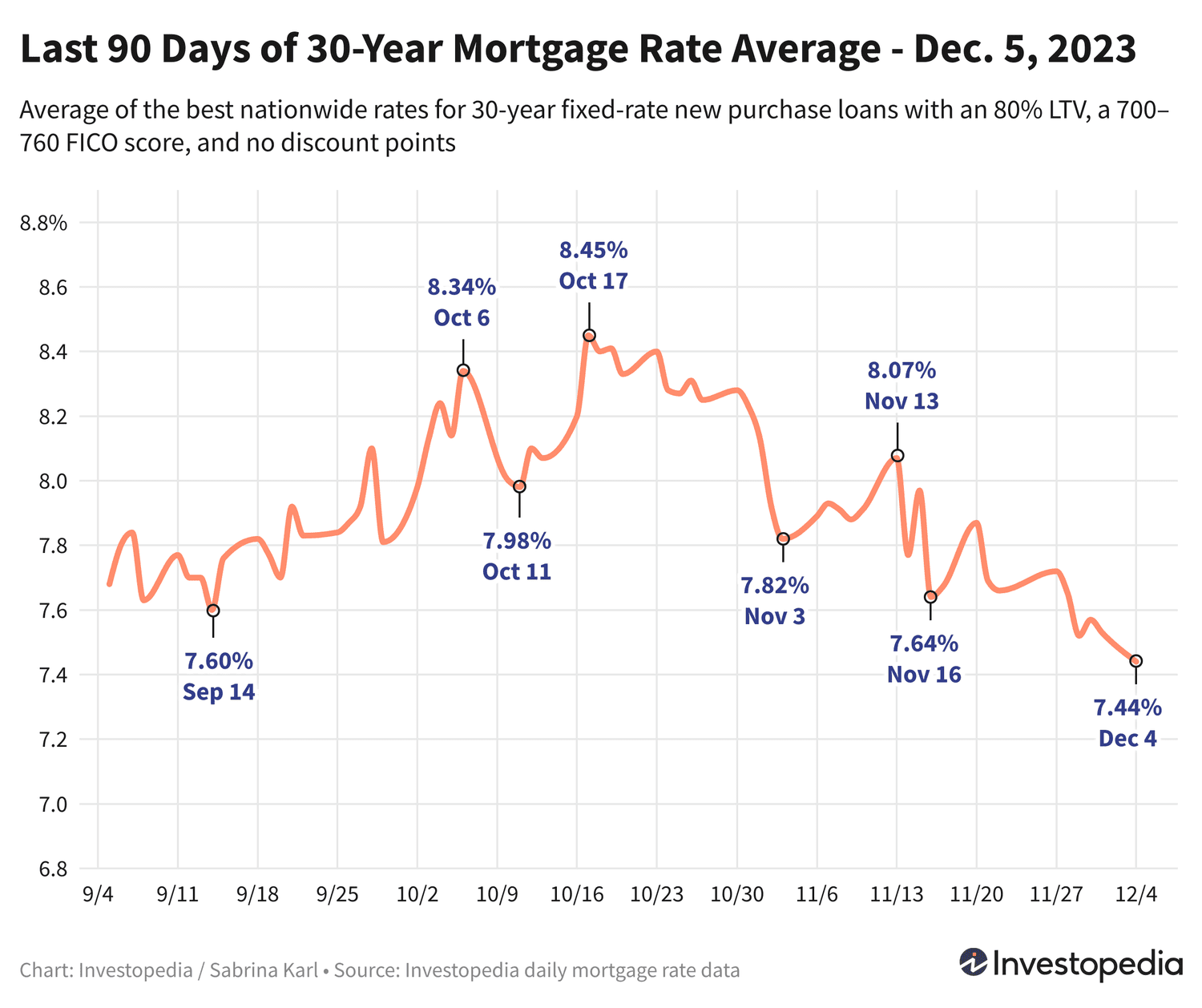
The average 30-year mortgage rate has dropped to its lowest level since August, reaching 7.44%. Other loan averages also decreased, but some remained unchanged and refinancing averages saw multiple increases. It is advised to shop around for the best mortgage option and regularly compare rates from different lenders. The factors influencing mortgage rates include the bond market, Federal Reserve policies, and competition among lenders. The Fed's tapering of bond purchases and rate increases have contributed to the recent upward impact on mortgage rates. However, the Fed has held rates steady in its last two meetings, and future rate increases are uncertain.
Mortgage rates on 30-year fixed loans have been steadily increasing, with the average rising 15 basis points over six days to reach 7.21%. Rates on 15-year loans also rose, reaching an average of 6.57%. The jumbo 30-year average returned to its high of 6.39%. Refinancing rates followed a similar trend. After a historical rate plunge in August 2021, mortgage rates have been on the rise, reaching a 20-year high in October 2022. The recent surge in rates has taken them even higher, but it's difficult to determine when rates were last higher due to limited historical data.
The average rate for a new purchase 30-year fixed mortgage increased by 1 basis point to 7.14%, while its refinance counterpart decreased by 1 basis point to 7.54%. Rates for other mortgage types were mixed. Jumbo 30-year mortgage rates moved in sync, with both the new purchase rate and refi rate dropping 12 basis points to sit back at 6.27%. The Federal Reserve paused rate hikes, keeping the fed funds rate at the current range of 5.00% to 5.25%.
The average rate for a new purchase 30-year fixed mortgage dropped 8 basis points to 7.18%, while the 30-year refinance mortgage rate average ticked up 6 basis points to 7.57%. Rates for jumbo mortgages saw no changes, with the 30-year fixed new purchase mortgage rate still at 6.39%. The recent surge in 30-year rates took the average to another high, 7 basis points above the October high-water mark. Mortgage rates are influenced by macroeconomic and industry factors, such as the bond market, Federal Reserve's monetary policy, and competition between lenders.
The average rate for a 30-year fixed mortgage increased by 4 basis points to 7.26%, the highest rate seen in June. Rates on most other mortgage types also rose, including jumbo loans and their refinance counterparts. The recent surge in rates is attributed to a complex interaction of macroeconomic and industry factors, including the Federal Reserve's monetary policy and competition between lenders.
Mortgage rates for 30-year and 15-year fixed loans have slightly decreased, while jumbo 30-year rates have remained steady. Refinancing rates have also dropped slightly. Rates have been fluctuating since June 1, with the 30-year average hitting a 20-year high of 7.65% on May 26. The Federal Reserve's bond-buying policy and competition between lenders are factors that influence mortgage rates.
Mortgage rates were mixed on Friday, with the 30-year fixed-rate average increasing slightly, while the 15-year, 10-year, and 10/6 ARM averages decreased slightly. Three of the four jumbo averages remained unchanged. Refinancing rates moved similarly to new purchase rates, with the 30-year refi average increasing slightly, the 15-year average decreasing, and the jumbo 30-year refi average remaining steady. The recent surge in 30-year rates took the average to another high, 7 basis points above the October high-water mark. Mortgage rates are influenced by macroeconomic and industry factors, such as the bond market, Federal Reserve policy, and competition between lenders.
The average rate for a 30-year mortgage fell for a third day in a row Thursday, dropping another 16 basis points to 7.13%, the lowest rate in two weeks. The 30-year refinance rate fell 29 basis points to 7.43%. Both rates are now more than a half percent below last Friday's highs of 7.65% and 8.00%, respectively. Mortgage rates are influenced by macroeconomic and industry factors, such as the level and direction of the bond market, the Federal Reserve's current monetary policy, and competition between mortgage lenders and across loan types.