The US GENIUS bill's ban on yield-bearing stablecoins is expected to boost demand for Ethereum-based DeFi applications, as investors seek alternative ways to generate passive income, potentially leading to increased institutional interest and a shift in the stablecoin landscape.
The article emphasizes the importance of focusing on steady dividends and fixed-income investments with yields over 7%, advocating for patience and strategic planning in investing, similar to playing golf against the environment, to achieve reliable total returns and financial stability.
The article discusses OXLC's 24% yield, emphasizing the importance of cautious investment despite high returns, and includes disclosures about the author's positions and the nature of the analysis.
Coca-Cola raised its quarterly dividend by 5.4% to 48.5 cents a share, boosting its yield advantage over PepsiCo Inc., with shareholders of record on March 15 set to receive the new dividend on April 1.
The US Treasury auctioned off a record $42 billion of 10-year notes at a high yield of 4.093%, with international demand at nearly 71% and domestic demand slightly below the six-month average. Dealers received less than the normal amount, and the tail was -1.2 basis points below the WI level. The bid-to-cover ratio was above the six-month average. The auction of 30-year bonds is scheduled for tomorrow.
Investing in dividend stocks has historically been a successful strategy for wealth accumulation. The author, in their 40s, has shifted focus to high-yield dividend stocks, including Annaly Capital Management with a 13.47% yield, Innovative Industrial Properties with a 7.73% yield, and PennantPark Floating Rate Capital with a 10.44% yield. Annaly is a mortgage REIT poised to benefit from an expected rate-easing cycle and a normalized Treasury yield curve, while IIP, a cannabis REIT, has successfully navigated challenges and benefits from triple net leases. PennantPark, a BDC, focuses on debt investments with a high yield and a low nonaccrual rate, making it an attractive income-driven investment.
Pimco predicts that bond investors can still achieve stock-like returns in 2024 despite the decrease in yields from last year's highs. Their latest outlook suggests that the recent gains in the bond market will continue, but they do not recommend increasing exposure to interest rates as they did in October.
Long-term interest rates have been declining, making it a good time for income-seeking investors to consider bond funds. One standout option is the ICON Flexible Bond Fund, managed by Jerry Paul, who highlighted his advantages over larger competitors. Paul's specialization allows him to take advantage of unique investment opportunities, such as airline equipment trust securities, which make up a significant portion of the fund's portfolio. These securities offer higher yields due to their crossover rating and second-lien position. With $250 million in assets under management, the fund has the flexibility to take concentrated positions and provide attractive yields compared to its competitors.
The U.S. Treasury sold $37 billion of 10-year notes at a high yield of 4.296%, with a positive tail of 1.4 basis points. The bid-to-cover ratio was 2.53X, and dealers took on a larger portion of the auction than average. Domestic buyers accounted for 18.87% of the purchases, while international buyers made up 63.83%. The auction grade was D+, indicating below-average performance. The results suggest some apprehension among investors, possibly due to the upcoming Fed meeting and the lackluster performance of the 3-year note auction.
Retail investors can tap into the high yields of private credit by investing in business development companies (BDCs). BDCs lend to small or medium-sized businesses that don't have access to public debt markets. These companies typically pay out 90% of their earnings as dividends and offer annualized yields ranging from 6% to over 16%. Some reliable performers in the BDC space include Blue Owl Capital, Ares Capital, Golub Capital BDC, Oaktree Specialty Lending, and Sixth Street Specialty Lending. Investors can also consider the VanEck BDC Income ETF for diversification. However, it's important to carefully evaluate BDCs as they can be vulnerable to economic downturns and their performance may not always match their dividend payouts.
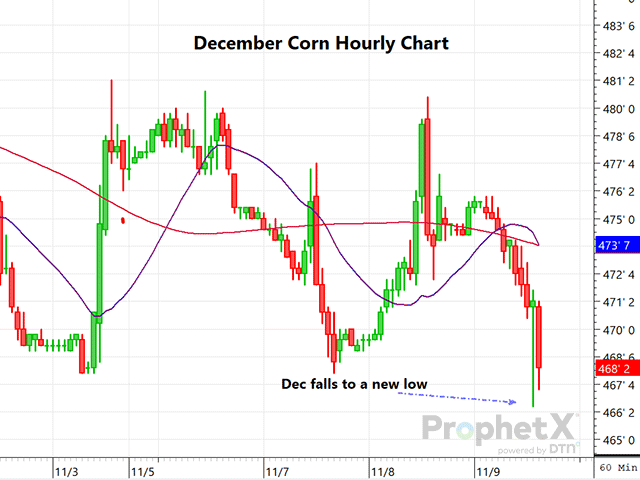
The USDA's November World Agricultural Supply and Demand Estimate (WASDE) report revealed higher-than-expected yield and production changes for corn and soybeans, leading to a sharp decline in their respective markets. Corn production reached a record high of 15.234 billion bushels, while soybean ending stocks increased. Despite recent sales of U.S. beans to China and unknown destinations, soybean futures also experienced a significant drop. Wheat supply and demand remained relatively unchanged, with minor adjustments in imports and food use. The focus now shifts to Brazil's weather conditions and external political and macro developments.
The US Treasury auctioned off $24 billion of 30-year bonds at a high yield of 4.769%. The auction results were disappointing, with a tail of 5.3 basis points and a bid-to-cover ratio below the six-month average. Dealers were left with a higher percentage of the bonds than usual, while domestic and international demand fell below their respective averages. The treasury curve also showed an increase in yields across various maturities. The auction's poor performance contributed to a decline in stock markets.
Dividend stocks and ETFs, despite underperforming the broad market in the past year, have historically shown a tendency to bounce back strongly after periods of negative performance. The alpha of dividend stocks relative to the S&P 500 has swung between positive and negative extremes at regular intervals. While there are no guarantees, the historical record suggests that dividend-stock investors should not give up on these investments. It may even be an opportune time to buy more dividend stocks at their currently depressed prices. However, investors should exercise caution and consider other metrics alongside dividend yield to ensure the underlying companies are financially stable.
Traders are using "bond math" to justify contrarian bets on long-dated Treasurys, as they believe the potential gains from a rally outweigh the losses from further price deterioration. Calculations show that a 50 basis point decline in yields could result in a 13% return, while the opposite would lead to a 2.6% loss. However, critics argue that factoring in the opportunity cost of holding a one-year Treasury bill with a higher yield diminishes the attractiveness of these returns. While this bond market theory has little impact on price direction, it highlights potential outcomes for traders.
Investor demand for ether staking yields has slowed, according to a research report by Coinbase. The Ethereum blockchain validator queue has emptied for the first time since the Shanghai upgrade in May, indicating leveling off of investor interest. Staking yields have dropped to 3.5% from over 5% as the validator entry reached peak capacity. Coinbase expects the staking yield to remain flat now that validator growth has slowed, as long as underlying activity and transaction fees on the Ethereum network remain consistent. The report also noted that the upcoming Dencun upgrade in the first half of 2024 is not expected to have a major impact on onchain activity.