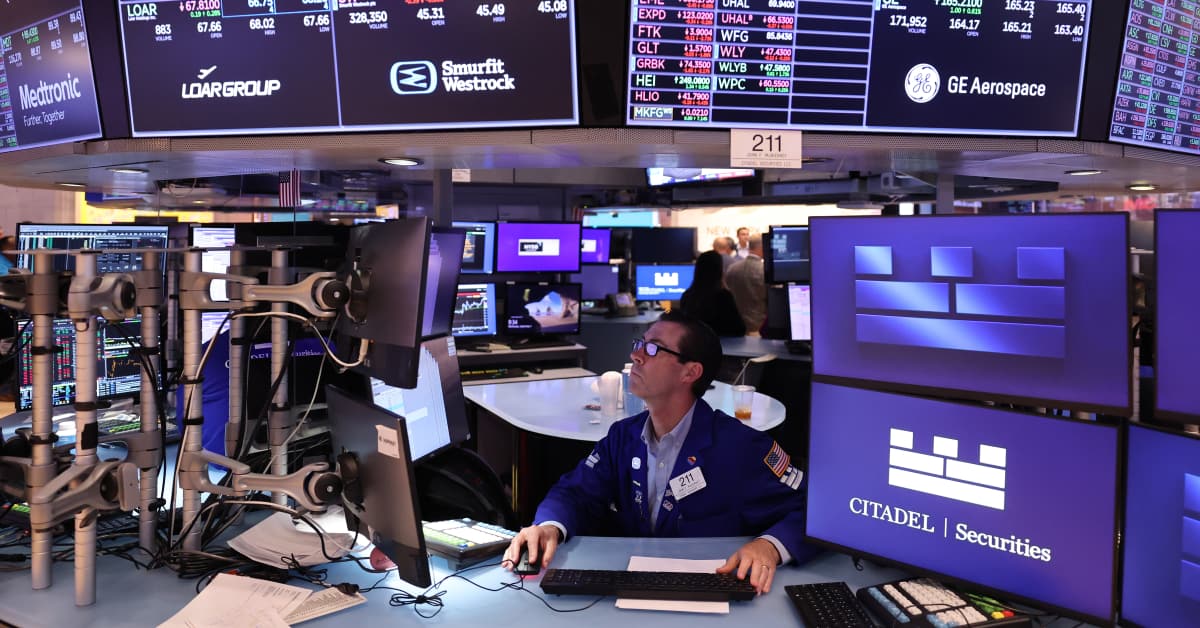
Stock futures are stable as Wall Street prepares to close out 2025, with the S&P 500 up over 17% for the year and markets experiencing a mix of gains and some profit-taking, amid expectations of continued volatility and a potential range-bound year in 2026, driven by factors including AI developments and sector performance shifts.
Asian stocks are set for a muted open during holiday trading, with markets rallying on optimism about economic growth and corporate earnings, while gold and silver hit record highs amid geopolitical tensions and dollar weakness. The global markets continue to show resilience with positive momentum in equities, commodities, and currencies, despite holiday closures and mixed economic signals.
Wall Street is entering the new week with doubts about a year-end rally amid ongoing market rotations and upcoming economic data that could influence the stock market's direction.
Despite current credit market apprehensions and recent bank troubles, market analyst Tom Lee predicts the S&P 500 will rally to 7,000 by year-end, supported by strong corporate earnings, contrarian investor sentiment, and seasonal factors, viewing recent dips as buying opportunities in a longer-term bull market.
Goldman Sachs analyst Scott Rubner predicts a year-end rally for the S&P 500, potentially starting this week, as the index has already gained 24% in 2024. Analysts are optimistic about continued growth due to Federal Reserve interest-rate cuts, a strong U.S. economy, and pro-growth policies from the incoming Trump administration. The S&P 500 is expected to reach 6,300 points by year-end, with longer-term targets of 8,000-10,000 points by the decade's end, driven by AI productivity gains and favorable economic conditions.
A total of 51 stocks in the S&P 500 reached record highs on Tuesday, the highest number since April 2022. This surge in stock prices is part of a year-end rally driven by falling benchmark yields and expectations of future interest rate cuts. The Dow Jones Industrial Average also ended at its third-highest level on record, while the S&P 500 and Nasdaq Composite Index continued to set new closing highs for 2023. The push higher for stocks followed easing inflation data for November, although inflation still remains above the Federal Reserve's target. Investors are now awaiting the Federal Reserve's decision on interest rates, with expectations that short-term rates will remain unchanged.
Despite economic and geopolitical challenges, historical data suggests a potential year-end rally for the S&P 500. In years when the index gained more than 1.4% in the first five days and showed negative performance for the previous year, the S&P 500 posted an average gain of 3.6% between October 17 and year-end. However, the near-term outlook may not be as optimistic, with average changes of -0.2% in October, 1.2% in November, and 2.5% in December. Positive earnings growth and a dovish message from the Federal Reserve could support the market, but inflation and geopolitical tensions remain concerns. The traditional Santa Claus rally in December could potentially lift the market.
Wall Street strategist Mike Wilson, known for his bearish outlook, predicts that U.S. stocks could experience a year-end rally, although he still believes that stocks will end the year lower than their current levels. Wilson points to technical breakdowns in the average stock, cautious factor leadership, declining earnings revisions, and fading consumer confidence as factors supporting his projection of a 10% decline in the S&P 500 by the end of 2023. However, he acknowledges that many investors are still betting on stocks, which could contribute to a rally in the fourth quarter. Wilson's previous predictions have not always come true, and he has reflected on why his projections missed the mark. Other Wall Street analysts have also taken a cautious stance on stocks, with some predicting a potential nosedive of 20% or more.