AI is revolutionizing cancer treatment by rapidly designing personalized synthetic proteins that train the immune system to target tumors, significantly speeding up the development process and enhancing safety through virtual screening, with potential to transform oncology within a few years.
Researchers at the University of Washington's Institute for Protein Design are using AI models to build synthetic proteins, aiming to make biofuel production more efficient and cost-effective by potentially replacing traditional crop-based methods.
Scientists are utilizing artificial intelligence (AI) to accelerate the scientific process, including drug design and hypothesis development. AI has the potential to code computer programs, create visual content, and assist doctors with note-taking. The use of AI in protein labs has shown promising results, offering new possibilities for scientific advancements.
Scientists are using artificial intelligence (AI) to design synthetic proteins, revolutionizing the process of drug discovery and protein engineering. AI systems, such as diffusion modeling, can rapidly generate protein structures that fit specific shapes, significantly speeding up the development of potential therapeutics. While AI has shown great promise in the field of proteins, its application in other scientific domains, such as materials science, may be limited due to the lack of organized data. However, researchers believe that AI could play a fundamental role in scientific discovery by analyzing vast amounts of scientific literature and generating new hypotheses. The ultimate goal is to develop AI systems that can plan and execute experiments autonomously, leading to more systematic and reproducible research.
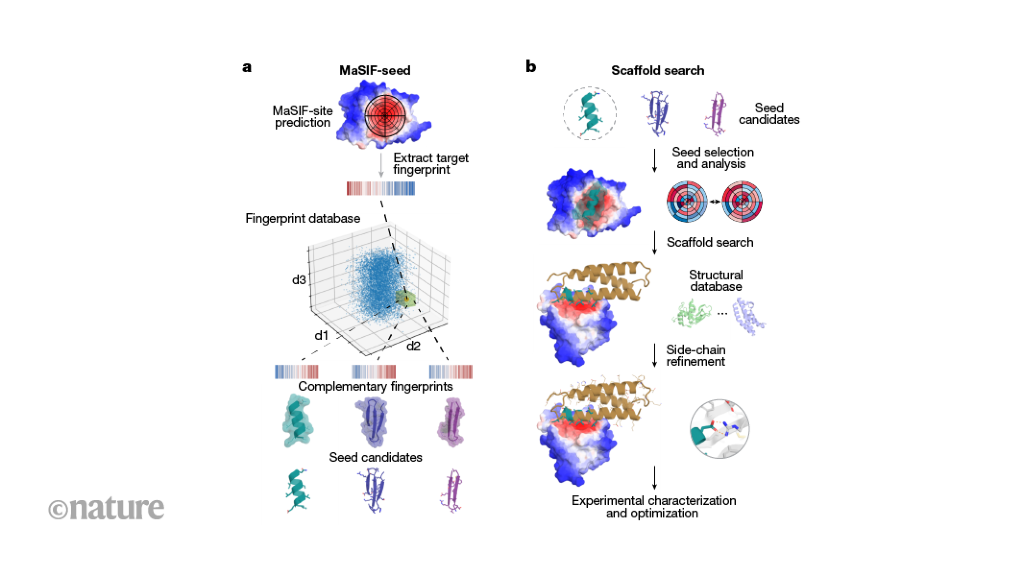
Researchers have used a computational approach to create synthetic proteins that can engage immunotherapeutic or viral targets with binding affinities comparable to those of naturally occurring proteins. The approach uses machine-learned fingerprints of protein-surface features to design protein interactions, which is a key challenge in the fields of basic and translational biology.