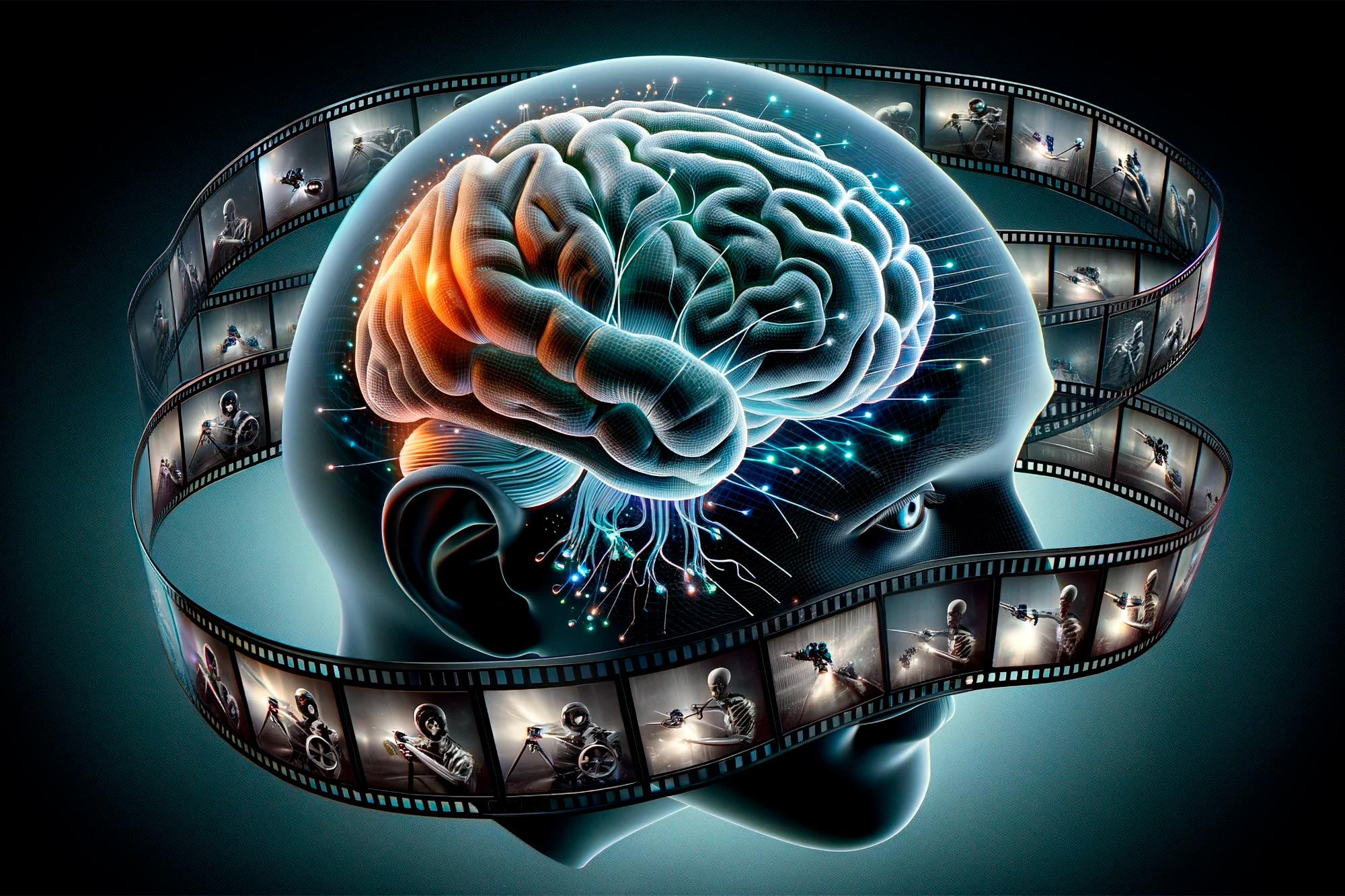
A new study reveals that the ancient midbrain circuit in the superior colliculus is involved not only in reflexive eye movements but also in high-level cognitive functions like decision-making, challenging traditional views that separate perception and reflection in the brain.
A new study suggests that the superior colliculus, a small pea-sized region in the human brain, plays a more significant role than previously thought, alongside the visual cortex, in how mice perceive their immediate surroundings. Researchers from the Netherlands Institute for Neuroscience used optogenetics to switch off the superior colliculus in mice and found that it significantly impaired their ability to detect objects. The study indicates that this tiny brain region may be more important than previously believed and could be responsible for visual perception in both mice and humans.
A study reveals the role of the superior colliculus (SC) in the brain's transition from perceiving rapid flashes as static to continuous motion, shedding light on the continuity illusion. By employing fMRI, behavioral experiments, and electrophysiological recordings, researchers found that the SC's response changes with the frequency of visual stimuli, playing a key role in the continuity illusion. The findings not only enhance our understanding of visual perception but also open new avenues for assessing and treating visual impairments.
Researchers at the Champalimaud Foundation have uncovered the role of the superior colliculus (SC) in the continuity illusion, a process crucial to perceiving smooth motion. Using a combination of fMRI, behavioral experiments, and electrophysiology, they found that the SC plays a pivotal role in transitioning from perceiving individual flashes to continuous motion. This study offers new insights into visual perception and potential clinical applications, providing a roadmap for future neuroscience experiments and potential treatments for visual dysfunctions.
A new study suggests that the superior colliculus, a small pea-sized region in the human brain, plays a more significant role in vision than previously thought. Researchers from the Netherlands Institute for Neuroscience conducted experiments in mice and found that when the superior colliculus was switched off, the mice were less able to detect objects around them. This indicates that the superior colliculus, along with the visual cortex, is crucial in interpreting immediate surroundings. The study provides valuable new insight into the visual processing mechanism in the brain, although further research is needed to demonstrate these findings in humans.
A study by the Netherlands Institute for Neuroscience reveals that the superior colliculus, a small part of the brain, plays a crucial role in object detection and visual processing, challenging previous understanding. Using optogenetics and electrophysiology on mice, researchers found that deactivating the superior colliculus led to difficulties in distinguishing objects from backgrounds, indicating its significance in complex visual environments. This discovery could reshape our understanding of vision and potentially offer insights into addressing visual impairments.