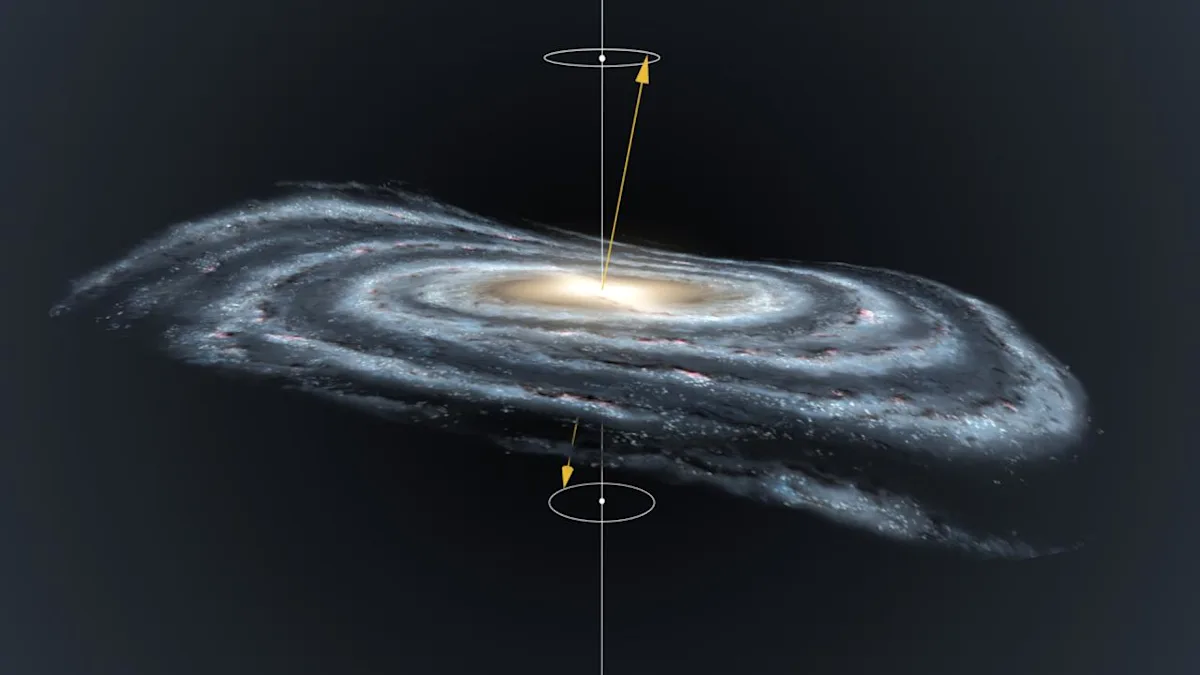
Astronomers have discovered why spiral galaxies like the Milky Way are rare in our cosmic neighborhood. Supercomputer simulations revealed that frequent galactic collisions in the Supergalactic Plane transformed spiral galaxies into elliptical galaxies, while somehow sparing our own. The collisions shattered the delicate arms of spiral galaxies and pushed more matter into their supermassive black holes, making them even bigger. Spiral galaxies located away from the plane were mostly unaffected, allowing them to preserve their structures.
Researchers have used supercomputer simulations to understand why there are few disk galaxies like the Milky Way in the supergalactic plane (SGP). The simulations showed that inside the SGP, galaxies interact and merge more frequently, transforming spirals into ellipticals. Outside the SGP, galaxies interact less, allowing disk galaxies to retain their form. The results align with observations and support the Lambda Cold Dark Matter (CDM) model, which suggests that the distribution of galaxies in relation to the SGP arises naturally within the standard model of galaxy formation and evolution.
Astrophysicists have discovered why spiral galaxies, like the Milky Way, are largely absent from the Supergalactic Plane. The dense galaxy clusters in this region lead to frequent interactions and mergers, transforming spiral galaxies into elliptical galaxies. In contrast, galaxies outside the Plane can evolve in relative isolation, preserving their spiral structure. The findings, based on supercomputer simulations, provide insights into the distribution and evolution of galaxies in our local universe.