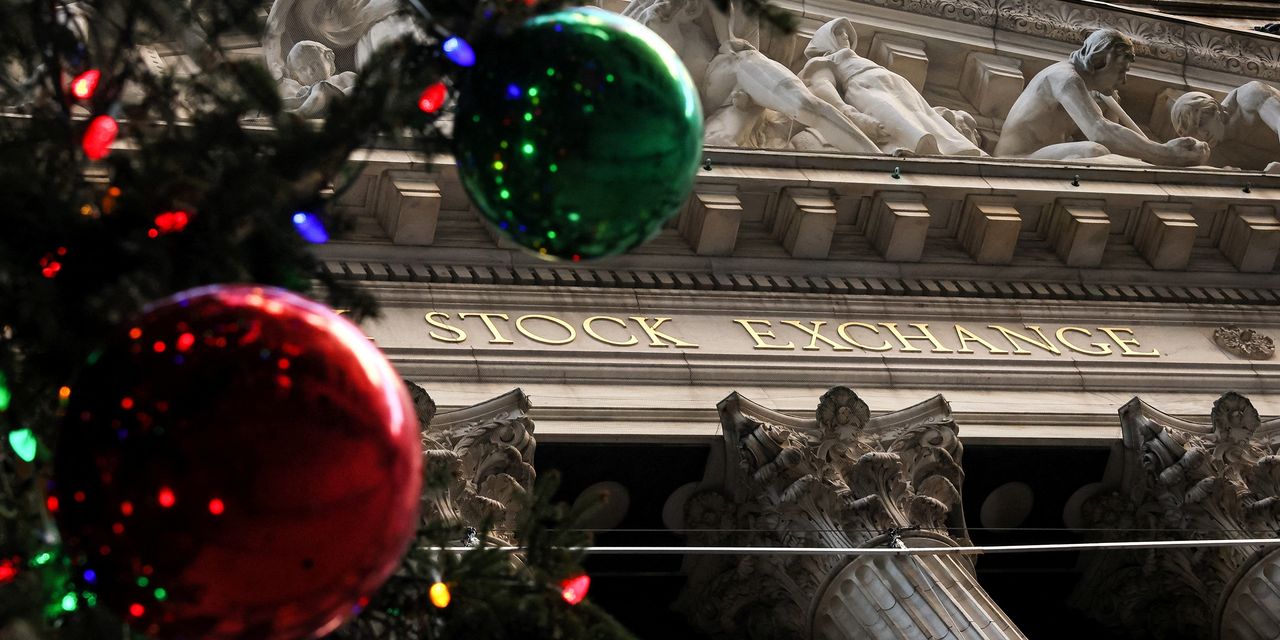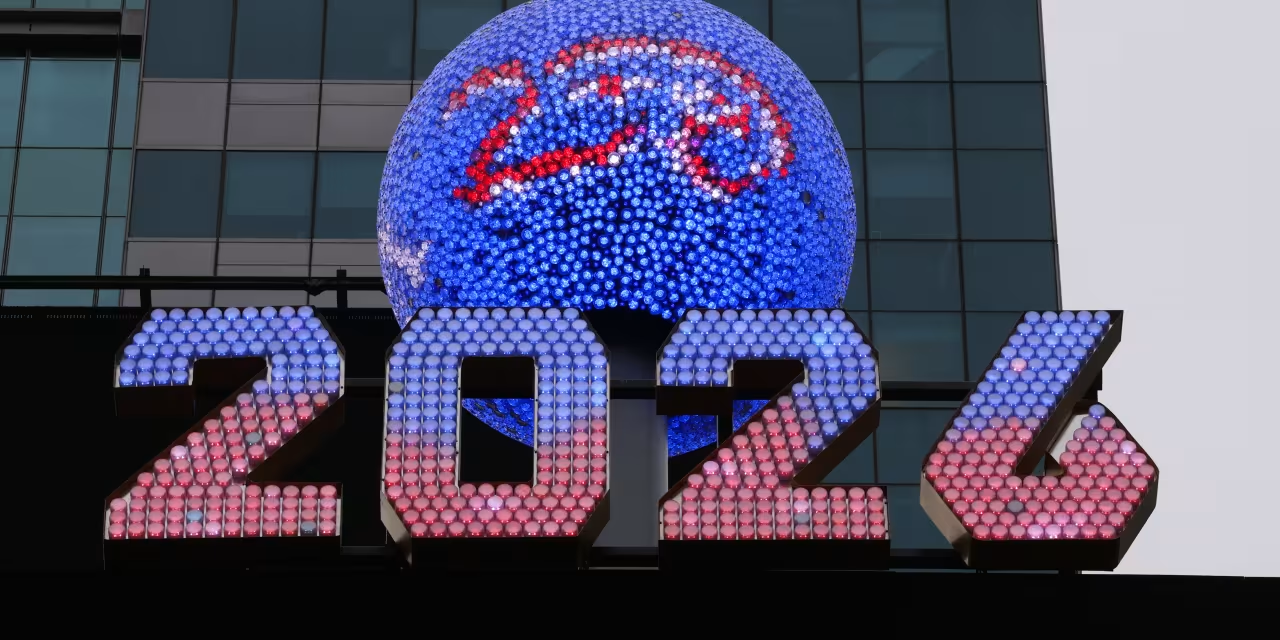
The S&P 500 is experiencing its third consecutive year of decline during the traditional Santa Claus rally, an unusual pattern that may serve as an early warning but does not necessarily signal the end of the bull market. Investors are also paying attention to the January barometer and the first five trading days of January, which historically have strong predictive power for the year's market performance. However, market direction will ultimately depend on economic fundamentals and upcoming events such as jobs reports and geopolitical developments.
The article discusses the historical Santa Claus rally, which often signals positive market performance but is not a guarantee of a strong year ahead. While the rally's occurrence is reassuring, fundamental factors like high market valuations, inflation, and interest rates will likely influence 2026's market performance. Investors are advised to focus on long-term fundamentals rather than short-term market signals.
U.S. stocks remained mostly flat at record highs during quiet trading after Christmas, with the S&P 500, Dow, and Nasdaq showing slight declines amid the Santa Claus Rally period, which historically sees positive returns. The market has had a strong year, driven by deregulatory policies and optimism about AI. Gold and silver prices continued to rise as safe havens, influenced by geopolitical and economic factors.
The day after Christmas, historically the most positive trading day of the year, often brings a market boost, with the S&P 500 averaging gains of around 0.4-0.5%, making it a significant period for investors during the holiday season.
The stock market experienced a Santa Claus rally with indexes reaching new highs, as most stocks on the Nasdaq and NYSE gained, reflecting a positive holiday season trend, with the Dow outperforming the Nasdaq.
Major stock indices are approaching record highs with investor optimism for a Santa Claus rally, driven by strong performances from Nvidia, Nike, and other stocks, amid economic data and index rebalancing news, while the market remains cautious ahead of the holiday break.
Historically, December 26 is the most reliably positive trading day of the year for the S&P 500, with gains occurring in 33 of the past 39 years since 1953, making it a significant day for investors following Christmas. This year, the market has been strong, and the upcoming session marks the second day of the Santa Claus rally, which has been notably positive despite recent years of negative returns.
U.S. stock futures are nearly unchanged after the S&P 500 reached a record close, with major indexes climbing for the fourth consecutive day amid strong economic data and optimism about a year-end rally. Investors are eyeing potential gains during the Santa Claus rally period, supported by positive market momentum and sector rotation, while awaiting weekly jobless claims and holiday market closures.
Wall Street experienced a broad rally with the S&P 500, Dow, and Nasdaq all rising, driven by increased risk appetite and nearing year-end highs, amid geopolitical tensions and rising yields, with the Santa Claus rally beginning midweek.
Tech stocks rebounded at the end of last week, raising hopes for a Santa Claus rally, while the Justice Department released some Epstein investigation files. Google is hiring many ex-employees for its AI teams, and social media's impact on business leaders is highlighted. Additionally, holiday-themed supplements are gaining popularity, but Xbox remains in a slump amid layoffs and closures.
U.S. stock futures are rising ahead of a holiday-shortened week, with investors watching tech and AI stocks for potential gains and the possibility of a Santa Claus rally as the year-end approaches.
The article discusses the possibility of a Santa Claus rally in the stock market, specifically the S&P 500, and suggests that current signs indicate there may not be one this year, reflecting cautious investor sentiment and market conditions.
The stock market has experienced a significant rally following Donald Trump's presidential election win, with major indices like the S&P 500 and Dow Jones reaching new highs. This early 'Santa Claus rally' is driven by expectations of reduced regulation and lower interest rates under a conservative administration. Despite high mortgage rates and housing market challenges, the economic outlook remains positive, with no immediate threats to the market. Upcoming earnings reports and inflation data will be closely watched, but the general sentiment is optimistic for continued market growth.
The Santa Claus rally period, which starts on Friday, historically sees an average gain of about 1% over the next seven trading days, according to market data.
Investors are concerned about the quality of gifts they are receiving from the stock market during the Santa Claus Rally period. However, historical data shows that the S&P 500 has gained during this rally for the past seven years, indicating a favorable period for equities.